Inland Waterways in India: An Overview
Why in news?
Sarbananda Sonowal inaugurates a new inland waterways terminal at Jogighopa; 110 MT of coal, stone chips sent to Bangladesh.
Introduction
- India’s inland waterways, spanning over 14,500 km, comprise rivers, canals, backwaters, and creeks.
- The Inland Waterways Authority of India (IWAI), established in 1986, is responsible for developing and regulating these waterways for navigation and shipping.
- The National Waterways Act, 2016, declared 111 waterways as National Waterways (NWs) to promote Inland Water Transport (IWT), a cost-effective and eco-friendly mode of transportation.
History of Inland Water Transport (IWT) in India
- Ancient & Medieval Period: Rivers were the primary mode of trade and transport.
- British Era: Inland waterways played a crucial role in cargo movement, particularly for commodities like jute and tea.
- Post-Independence: The focus shifted to road and rail transport, leading to the decline of IWT.
- 1986: IWAI was established to revive and develop inland waterways.
- 2016: The National Waterways Act was passed to boost water-based transportation.
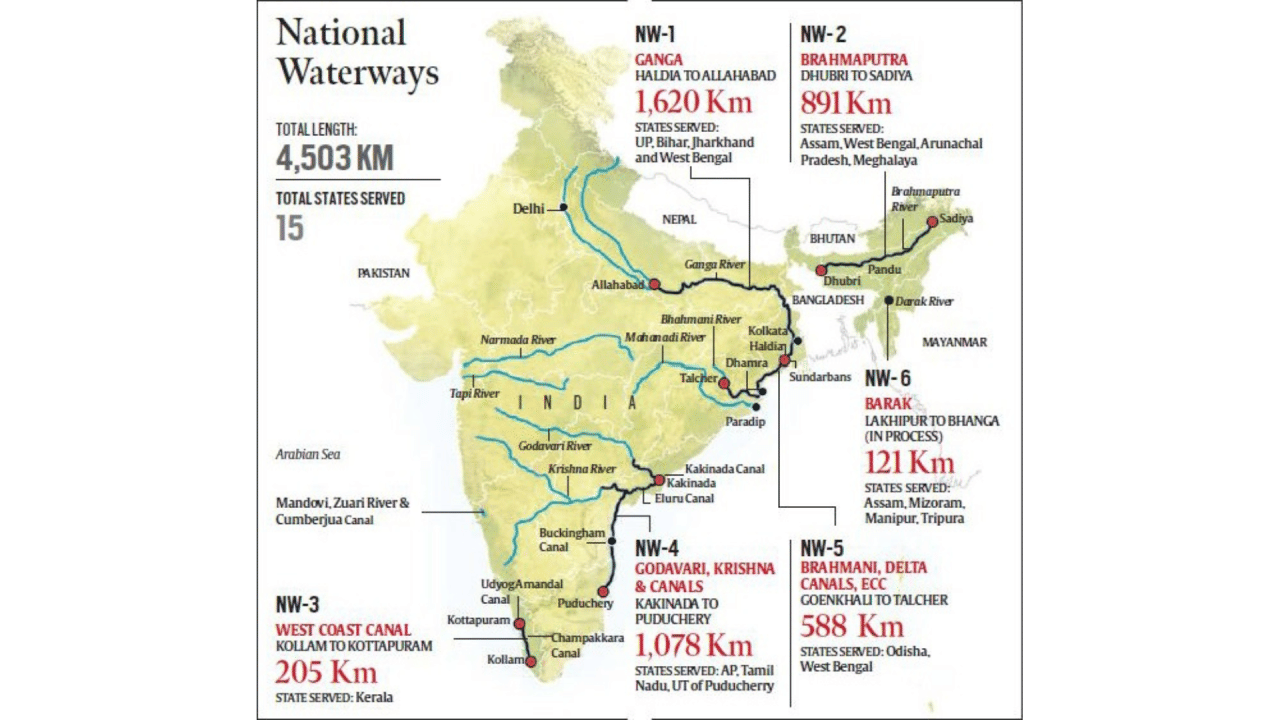
Designated National Waterways
- The National Waterways Act, 2016, designated 111 waterways as National Waterways.
- Out of these, 25 have been identified as viable for cargo/passenger movement, and development has been initiated in 13.
- Key national waterways include:
| Waterway | Stretch | States Covered | Length (km) |
|---|---|---|---|
| NW-1 | Allahabad-Haldia | UP, Bihar, Jharkhand, West Bengal | 1,620 |
| NW-2 | Sadiya-Dhubri | Assam | 891 |
| NW-3 | Kottapuram-Kollam | Kerala | 205 |
| NW-4 | Godavari-Krishna Rivers, Kakinada-Puducherry Canals | Andhra Pradesh | 1,078 |
| NW-5 | Brahmani-Matai Rivers, Mahanadi Delta, East Coast Canals | Odisha, West Bengal | 588 |
| NW-6 | Barak River | Assam | 121 |
Current Status of Inland Waterways in India
- Operational Waterways: 13 National Waterways are currently used for commercial shipping and passenger transport.
- Cargo Movement: Around 55 million tonnes of cargo are transported annually via inland waterways.
- Infrastructure Development: Includes fairways, navigation aids, terminals, and dredging operations.
- Regulations: IWAI enforces safety regulations and maintains waterways.
- Key Focus Areas: Development of multimodal transport hubs, improved connectivity, and private sector participation.
Advantages of Inland Waterways
- Cost-Effectiveness: 60% cheaper than road transport and 20-30% cheaper than rail transport (World Bank).
- Fuel Efficiency: Energy consumption per ton-km is 17% of road transport and 50% of rail transport.
- Eco-Friendliness: Emits 10 times less CO2 than road transport.
- Employment Generation: Labor-intensive industry providing jobs in vessel operation, river conservancy, and terminal maintenance.
- Reduced Road & Rail Congestion: Enhances overall transportation efficiency by decongesting existing networks.
- Tourism & Economic Growth: Development of cruise tourism and related industries like shipbuilding.
Challenges of Inland Waterways
- Navigational Hazards: Shallow waters, siltation, erosion, and lack of navigational aids hinder smooth movement.
- Environmental Concerns: Dredging and construction of barrages disrupt aquatic ecosystems and water quality.
- Intermodal Connectivity Issues: Poor integration with roads and railways limits efficient cargo movement.
- Jurisdiction & Governance: Regulatory overlap between central and state governments slows decision-making.
- Water Flow Variability: Diversion for irrigation and industrial use reduces navigability.
- Infrastructure Deficiencies: Lack of terminals, jetties, and maintenance facilities.
- Limited Private Sector Participation: High initial investment costs deter private investment.
Government Initiatives
- Jal Marg Vikas Project (JMVP): Launched for the development of NW-1 (Ganga-Bhagirathi-Hooghly) with World Bank assistance.
- Sagarmala Project: Aims to integrate inland waterways with coastal shipping for better logistics efficiency.
- Project Arth Ganga: Focuses on economic development along NW-1 through community participation.
- Inland Vessels Act, 2021: Establishes a uniform regulatory framework for vessel construction, operation, and safety.
- Maritime India Vision 2030: Aims to increase cargo traffic to 2,570 million tonnes per annum (MTPA) by 2030.
- National Waterways Act, 2016: Declared 111 waterways as National Waterways for improved governance and development.
SWOT Analysis of Inland Water Transport
| Strengths | Weaknesses |
|---|---|
| Cost-effective and fuel-efficient | Slow transport speed |
| Eco-friendly | Limited connectivity with other transport modes |
| Reduces congestion on roads and railways | Navigational challenges |
| High employment potential | Lack of adequate terminals and jetties |
| Opportunities | Threats |
|---|---|
| Expansion of multimodal transport | Environmental concerns |
| Development of cruise tourism | Seasonal water level fluctuations |
| Increased private sector participation | High infrastructure costs |
| Strengthened international trade links | Inter-state jurisdictional issues |
Way Forward
- Infrastructure Development: Construct modern terminals, jetties, and navigation aids.
- Integration with Multimodal Transport: Improve connectivity with road, rail, and coastal shipping.
- Revival of Obsolete Jetties: Upgrade and operationalize existing jetties to enhance efficiency.
- Incentives for Private Participation: Provide tax benefits, subsidies, and Public-Private Partnership (PPP) models.
- Technological Innovation: Develop low-cost, shallow-draft vessels for better navigation.
- Policy & Governance Reforms: Strengthen coordination between central and state governments.
- Ecological Conservation Measures: Implement sustainable dredging and eco-friendly vessel technologies.
International Collaboration: Enhance trade through waterways with Bangladesh, Nepal, Bhutan, and Myanmar.
Download the PREPP App and attempt FREE IAS Exam Mock Tests and get complete study material!
*The article might have information for the previous academic years, please refer the official website of the exam.
How likely are you to recommend Prepp.in to a friend or a colleague?
Not so likely
Highly likely
UPSC CSE (IAS) 2027 Prelims Mock Test Series
Live Quizzes
Quizzes
Live Tests
Free
• Live
Live Test : UPSC IAS : GS - Indian Geography - Subject Knowledge Test
35 Minutes
30 Questions
60 Marks
English, Hindi
Test will end in 03:33:44

• Live
Live Test : UPSC CSE Prelims CSAT (Paper-II) (Oct 08 - 11)
120 Minutes
80 Questions
200 Marks
English, Hindi
MEDIUM
Test will end on 11th Oct, 07:00 PM
Full Tests
Full Test - 04: UPSC CSE Prelims CSAT (Paper-II)
120 Minutes
80 Questions
200 Marks
English, Hindi
MEDIUM
Attempted by 19 aspirants in 12 hours
Full Test - 03: UPSC CSE Prelims CSAT (Paper-II)
120 Minutes
80 Questions
200 Marks
English, Hindi
MEDIUM
Attempted by 21 aspirants in 12 hours
Previous Year Papers
UPSC CSE Prelims 2026 GS Paper 1 Question Paper (24-May-2026)
120 Minutes
100 Questions
200 Marks
2,967 Attempted
English, Hindi
MEDIUM
Attempted by 13 aspirants in 12 hours
UPSC CSE Prelims 2026 CSAT Paper 2 Question Paper (24-May-2026)
120 Minutes
80 Questions
200 Marks
3,144 Attempted
English, Hindi
MEDIUM
Attempted by 13 aspirants in 12 hours
Videos

17 February 2025 | The Hindu Must Read Articles | Current Affairs
7,202 Views
•4
•7 months ago

16 February 2026 | The Hindu Must Read Articles | Current Affairs
6,962 Views
•4
•7 months ago

13 February 2026 | The Hindu Must Read Articles | Current Affairs
8,765 Views
•5
•7 months ago

12 February 2026 | The Hindu Must Read Articles | Current Affairs
5,788 Views
•4
•7 months ago






Also Check
IAS Exam Overview
IAS Exam Admit Card
IAS Exam Question Paper 2026
IAS Exam Mains Syllabus
IAS Exam Application Process
IAS Exam Eligibility
IAS Exam Result
IAS Exam Exam Pattern
IAS Exam CSAT Syllabus
IAS Exam Answer Key
IAS Exam Previous Year Paper
IAS Exam Current Affairs
IAS Exam Mains Question Paper
IAS Exam IAS Courses
IAS Exam UPSC Study Notes
IAS Exam Foundation Course 2024
IAS Exam Prelims Question Paper
IAS Exam Exam Center
IAS Exam Foundation Course 2025
IAS Exam Notification 2026
IAS Exam IAS Success Stories
IAS Exam Salary
IAS Exam Cutoff
IAS Exam Mock Tests
IAS Exam News


Comments