Indus Water Treaty: A Comprehensive Overview
Why in news?
- The World Bank-appointed experts recently supported India's stance on the Kishenganga and Ratle hydroelectric projects, which are key developments in the Jammu and Kashmir region.
- This endorsement strengthens India's position and highlights the ongoing relevance of the treaty in resolving contemporary water disputes.
About Indus Water Treaty
- The Indus Water Treaty (IWT), brokered by the World Bank in 1960, remains a cornerstone of water-sharing between India and Pakistan.
- Despite the complex geopolitical relationship between the two countries, this treaty has provided a framework for resolving water disputes and ensuring equitable distribution of the vital water resources from the Indus River system.
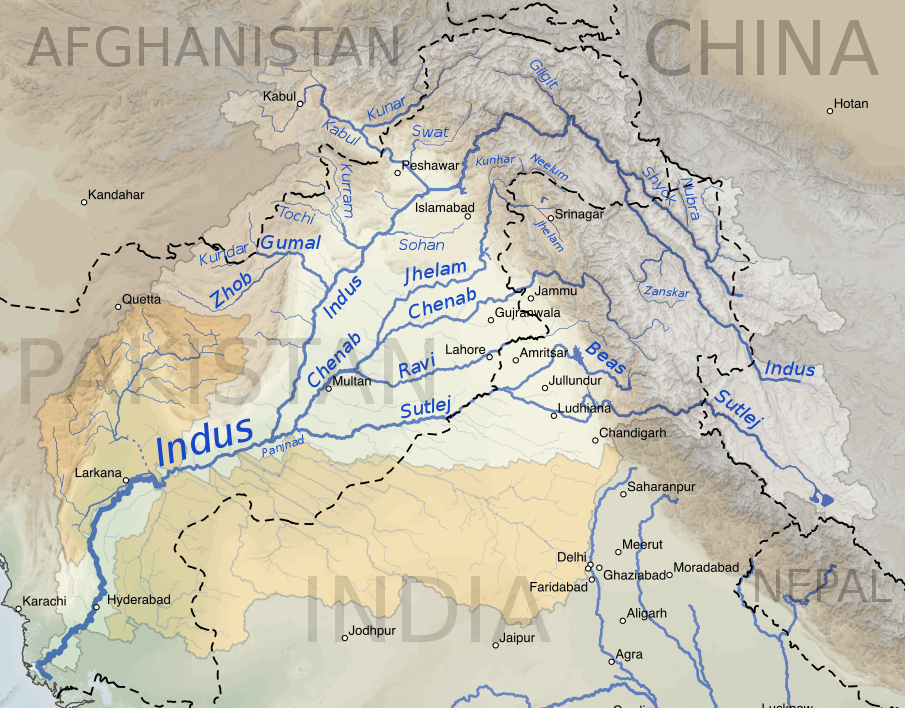
Key Aspects of the Indus Water Treaty (IWT)
- Water-Sharing Agreement
Signed by then Prime Minister Jawaharlal Nehru and Pakistan President Ayub Khan, the IWT outlines rules for the equitable distribution of water resources from the Indus River system. It guarantees fair allocation and usage of water, thus promoting peace and cooperation.
- World Bank’s Role
The World Bank played a pivotal role as a mediator during the negotiations, facilitating the treaty by offering technical expertise and financial support. The treaty promotes regional stability by offering a framework for peaceful dispute resolution.
- Division of Rivers
The Indus Water Treaty divides control of six major rivers in the Indus basin between India and Pakistan:
- India controls the eastern rivers: Ravi, Beas, and Sutlej, granting India unrestricted rights for irrigation, power generation, and other uses within its territory.
- Pakistan controls the western rivers: Indus, Jhelum, and Chenab, with India allowed limited use for non-consumptive purposes like electricity generation.
- Provisions for Dispute Resolution
The Permanent Indus Commission was established to implement the treaty, allowing both countries to exchange data, resolve disputes, and cooperate on issues related to the Indus basin’s water resources. The IWT also outlines mechanisms for resolving technical and legal disputes, including appointing neutral experts.
History and Evolution of the Indus Water Treaty
- The need for the IWT arose post-Partition in 1947, when the new borders divided the Indus river system. The treaty was negotiated from 1951 to 1960, with significant involvement from the World Bank, which facilitated dialogue between India and Pakistan.
- Despite several conflicts and wars between India and Pakistan, the IWT has remained largely intact, demonstrating its critical importance in ensuring water security and fostering diplomatic cooperation.
Significance of the Indus Water Treaty for India
- Water Security and Economic Development
The treaty guarantees India’s reliable access to water, crucial for agriculture, industry, and domestic use, particularly in northern India. This supports economic development and ensures food security in the region.
- Hydropower Potential
India’s right to utilize the eastern rivers for hydropower generation is crucial in meeting the country’s growing energy needs, contributing to energy security.
- Agricultural Benefits
The treaty enables extensive irrigation networks in states like Punjab and Haryana, boosting agricultural productivity and improving rural livelihoods.
- Diplomatic Leverage
The IWT provides a platform for India to engage with Pakistan on water-related issues, ensuring that India can assert its rights while negotiating future water-sharing agreements and developments.
Conclusion
- The Indus Water Treaty stands as a model for resolving transnational water disputes and has endured as a critical element of India-Pakistan relations.
- By ensuring fair and equitable water sharing, the IWT continues to foster cooperation, enhance water security, and contribute to the economic and diplomatic stability of both nations.
Download the PREPP App and attempt FREE IAS Exam Mock Tests and get complete study material!

Live Test : UPSC CSE Prelims CSAT (Paper-II) (Oct 08 - 11)
Full Test - 04: UPSC CSE Prelims CSAT (Paper-II)
Full Test - 03: UPSC CSE Prelims CSAT (Paper-II)
UPSC CSE Prelims 2026 GS Paper 1 Question Paper (24-May-2026)
UPSC CSE Prelims 2026 CSAT Paper 2 Question Paper (24-May-2026)

17 February 2025 | The Hindu Must Read Articles | Current Affairs

16 February 2026 | The Hindu Must Read Articles | Current Affairs

13 February 2026 | The Hindu Must Read Articles | Current Affairs









Comments