Indus Valley Script: Deciphering the Ancient Writing System
Why in news?
- Tamil Nadu Chief Minister M.K. Stalin has announced a $1 million prize for experts or organizations who successfully decipher the Indus Valley Civilization (IVC) script.
- This exciting development could open new insights into one of the oldest and most enigmatic writing systems in the world.
About the Indus Valley Script:
- The Indus Script, developed by the Indus Valley Civilization, remains a critical yet undecoded component of ancient history, believed to date back to 2600–1900 BCE.
- It offers significant clues about the socio-economic, cultural, and technological advancements of civilization.
Key Features of the Indus Script:
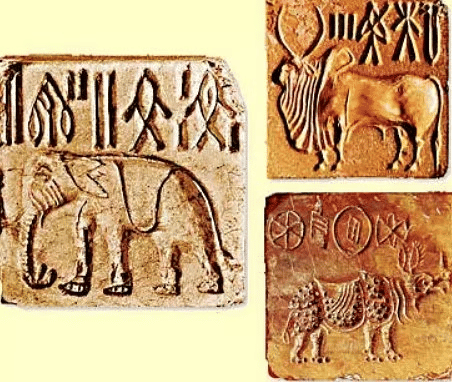
- Material Use: The script was primarily inscribed on seals, pottery, tools, and tablets, crafted from materials like steatite, bone, and copper.
![indus trip specifcation]()
- Directionality: Written predominantly right to left, with some instances of bidirectional writing (alternating lines).
- Boustrophedon Style: Written in an alternating pattern of right-to-left and left-to-right across lines, resembling a boustrophedon format.
- Sign Types: The script features logo-syllabic signs, where some symbols represent whole words, while others signify phonetic sounds.
- Numerals: A decimal system was used, with downward strokes for single units and semicircles to denote tens.
- Evolution: The Indus Script evolved from simple potter's marks to a fully developed writing system.
- Deciphering Challenges: The lack of bilingual inscriptions and the unknown language behind the script make it difficult to decode. Scholars have speculated links to languages such as Dravidian, Indo-European, or others.
Decline of the Indus Script:
- The script began to fade around 1800 BCE, coinciding with the decline of the Indus Valley Civilization. This writing system was not adopted by later civilizations, making the script's eventual disappearance a significant loss to history.
Challenges in Deciphering the Indus Script:
- Absence of bilingual inscriptions: Unlike Egyptian hieroglyphs, the Indus Script lacks a known comparative bilingual text, making translation difficult.
- Short Texts: Most inscriptions are brief, with fewer than 30 signs, which complicates identifying recurring patterns.
- Uncertain Linguistic Connections: The language of the script remains unknown, with several theories, including links to Dravidian, Indo-European, and Austroasiatic languages.
Conclusion:
The Indus Script continues to captivate researchers, and with Tamil Nadu's $1 million prize, there is renewed hope for breakthroughs in understanding this ancient writing system. Deciphering the Indus Script could provide invaluable knowledge about the Indus Valley Civilization's complex society, trade networks, technological advancements, and cultural practices.
Download the PREPP App and attempt FREE IAS Exam Mock Tests and get complete study material!
*The article might have information for the previous academic years, please refer the official website of the exam.
How likely are you to recommend Prepp.in to a friend or a colleague?
Not so likely
Highly likely
UPSC CSE (IAS) 2027 Prelims Mock Test Series
Live Quizzes
Quizzes
Live Tests

• Live
Live Test : UPSC CSE Prelims CSAT (Paper-II) (Oct 08 - 11)
120 Minutes
80 Questions
200 Marks
English, Hindi
MEDIUM
Test will end in 05:31:37
Full Tests
Full Test - 04: UPSC CSE Prelims CSAT (Paper-II)
120 Minutes
80 Questions
200 Marks
English, Hindi
MEDIUM
Attempted by 19 aspirants in 12 hours
Full Test - 03: UPSC CSE Prelims CSAT (Paper-II)
120 Minutes
80 Questions
200 Marks
English, Hindi
MEDIUM
Attempted by 20 aspirants in 12 hours
Previous Year Papers
UPSC CSE Prelims 2026 GS Paper 1 Question Paper (24-May-2026)
120 Minutes
100 Questions
200 Marks
2,989 Attempted
English, Hindi
MEDIUM
Attempted by 12 aspirants in 12 hours
UPSC CSE Prelims 2026 CSAT Paper 2 Question Paper (24-May-2026)
120 Minutes
80 Questions
200 Marks
3,167 Attempted
English, Hindi
MEDIUM
Attempted by 13 aspirants in 12 hours
Videos

17 February 2025 | The Hindu Must Read Articles | Current Affairs
7,202 Views
•4
•7 months ago

16 February 2026 | The Hindu Must Read Articles | Current Affairs
6,962 Views
•4
•7 months ago

13 February 2026 | The Hindu Must Read Articles | Current Affairs
8,765 Views
•5
•7 months ago

12 February 2026 | The Hindu Must Read Articles | Current Affairs
5,788 Views
•4
•7 months ago






Also Check
IAS Exam Overview
IAS Exam Admit Card
IAS Exam Question Paper 2026
IAS Exam Mains Syllabus
IAS Exam Application Process
IAS Exam Eligibility
IAS Exam Result
IAS Exam Exam Pattern
IAS Exam CSAT Syllabus
IAS Exam Answer Key
IAS Exam Previous Year Paper
IAS Exam Current Affairs
IAS Exam Mains Question Paper
IAS Exam IAS Courses
IAS Exam UPSC Study Notes
IAS Exam Foundation Course 2024
IAS Exam Prelims Question Paper
IAS Exam Exam Center
IAS Exam Foundation Course 2025
IAS Exam Notification 2026
IAS Exam IAS Success Stories
IAS Exam Salary
IAS Exam Cutoff
IAS Exam Mock Tests
IAS Exam News


Comments