India's Gross Domestic Product (GDP) Growth in Q3 2024: Key Insights and Analysis
Why in the News?
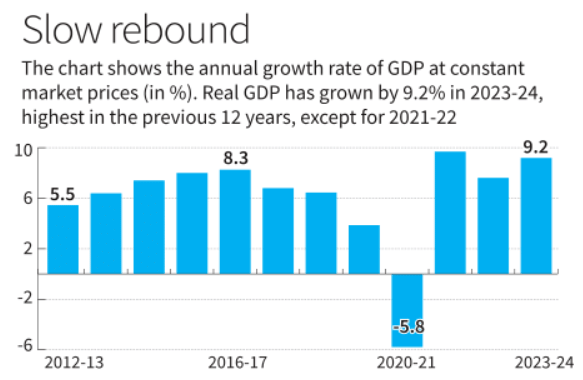
India’s real Gross Domestic Product (GDP) registered a 6.2% growth in the third quarter of 2024 (October to December), marking an improvement from 5.6% in Q2 2024. This economic growth reflects stronger consumer demand, improved trade performance, and sectoral contributions.
Key Drivers of GDP Growth and Associated Concerns
1. Higher Consumption
- Increased government spending and rising private consumption significantly boosted GDP growth in Q3.
- A surge in festive season spending and government stimulus measures further fueled demand.
2. Improved Trade Performance
- Exports grew significantly, driven by strong global demand for Indian goods and services.
- Imports declined by 1.1%, reducing the trade deficit and positively impacting GDP.
3. Sectoral Growth Trends
- The primary sector (agriculture and mining) expanded by 5.2%, supported by strong agricultural output.
- The secondary sector (manufacturing and industry), however, exhibited slower growth due to global supply chain disruptions and inflationary pressures.
4. Global Economic Risks
- External factors such as global trade policies, inflation trends, and financial market volatility pose potential risks to India’s future economic trajectory.
Understanding Gross Domestic Product (GDP)
What is GDP?
GDP is a monetary measure that represents the total market value of all final goods and services produced within a country over a specific period. It is a fundamental indicator of a nation’s economic performance and is widely used for national and international economic comparisons.
Types of GDP
- Nominal GDP – Measured at current market prices, without adjusting for inflation.
- Real GDP – Adjusted for inflation, providing a more accurate representation of economic output.
- GDP Per Capita – The ratio of GDP to the total population, often used to assess standard of living.
Sectoral Contribution to GDP
GDP is often analyzed based on different economic sectors:
- Agriculture: Includes farming, forestry, and fishing.
- Industry: Encompasses manufacturing, mining, and construction.
- Services: Covers trade, banking, IT, and other service-oriented industries.
Limitations of GDP as an Economic Indicator
While GDP is a critical economic metric, it has certain limitations:
- Does not account for income inequality – GDP growth does not necessarily reflect equitable wealth distribution.
- Ignores environmental impact – Economic activities contributing to GDP may have negative environmental consequences.
- Excludes unpaid domestic work – Contributions from household labor and caregiving are not factored into GDP calculations.
Alternative Measures for Economic Well-Being
To gain a broader perspective on economic well-being, alternative indicators such as:
- Human Development Index (HDI) – Measures overall human progress, including education and health.
- Better Life Index – Focuses on quality of life factors beyond economic output.
Conclusion
India’s 6.2% GDP growth in Q3 2024 highlights a resilient economy, driven by strong domestic consumption, robust trade performance, and sectoral expansion. However, global risks and economic challenges necessitate strategic policy measures to sustain growth and ensure long-term economic stability.
Download the PREPP App and attempt FREE IAS Exam Mock Tests and get complete study material!

Live Test : UPSC CSE Prelims CSAT (Paper-II) (Oct 08 - 11)
Full Test - 04: UPSC CSE Prelims CSAT (Paper-II)
Full Test - 03: UPSC CSE Prelims CSAT (Paper-II)
UPSC CSE Prelims 2026 GS Paper 1 Question Paper (24-May-2026)
UPSC CSE Prelims 2026 CSAT Paper 2 Question Paper (24-May-2026)

17 February 2025 | The Hindu Must Read Articles | Current Affairs

16 February 2026 | The Hindu Must Read Articles | Current Affairs

13 February 2026 | The Hindu Must Read Articles | Current Affairs









Comments