India's Arms Imports and Strategic Autonomy: Trends, Challenges, and the Road Ahead
Why in the News?
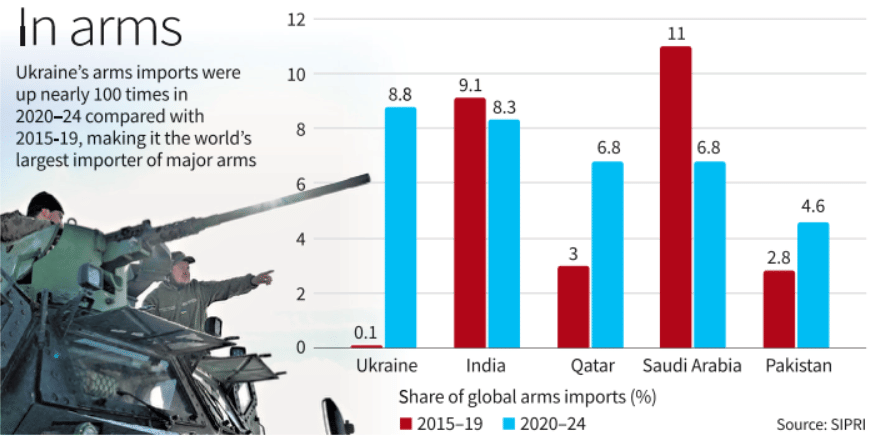
India is the second-largest arms importer globally, following Ukraine, as per the latest SIPRI (Stockholm International Peace Research Institute) data (2020-24). This has significant implications for India's strategic autonomy, defense modernization, and geopolitical positioning.
Key Trends in India's Arms Imports (SIPRI 2020-24)
Declining Arms Imports
- India's arms imports declined by 9.3%, reflecting efforts to strengthen domestic defense production.
Shifting Dependence on Suppliers
- Russia’s Share Declines: The share of Russian arms fell from 72% (2010-14) to 36% (2020-24).
- France Becomes a Key Supplier: India’s procurement of Rafale jets and Scorpene submarines contributed to a rise in French arms imports.
- Diversification of Sources: India is increasingly procuring weapons from the USA, Israel, and European nations to avoid over-reliance on a single country.
Global Arms Trade Shifts
- Ukraine’s Arms Imports Surge: Ukraine saw a 100-fold increase in imports due to the ongoing war.
- Pakistan’s Growing Dependence on China: Pakistan’s arms imports rose by 61%, with 81% of its arms coming from China.
- US Dominance in Exports: The USA now accounts for 43% of global arms exports.
- France Overtakes Russia: France became the second-largest arms exporter, surpassing Russia, whose exports fell by 64%.
- European Rearmament: European nations increased arms imports by 155% following Russia’s invasion of Ukraine.
Strategic Autonomy and India's Arms Imports
Advantages of Diversification
- Reduced Supplier Dependence: Diversifying defense imports from multiple countries enhances India’s bargaining power.
- Technology Transfer: Many defense deals include technology-sharing agreements, boosting indigenous production.
- Defense Preparedness: Advanced weapons procurement strengthens India’s military readiness against China and Pakistan.
- Geopolitical Leverage: Stronger defense ties with global powers enhance India’s diplomatic influence.
Challenges to Strategic Autonomy
- Continued Foreign Dependency: Despite diversification, India remains reliant on imports for critical defense systems.
- Slow Domestic Production: Indigenous defense manufacturing is lagging, affecting self-reliance.
- High Financial Costs: Large-scale arms imports strain the defense budget.
- Geopolitical Constraints: Dependence on multiple suppliers can sometimes limit India’s independent foreign policy decisions.
Government Initiatives to Boost Indigenous Defense Production
- Increased Budget Allocation: The defense budget rose by 13% (2023-24).
- Positive Indigenisation Lists: Banning imports of certain weapons to promote domestic manufacturing.
- FDI Liberalization: Raising Foreign Direct Investment (FDI) limits to 74% via Automatic Route and 100% via Government Route.
- Corporatization of OFB: Restructuring the Ordnance Factory Board (OFB) into seven defense companies.
- Defence Industrial Corridors: Establishing Uttar Pradesh and Tamil Nadu defense corridors to boost local production.
- iDEX & SRIJAN Portals: Promoting defense startups and private-sector participation.
Challenges in India's Domestic Defense Industry
- Infrastructure Gaps: Limited advanced manufacturing facilities.
- Funding Shortfalls: Insufficient investment in R&D.
- Bureaucratic Hurdles: Slow procurement and approval processes.
- Public Sector Monopoly: Limited competition reduces innovation.
- Skilled Workforce Deficit: Shortage of specialized engineers and defense experts.
- Intellectual Property Constraints: Limited access to foreign military technology.
The Road Ahead: Strengthening India's Defense Industry
Boosting Indigenous Manufacturing
- Expanding the Make in India initiative to include stealth aircraft, UAVs, and advanced missile systems.
- Prioritizing the Advanced Medium Combat Aircraft (AMCA) project to reduce reliance on imported fighter jets.
Enhancing R&D and Technology Transfer
- Increasing the Technology Development Fund (TDF) by DRDO to support defense startups.
- Strengthening defense partnerships with France (jet engines), the US (UAVs), and Israel (missile technology).
- Expanding successful models like the India-Russia BrahMos missile project.
Developing Defense Industrial Corridors
- Expanding Tamil Nadu and Uttar Pradesh Defense Corridors to integrate more MSMEs.
- Offering tax incentives to attract global defense manufacturers.
Reforming Defense Procurement
- Expanding the Positive Indigenisation Lists to include AWACS, submarines, and heavy-lift helicopters.
- Accelerating approvals for indigenous defense projects like the Tejas fighter jet.
Building a Skilled Workforce
- Partnering with IITs, NITs, and defense universities to develop specialized courses in aerospace, robotics, and cyber warfare.
Conclusion
While India's arms imports remain substantial, the country is making significant progress toward defense self-reliance. Strategic diversification, policy reforms, and enhanced indigenous manufacturing will be key to achieving true strategic autonomy in defense. By prioritizing R&D, technology transfer, and domestic production, India can reduce dependency on foreign arms and emerge as a global defense powerhouse.
Download the PREPP App and attempt FREE IAS Exam Mock Tests and get complete study material!

Live Test : UPSC CSE Prelims CSAT (Paper-II) (Oct 08 - 11)
Full Test - 04: UPSC CSE Prelims CSAT (Paper-II)
Full Test - 03: UPSC CSE Prelims CSAT (Paper-II)
UPSC CSE Prelims 2026 GS Paper 1 Question Paper (24-May-2026)
UPSC CSE Prelims 2026 CSAT Paper 2 Question Paper (24-May-2026)

17 February 2025 | The Hindu Must Read Articles | Current Affairs

16 February 2026 | The Hindu Must Read Articles | Current Affairs

13 February 2026 | The Hindu Must Read Articles | Current Affairs









Comments