India-US Trade Relations: Strengthening Economic and Strategic Ties
Why in the News?
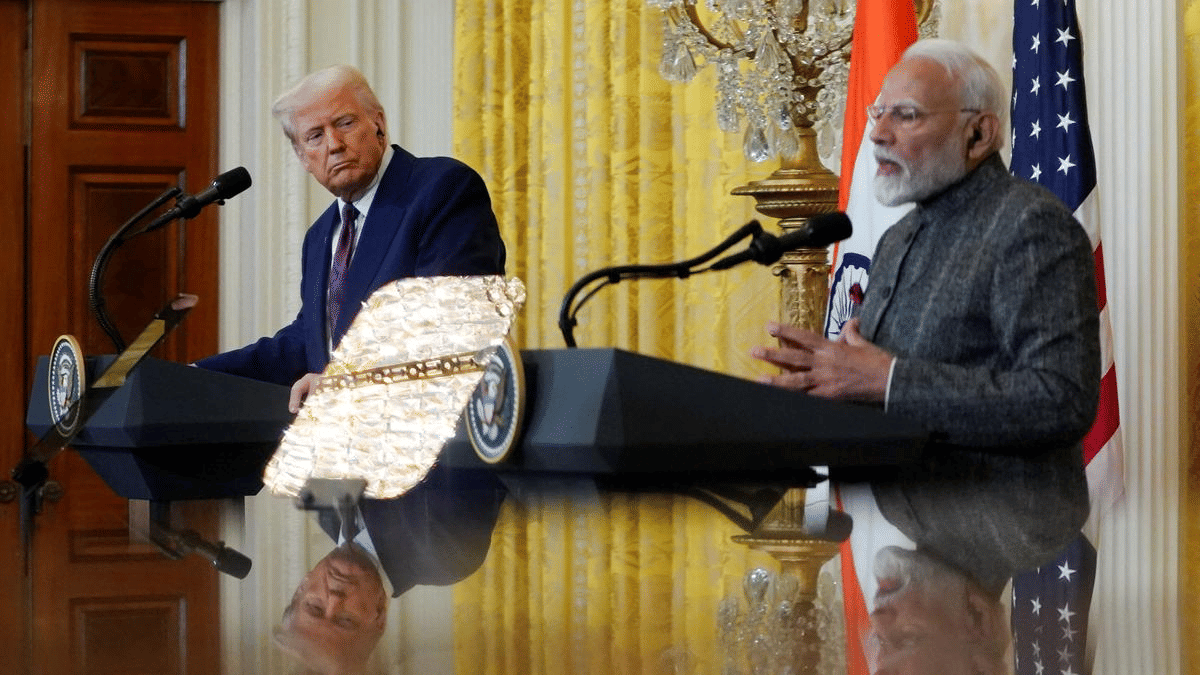
During Prime Minister Narendra Modi's recent visit to the U.S., both nations set an ambitious goal to more than double their bilateral trade, targeting $500 billion by 2030. This move signifies a deepening economic partnership and strategic collaboration across multiple sectors.
Key Highlights of India-US Trade Agreements
1. Bilateral Trade Expansion
- Trade Agreement Negotiations: India and the U.S. will negotiate the first phase of a trade agreement by autumn 2025, aiming for enhanced economic cooperation.
- Energy Trade Growth: India is set to increase its energy imports from the U.S., helping reduce its trade deficit.
- Technology & Defense Collaboration: Joint efforts in defense, semiconductor manufacturing, and artificial intelligence (AI) development will bolster economic and security ties.
- Reciprocal Tariff Policies: The U.S. has introduced a policy of reciprocal tariffs, impacting ongoing trade discussions.
2. New Trade and Investment Initiatives
- Mission 500: A strategic initiative to boost bilateral trade to $500 billion by 2030, spanning energy, defense, and technology.
- Small Modular Nuclear Reactors: Collaborative efforts to develop and deploy small modular nuclear reactors, strengthening India's energy security.
- Reciprocal Defense Procurement Agreement: A framework to streamline defense procurement and facilitate advanced arms transfers.
3. Defense and Security Cooperation
- F-35 Fighter Jets: The U.S. is exploring pathways for India to acquire F-35 stealth fighters, enhancing its air defense capabilities.
- P-8I Maritime Patrol Aircraft: India plans to procure six additional P-8I aircraft to bolster its Indian Ocean surveillance.
- GE-414 Engine Co-Production: The U.S. has backed co-production of General Electric F-414 engines in India, strengthening indigenous fighter jet development.
4. Technology and Energy Partnerships
- TRUST Initiative: The "Transforming the Relationship Utilizing Strategic Technology" (TRUST) initiative will focus on AI, semiconductor manufacturing, and space cooperation.
- Autonomous Systems Industry Alliance: A joint effort to enhance underwater domain awareness technologies for maritime security.
- Civil Nuclear Agreement Implementation: The operationalization of the 123 Civil Nuclear Agreement, including the construction of U.S.-designed nuclear reactors in India.
5. Multilateral and Regional Engagements
- Quad and Indo-Pacific Strategy: Reaffirmed commitment to Quad and regional security cooperation in the Indo-Pacific.
- IMEC & I2U2 Partnerships: India and the U.S. will work with regional partners in the India-Middle-East-Europe Corridor (IMEC) and I2U2 (India, Israel, U.S., UAE) to enhance economic connectivity.
Significance of Strengthening India-US Trade Relations
- Trade Diversification: Enhances India’s export basket, reducing reliance on specific commodities.
- Infrastructure Development: Increased trade will drive investment in ports, logistics, and industrial corridors.
- Countering China’s Influence: Strengthened ties with the U.S. act as a counterbalance to China’s growing regional presence.
- Defense Self-Reliance: Technology transfers and joint manufacturing bolster India's indigenous defense capabilities.
- Energy Security: Diversified energy imports, including U.S. liquefied natural gas (LNG), will reduce dependence on Middle Eastern oil.
- Renewable Energy Growth: U.S. investments in India’s renewable energy sector support clean energy initiatives.
India-US Bilateral Trade Overview
- Trade Volume & Composition
![india and usa bilateral trade]()
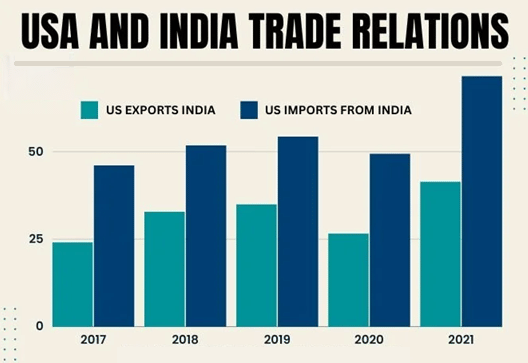
- Record Trade Figures: India-US bilateral trade reached $118.2 billion in FY24, with India maintaining a trade surplus of $36.8 billion.
- Key Indian Exports: Engineering goods, electronics, gems & jewelry, pharmaceuticals, petroleum products, textiles.
- Major U.S. Imports to India: Mineral fuels, precious stones, nuclear reactors, electrical machinery, medical devices.
- US Foreign Direct Investment (FDI) in India: The U.S. ranks as the third-largest investor, with cumulative FDI inflows of $65.19 billion from April 2000 to March 2024.
- Defense Trade Expansion: The U.S. is emerging as a key arms supplier to India, replacing traditional defense partners like Russia.
- Tariff Disparities: India’s average tariff stands at 17%, compared to 3.3% in the U.S., causing trade frictions.
Challenges in India-US Trade Relations
- High Tariffs & Trade Barriers: Despite reductions, tariff disparities remain a contentious issue.
- Regulatory Bottlenecks: Complex trade regulations and bureaucratic hurdles slow business operations.
- Russia-India Relations: India's defense ties with Russia raise strategic concerns for the U.S.
- China's Economic Influence: Balancing India-U.S. trade relations while countering China’s regional dominance is a challenge.
- Intellectual Property (IP) Disputes: The U.S. has expressed concerns over India's IP protection laws, particularly in pharmaceuticals and technology.
- Technology Transfer Restrictions: U.S. export controls limit the sharing of sensitive defense and space technology with India.
- Immigration and Visa Barriers:
- Work Visa Constraints: Tightened U.S. visa policies impact Indian professionals, especially in IT and technology.
- Illegal Immigration Concerns: India has committed to repatriating undocumented migrants, but broader immigration reforms remain unresolved.
The Way Forward: Strengthening India-US Economic Cooperation
- Bilateral Free Trade Agreement (FTA): A comprehensive FTA will help resolve tariff disputes and boost trade volumes.
- Regulatory Streamlining: Simplifying customs procedures and harmonizing trade standards.
- Joint Defense Production: Expanding co-production of fighter jet engines, missile systems, and other defense equipment.
- Enhanced Indo-Pacific Security Cooperation: Strengthening military exercises, joint operations, and intelligence-sharing.
- Investment in Renewable Energy: Strengthening cooperation in solar and wind energy to promote sustainability.
- Semiconductor & AI Development: Setting up semiconductor fabrication plants in India to mitigate supply chain risks.
- Visa Policy Reforms:
- Mutual Visa Agreements: Developing frameworks for easier movement of professionals and students.
- Anti-Human Trafficking Measures: Strengthening border security and illegal immigration controls.
Conclusion
India-US trade relations are poised for significant growth, with a clear vision for $500 billion in bilateral trade by 2030. Enhanced economic, defense, and technology partnerships will not only bolster both economies but also contribute to regional stability. Addressing key challenges through policy reforms and trade facilitation will further solidify this strategic partnership.
Download the PREPP App and attempt FREE IAS Exam Mock Tests and get complete study material!

Live Test : UPSC CSE Prelims CSAT (Paper-II) (Oct 08 - 11)
Full Test - 04: UPSC CSE Prelims CSAT (Paper-II)
Full Test - 03: UPSC CSE Prelims CSAT (Paper-II)
UPSC CSE Prelims 2026 GS Paper 1 Question Paper (24-May-2026)
UPSC CSE Prelims 2026 CSAT Paper 2 Question Paper (24-May-2026)

17 February 2025 | The Hindu Must Read Articles | Current Affairs

16 February 2026 | The Hindu Must Read Articles | Current Affairs

13 February 2026 | The Hindu Must Read Articles | Current Affairs









Comments