India State of Forest Report 2023: Key Findings and Insights
Why in the News?
The Ministry of Environment, Forest and Climate Change, led by Shri Bhupender Yadav, recently released the India State of Forest Report 2023 (ISFR 2023) at the Forest Research Institute in Dehradun. This biennial report highlights the current status of India's forests, including key findings on forest cover, tree cover, carbon stock, and the progress in afforestation initiatives.
Key Findings of the India State of Forest Report 2023
1. Increase in Forest and Tree Cover
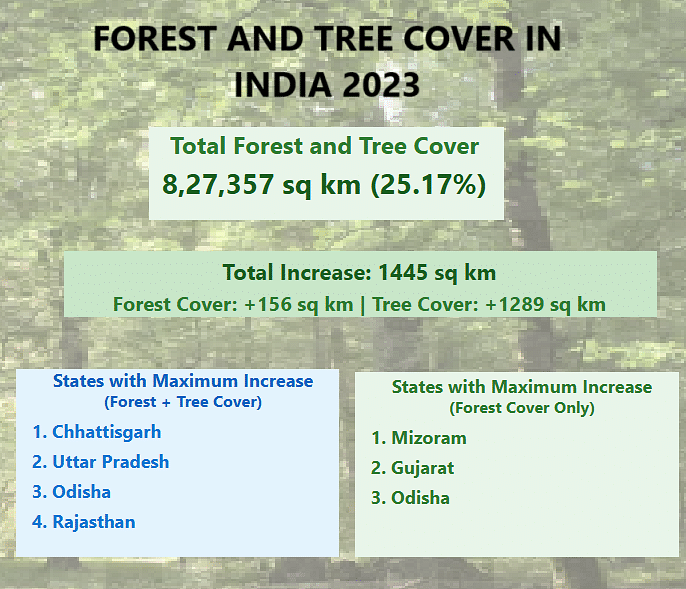
India’s total forest and tree cover is now 8,27,357 sq km, constituting 25.17% of the country’s geographical area.
- Forest cover increased by 156 sq km, and tree cover expanded by 1289 sq km.
- Top states with the highest increase: Chhattisgarh, Uttar Pradesh, Odisha, and Rajasthan.
- Top states with the maximum increase in forest cover: Mizoram, Gujarat, and Odisha.
2. Area Under Forest and Tree Cover
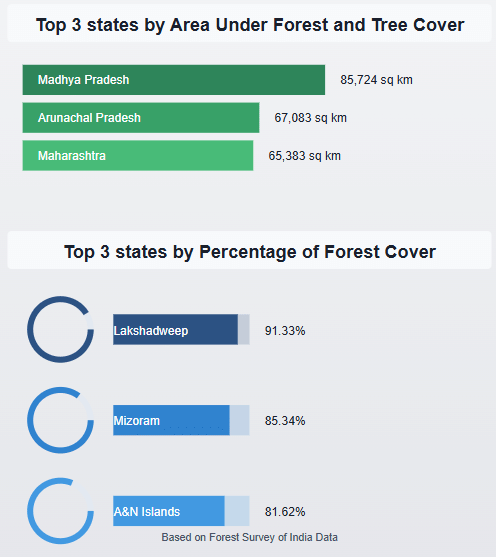
- Madhya Pradesh has the largest forest and tree cover area at 85,724 sq km.
- Other significant states include Arunachal Pradesh and Maharashtra.
- Madhya Pradesh also leads in total forest cover area.
3. Forest Cover Percentage
- Lakshadweep has the highest forest cover percentage at 91.33%, followed by Mizoram and Andaman & Nicobar Islands.
- 19 states/UTs have over 33% of their geographical area under forest cover.
4. Mangrove and Bamboo Cover
- Mangrove cover in India totals 4,992 sq km.
- Bamboo-bearing area increased to 1,54,670 sq km, a growth of 5,227 sq km.
5. Carbon Stock and Growing Stock
- Carbon stock in India’s forests is estimated at 7,285.5 million tonnes.
- This has surpassed the target of 2.5 to 3.0 billion tonnes of additional carbon sink set by the Paris Agreement by 2030.
- Growing stock of forests and trees outside forests is estimated at 6430 million cubic meters, marking an increase of 262 million cubic meters from the previous assessment.


Important Terms
- Forest Cover: Refers to larger areas of land (at least 1 hectare) with a tree canopy density exceeding 10%.
- Forest and Tree Cover: A broader term encompassing any area covered by trees, regardless of size or density.
- Recorded Forest Area: The ‘recorded forest area’ (RFA) (or forest area) refers to all the geographic areas recorded as ‘forest’ in government records. The ‘recorded forest area’ largely consists of the ‘Reserved Forests’ (RF) and the ‘Protected Forests’ (PF), constituted under the provisions of the Indian Forest Act, 1927.
About the India State of Forest Report (ISFR)
The ISFR is a biennial publication by the Forest Survey of India (FSI) under the Ministry of Environment, Forest & Climate Change. It provides comprehensive data on India’s forest resources, aligning with global reporting standards like FAO, UNFCCC, and CBD. The report uses remote sensing data from ISRO’s Resourcesat satellite for accurate assessments.
Significance of ISFR 2023
The ISFR serves as a crucial data source for government agencies, policy makers, forest departments, and international organizations, supporting:
- Forest management and policy planning
- Monitoring climate change mitigation efforts
- International forest reporting to organizations like FAO and UNFCCC.
Challenges in Forest Conservation
- Deforestation and Forest Degradation: Despite the increase in forest cover, deforestation and forest degradation continue to pose significant challenges, particularly in areas with high human population pressure and competing land uses.
- Declines in forest cover have been observed in the Western Ghats (58.22 sq. km) and the Northeast (327.30 sq. km).
- Illegal Logging and Timber Trade: Illegal logging and the associated timber trade remain a major threat to forest ecosystems, impacting biodiversity and livelihoods.
- Forest Fires: Forest fires, exacerbated by climate change and human activities, pose a significant threat to forest health and carbon stocks.
- Inclusion of Plantations: Plantations are counted as forests, but they lack biodiversity and critical features like deadwood and underground biomass for carbon sequestration.
- Climate Change: Climate change impacts, such as altered rainfall patterns, increased temperatures, and extreme weather events, pose significant threats to forest ecosystems and their biodiversity.
- Lack of Adequate Funding and Resources: Inadequate funding and resource constraints often hinder effective forest management and conservation efforts.
Government Initiatives for Forest Conservation
India’s government has implemented several initiatives to strengthen forest conservation efforts, including:
- National Mission for a Green India (2014)
- Launched in 2014 under the National Action Plan on Climate Change (NAPCC).
- This mission aims to protect India's biological resources and associated livelihoods from the impacts of climate change.
- National Afforestation Programme (NAP)
- The NAP promotes the afforestation of degraded forest lands. It is managed by the Ministry of Environment, Forest, and Climate Change.
- Compensatory Afforestation Fund Management and Planning Authority (CAMPA)
- Established in 2016 to channel funds for forest conservation and management.
- CAMPA funds various activities related to forest conservation, such as catchment area treatment, assisted natural regeneration, and wildlife protection.
- National Action Programme to Combat Desertification
- This program aims to address the growing problem of desertification and land degradation.
- Forest Fire Prevention and Management Scheme (FFPM)
- This scheme provides financial assistance to states for effective forest fire prevention and management.
Way Forward for India's Forests
- Promote Natural Forests: Shifting focus from monoculture plantations to restoring natural forests and encouraging biodiversity-rich forests that provide ecological and carbon sequestration benefits.
- Community Engagement and Participation: Engaging local communities in forest conservation efforts, such as through joint forest management programs, can enhance their ownership and stewardship of forest resources.
- Technology Integration:
- Expanding the use of satellite data and AI for real-time monitoring and forest health assessments.
- Implementing advanced fire detection and control systems to mitigate risks.
- Economic Incentives:
- Introducing carbon credit markets to incentivize forest conservation efforts.
- Providing financial support for agroforestry and sustainable land use practices.
- Investing in Forest Research and Development: Investing in research and development to improve forest management techniques, develop climate-resilient tree species, and enhance our understanding of forest ecosystems is essential.
- Focus on Urban Forests:
- Promoting urban forestry and green spaces to combat urban heat islands and improve air quality.
- Encouraging public-private partnerships for the creation and maintenance of city green zones.
Conclusion
The India State of Forest Report 2023 underscores India’s progress in forest conservation and climate action. With continued focus on sustainable forestry, biodiversity, and climate resilience, India is on track to further enhance its forest cover and carbon sequestration efforts, making significant strides towards achieving international climate commitments.
Download the PREPP App and attempt FREE IAS Exam Mock Tests and get complete study material!

Live Test : UPSC CSE Prelims CSAT (Paper-II) (Oct 08 - 11)
Full Test - 04: UPSC CSE Prelims CSAT (Paper-II)
Full Test - 03: UPSC CSE Prelims CSAT (Paper-II)
UPSC CSE Prelims 2026 GS Paper 1 Question Paper (24-May-2026)
UPSC CSE Prelims 2026 CSAT Paper 2 Question Paper (24-May-2026)

17 February 2025 | The Hindu Must Read Articles | Current Affairs

16 February 2026 | The Hindu Must Read Articles | Current Affairs

13 February 2026 | The Hindu Must Read Articles | Current Affairs









Comments