India Signs the Design Law Treaty (DLT): Key Benefits and Global Impact on Design Protection
Why in the News?
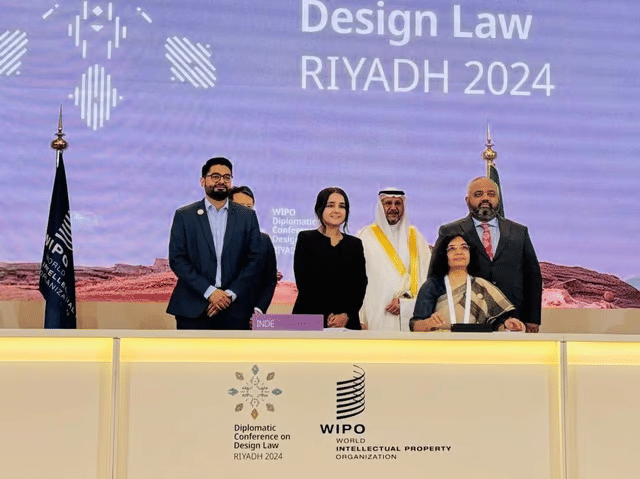
India has officially become one of the 193 member states of the World Intellectual Property Organization (WIPO) to sign the Design Law Treaty (DLT) on November 22, 2024, in Riyadh, Saudi Arabia. The DLT aims to harmonize design protection laws globally, benefiting small businesses and independent designers. This treaty will simplify the process for design registration and enforcement across multiple jurisdictions.
What is the Design Law Treaty (DLT)?
The Design Law Treaty (DLT), also known as the Riyadh Design Law Treaty, is an international legal instrument adopted by WIPO to streamline the design protection process worldwide.
Primary Objective:
The core objective of the DLT is to harmonize procedural frameworks for industrial design protection across multiple countries, creating a simplified global design registration process.
Target Beneficiaries:
The treaty primarily supports small and medium-sized enterprises (SMEs), startups, and independent designers. By simplifying the design registration process, it makes it easier for designers and businesses to protect their intellectual property (IP) internationally.
Key Provisions of the Design Law Treaty (DLT)
- Flexible Application Process:
- Multiple representation options: Including drawings, photographs, and videos.
- Multiple designs can be included in a single application.
- Standardized filing date requirements for simplicity.
- Multiple representation options: Including drawings, photographs, and videos.
- Filing Date & Grace Period:
- The DLT establishes uniform criteria for granting filing dates.
- A 12-month grace period is provided, allowing designers to disclose their designs without affecting the registration validity.
- Control Over Publication:
- Designers can keep designs unpublished for up to six months post-filing.
- Relief Measures:
- Flexibility to reinstate lost rights and simplified renewal procedures.
- Electronic Integration:
- Encouragement of electronic filing systems and priority document exchange for efficient management of design registrations.
History of the Design Law Treaty (DLT)
Initial Discussions & Negotiations:
- The DLT negotiations began in 2005 under the WIPO Standing Committee on Trademarks, Industrial Designs, and Geographical Indications. Over the years, multiple draft versions of the treaty were reviewed and refined.
Challenges:
- Key delays stemmed from the technical assistance requirements for developing nations and the disclosure of traditional cultural expressions (as proposed by the African Group).
Diplomatic Milestones:
- October 2023: Special session in Geneva to finalize the draft text.
- November 2024: Diplomatic conference in Riyadh, culminating in the official adoption of the treaty.
Expected Benefits of the Design Law Treaty (DLT)
- Global Design Protection: A simplified, efficient process to protect designs internationally.
- Cost Efficiency: Reduces administrative burdens and simplifies design registration, cutting costs.
- Startup Empowerment: The treaty aligns with initiatives like Startup India and SIPP, which encourage innovation.
- Accelerating Innovation: Eases the process for design registration, promoting faster innovation and market entry.
Challenges Facing the Implementation of DLT
- Infrastructure Gaps: Developing countries may lack the infrastructure to implement the required electronic filing systems.
- Legal System Diversity: Different legal systems and priorities can complicate harmonization efforts.
- Cultural Expression Disputes: The proposal to protect traditional knowledge and cultural expressions is still under discussion.
Way Forward: How Can Countries and Organizations Support DLT Implementation?
- Strengthening Technical Assistance: WIPO, along with developed nations, can help developing countries implement the DLT’s provisions by providing financial and technical aid.
- Promoting Awareness: Governments should focus on educating designers, especially in rural areas, about the benefits of the DLT.
- Encouraging Regional Cooperation: Regional organizations like ASEAN could work on shared e-filing systems to facilitate cross-border design registration.
About WIPO: The Organization Behind the DLT
The World Intellectual Property Organization (WIPO), a specialized agency of the United Nations, fosters creativity and innovation by providing global protection for intellectual property rights. Founded in 1967, WIPO administers major international agreements such as the Patent Cooperation Treaty (PCT) and the Madrid System for trademark registration.
Conclusion
The Design Law Treaty (DLT) is a significant step towards global harmonization of design protection laws. By easing the registration process and offering various provisions to support innovation, the treaty is expected to benefit businesses, startups, and independent designers worldwide. As countries work toward full implementation, collaboration and support will be key to realizing its full potential.
Download the PREPP App and attempt FREE IAS Exam Mock Tests and get complete study material!

Live Test : UPSC CSE Prelims CSAT (Paper-II) (Oct 08 - 11)
Full Test - 04: UPSC CSE Prelims CSAT (Paper-II)
Full Test - 03: UPSC CSE Prelims CSAT (Paper-II)
UPSC CSE Prelims 2026 GS Paper 1 Question Paper (24-May-2026)
UPSC CSE Prelims 2026 CSAT Paper 2 Question Paper (24-May-2026)

17 February 2025 | The Hindu Must Read Articles | Current Affairs

16 February 2026 | The Hindu Must Read Articles | Current Affairs

13 February 2026 | The Hindu Must Read Articles | Current Affairs









Comments