India-EU Free Trade Agreement (FTA): Key Developments, Challenges, and Future Prospects
Why in the News?
Prime Minister Narendra Modi recently announced that India and the European Union (EU) are committed to finalizing their long-pending Free Trade Agreement (FTA) by the end of 2025. This move aims to strengthen economic ties and enhance trade relations between the two regions.
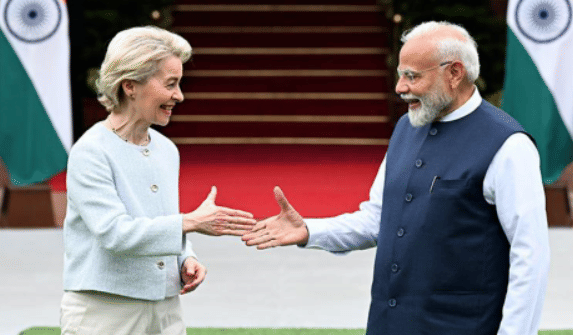
High-Level EU Visit to India
- Landmark Delegation: European Commission President Ursula Von Der Leyen, accompanied by 21 EU commissioners, visited Delhi, marking the largest EU delegation visit to any country.
- Strategic Security and Defence Partnership: Alongside trade discussions, negotiations are ongoing for a new security and defence partnership to replace the existing Strategic Roadmap (2020-2025).
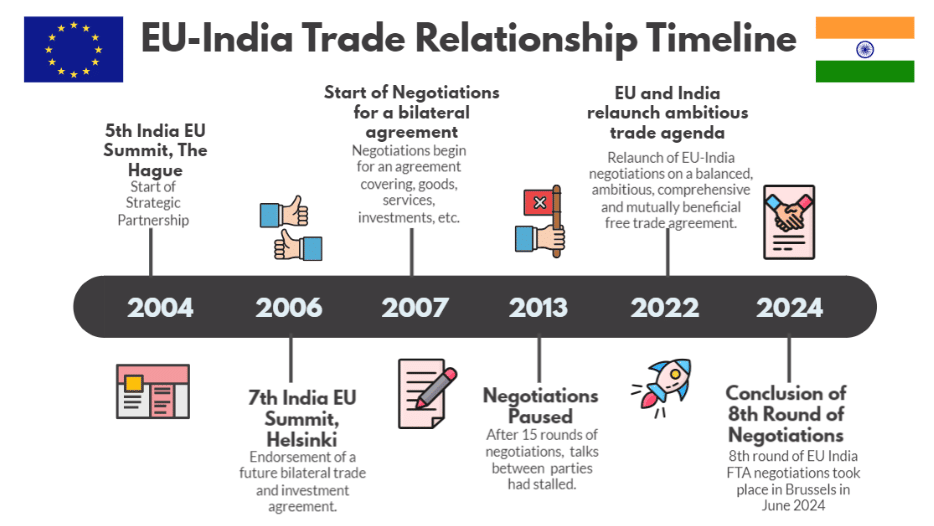
- Political Push for FTA: The India-EU FTA negotiations, which began in 2007, are receiving renewed political momentum, with the next round of talks scheduled in Brussels from March 10-14, 2025.
India-EU Trade: Current Status
- Trade Volume: The EU is India’s second-largest trading partner (after the Gulf Cooperation Council), with bilateral trade reaching approximately €124 billion in 2023, constituting 12.2% of India’s total trade.
- India’s Rank in EU Trade: India ranks as the EU’s 9th largest trading partner, accounting for around 2.2% of the EU’s total trade in goods.
- Key Indian Exports to the EU: Textiles, apparel, leather goods, pharmaceuticals, and agricultural products.
- Major EU Exports to India: Machinery, equipment, chemicals, aircraft, and vehicles.
- Investment Links: The EU remains a significant investor in India, with major European firms operating across sectors such as technology, automotive, and renewable energy.
India-EU Free Trade Agreement: Background and Objectives
- Objective: The India-EU FTA seeks to reduce trade barriers, enhance market access, and boost economic cooperation.
- History of Negotiations:
- Initial Talks (2007-2013): Negotiations started in 2007 but stalled in 2013 due to differences in tariffs and regulatory standards.
- Relaunch in 2022: Talks resumed after nine years, focusing on geopolitical realignment and economic recovery.
- Progress So Far:
- Trade and Technology Cooperation: India and the EU have initiated collaborations under the Trade and Technology Council (TTC).
- Geographical Indications Agreement: Progress on protecting products with regional identity, such as Basmati rice (India) and Champagne (France).
- Negotiation Rounds: A total of 15 rounds of negotiations have taken place, with both sides committed to finalizing the agreement by 2025.
Expected Provisions of the India-EU FTA
- Market Access: India seeks expanded access for textiles, IT services, and pharmaceuticals, while the EU aims for greater entry into India’s automobile and alcoholic beverage sectors.
- Investment Protection: Legal safeguards for investors, including protection against unfair expropriation and dispute resolution mechanisms.
- Sustainability Commitments: The EU demands strict environmental and labor standards, aligning with its Green Deal policies.
- Tariff Reductions: The FTA aims to eliminate or lower tariffs on a range of goods to promote smoother trade flows.
- Technology and Mobility: Provisions will facilitate cooperation in emerging technologies, digital trade, and work visas for professionals.
Contentious Issues in India-EU FTA Negotiations
- Automobiles & Alcohol: The EU demands significant tariff reductions on European cars and alcoholic beverages, while India seeks to protect domestic industries.
- Pharmaceuticals & Agriculture: India has concerns over the EU’s stringent regulations, which include bans on Indian drug and agricultural exports.
- Data Security & IT Services: India seeks data-secure status to boost IT sector access in the EU.
- Visa & Mobility Issues: India demands easier movement for skilled professionals, but the EU insists that visa policies remain under member states’ jurisdiction.
- Intellectual Property Rights (IPR): The EU wants stricter patent protection laws, which India fears could impact its pharmaceutical industry.
- Carbon Border Adjustment Mechanism (CBAM): The EU’s CBAM imposes a carbon tax on imports based on their carbon footprint, raising concerns for India’s steel and cement exports.
Key Challenges in India-EU FTA Negotiations
- Regulatory Barriers: India’s IT and telecom regulations pose challenges for European exporters.
- Divergent Standards: The EU’s strict environmental and product safety standards create compliance hurdles for Indian businesses.
- Trade Disputes: WTO disputes, such as those related to wine and spirits, affect trust in negotiations.
- Geopolitical Shifts: The rise of regional trade blocs (TPP, RCEP) influences global trade priorities.
- Domestic Resistance: Indian industry groups fear that tariff reductions on automobiles, wine, and professional services could hurt local businesses.
The Way Forward: Strategies for a Successful India-EU FTA
- Gradual Tariff Reduction: Implement a phased approach to reduce tariffs on sensitive sectors, allowing domestic industries to adapt.
- Mutual Recognition Agreements: Establish regulatory alignment in pharmaceuticals, agriculture, and data security.
- Sectoral Prioritization: Focus on high-potential sectors like renewable energy, digital trade, and technology cooperation.
- Investment Facilitation: Strengthen EU investments in Indian infrastructure, smart cities, and manufacturing.
- Balanced IPR Framework: Protect innovation while ensuring affordable medicines through a middle-ground approach.
- Flexible Mobility Policies: Develop alternative pathways like business visas and work permits for professional movement.
- Timely Dispute Resolution: Set up a dedicated dispute resolution mechanism to prevent trade conflicts from derailing negotiations.
Conclusion
The India-EU Free Trade Agreement holds immense potential for strengthening bilateral trade, investment, and economic cooperation. While challenges remain, a balanced and strategic approach can help both sides unlock new opportunities and achieve a mutually beneficial agreement by 2025.
Download the PREPP App and attempt FREE IAS Exam Mock Tests and get complete study material!
*The article might have information for the previous academic years, please refer the official website of the exam.
How likely are you to recommend Prepp.in to a friend or a colleague?
Not so likely
Highly likely
UPSC CSE (IAS) 2027 Prelims Mock Test Series
Live Quizzes
Quizzes
Live Tests

• Live
Live Test : UPSC CSE Prelims CSAT (Paper-II) (Oct 08 - 11)
120 Minutes
80 Questions
200 Marks
English, Hindi
MEDIUM
Test will end in 05:30:57
Full Tests
Full Test - 04: UPSC CSE Prelims CSAT (Paper-II)
120 Minutes
80 Questions
200 Marks
English, Hindi
MEDIUM
Attempted by 19 aspirants in 12 hours
Full Test - 03: UPSC CSE Prelims CSAT (Paper-II)
120 Minutes
80 Questions
200 Marks
English, Hindi
MEDIUM
Attempted by 20 aspirants in 12 hours
Previous Year Papers
UPSC CSE Prelims 2026 GS Paper 1 Question Paper (24-May-2026)
120 Minutes
100 Questions
200 Marks
2,989 Attempted
English, Hindi
MEDIUM
Attempted by 12 aspirants in 12 hours
UPSC CSE Prelims 2026 CSAT Paper 2 Question Paper (24-May-2026)
120 Minutes
80 Questions
200 Marks
3,167 Attempted
English, Hindi
MEDIUM
Attempted by 13 aspirants in 12 hours
Videos

17 February 2025 | The Hindu Must Read Articles | Current Affairs
7,202 Views
•4
•7 months ago

16 February 2026 | The Hindu Must Read Articles | Current Affairs
6,962 Views
•4
•7 months ago

13 February 2026 | The Hindu Must Read Articles | Current Affairs
8,765 Views
•5
•7 months ago

12 February 2026 | The Hindu Must Read Articles | Current Affairs
5,788 Views
•4
•7 months ago






Also Check
IAS Exam Overview
IAS Exam Admit Card
IAS Exam Question Paper 2026
IAS Exam Mains Syllabus
IAS Exam Application Process
IAS Exam Eligibility
IAS Exam Result
IAS Exam Exam Pattern
IAS Exam CSAT Syllabus
IAS Exam Answer Key
IAS Exam Previous Year Paper
IAS Exam Current Affairs
IAS Exam Mains Question Paper
IAS Exam IAS Courses
IAS Exam UPSC Study Notes
IAS Exam Foundation Course 2024
IAS Exam Prelims Question Paper
IAS Exam Exam Center
IAS Exam Foundation Course 2025
IAS Exam Notification 2026
IAS Exam IAS Success Stories
IAS Exam Salary
IAS Exam Cutoff
IAS Exam Mock Tests
IAS Exam News


Comments