Hypersonic Missiles: India's Latest Advancement in Defense Technology
What are Hypersonic Missiles?
- Missiles capable of speeds exceeding Mach 5 (5400+ km/hr)
- Advanced maneuverability during flight
- Part of cruise missile family, alongside subsonic (<Mach 1) and supersonic (Mach 1-5) variants
Types of Hypersonic Missiles
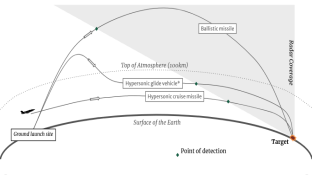
- Hypersonic Glide Vehicles (HGVs)
- Hypersonic Cruise Missiles (HCMs) with scramjet propulsion
SCRAMJET Technology Breakthrough
- Supersonic combustion ramjet enables sustained hypersonic flight
- Key differentiator: Supersonic air-fuel combustion
- No moving parts required for operation
India Joins Elite Hypersonic Club
- Successfully tested scramjet technology
- Joins USA, Russia, and China in operational hypersonic capabilities
- Significant milestone in defense modernization
Differences between ballistic and cruise missiles:
- Ballistic missiles arc high into space following a parabolic trajectory and rely primarily on gravity during descent, reaching extremely high speeds and typically carrying larger payloads.
- Cruise missiles fly at relatively lower altitudes within the atmosphere, use continuous propulsion and guidance systems, and can navigate complex paths to their targets.
Scramjet Vs Ramjet Technology
| Ramjet | SCRAMJET | |
|---|---|---|
| Speed range | Mach 3-Mach 6 | more Than Mach 5 |
| combustion Speed | Supersonic combustion | Hypersonic combustion |
| Methods | Ramjet technology uses the forwardmotion of an object to compress air into acombustion chamber, where it mixes withfuel and ignites. | Air flows through the engine atsupersonic speeds, compressingand mixing with fuel to sustaincombustion ,a process achievedwithout the need for movingparts like turbines orcompressors. |
Download the PREPP App and attempt FREE IAS Exam Mock Tests and get complete study material!
*The article might have information for the previous academic years, please refer the official website of the exam.
How likely are you to recommend Prepp.in to a friend or a colleague?
Not so likely
Highly likely
UPSC CSE (IAS) 2027 Prelims Mock Test Series
Live Quizzes
Quizzes
Live Tests

• Live
Live Test : UPSC CSE Prelims CSAT (Paper-II) (Oct 08 - 11)
120 Minutes
80 Questions
200 Marks
English, Hindi
MEDIUM
Test will end in 05:29:53
Full Tests
Full Test - 04: UPSC CSE Prelims CSAT (Paper-II)
120 Minutes
80 Questions
200 Marks
English, Hindi
MEDIUM
Attempted by 19 aspirants in 12 hours
Full Test - 03: UPSC CSE Prelims CSAT (Paper-II)
120 Minutes
80 Questions
200 Marks
English, Hindi
MEDIUM
Attempted by 20 aspirants in 12 hours
Previous Year Papers
UPSC CSE Prelims 2026 GS Paper 1 Question Paper (24-May-2026)
120 Minutes
100 Questions
200 Marks
2,989 Attempted
English, Hindi
MEDIUM
Attempted by 12 aspirants in 12 hours
UPSC CSE Prelims 2026 CSAT Paper 2 Question Paper (24-May-2026)
120 Minutes
80 Questions
200 Marks
3,167 Attempted
English, Hindi
MEDIUM
Attempted by 13 aspirants in 12 hours
Videos

17 February 2025 | The Hindu Must Read Articles | Current Affairs
7,202 Views
•4
•7 months ago

16 February 2026 | The Hindu Must Read Articles | Current Affairs
6,962 Views
•4
•7 months ago

13 February 2026 | The Hindu Must Read Articles | Current Affairs
8,765 Views
•5
•7 months ago

12 February 2026 | The Hindu Must Read Articles | Current Affairs
5,788 Views
•4
•7 months ago






Also Check
IAS Exam Overview
IAS Exam Admit Card
IAS Exam Question Paper 2026
IAS Exam Mains Syllabus
IAS Exam Application Process
IAS Exam Eligibility
IAS Exam Result
IAS Exam Exam Pattern
IAS Exam CSAT Syllabus
IAS Exam Answer Key
IAS Exam Previous Year Paper
IAS Exam Current Affairs
IAS Exam Mains Question Paper
IAS Exam IAS Courses
IAS Exam UPSC Study Notes
IAS Exam Foundation Course 2024
IAS Exam Prelims Question Paper
IAS Exam Exam Center
IAS Exam Foundation Course 2025
IAS Exam Notification 2026
IAS Exam IAS Success Stories
IAS Exam Salary
IAS Exam Cutoff
IAS Exam Mock Tests
IAS Exam News


Comments