Hoollongapar Gibbon Sanctuary: A Biodiversity Hotspot Under Threat
Why in the News?
The Hoollongapar Gibbon Sanctuary in Assam has recently come under the spotlight following the Centre’s Standing Committee of the National Board for Wildlife (NBWL) granting approval for exploratory oil and gas drilling in its eco-sensitive zone (ESZ).
Key Developments
- Proposal Approval: The proposal by Vedanta Group’s Cairn Oil & Gas received clearance for exploratory drilling within the ESZ.
- Assurances Provided: Vedanta has stated that no commercial drilling will take place in the eco-sensitive zone.
- Local Concerns: The project’s site is situated near the Assam-Nagaland border, raising concerns among local communities and the Nagaland government, which stress the importance of seeking their consent before operations commence.
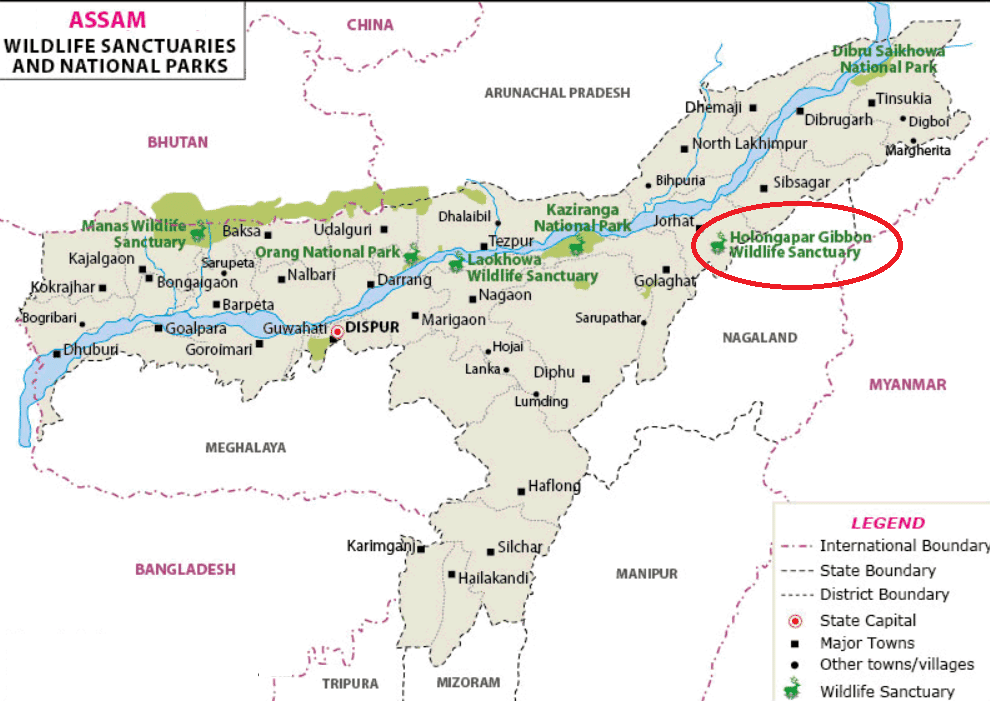
About Hoollongapar Gibbon Sanctuary
Location and Size
- District: Jorhat, Assam.
- Sanctuary Area: 20.98 sq km.
- Eco-Sensitive Zone: Spanning 264.92 sq km, the ESZ serves as a buffer to protect the sanctuary’s delicate ecosystem.
Historical Significance
- Established: Declared a reserve forest in 1881.
- Upgraded Status: Became a wildlife sanctuary in 1997 to safeguard its rich biodiversity.
Ecological Importance
- Connectivity: Functions as an ecological corridor linking the Dissoi Valley Reserve Forest and forested regions in Nagaland.
- Flora: Dominated by evergreen forests, the sanctuary’s upper canopy is marked by Hollong trees (Dipterocarpus retusus), while the middle canopy features Nahar trees (Mesua ferrea).
Unique Fauna of Hoollongapar
The sanctuary is a haven for diverse wildlife, including rare and endangered species.
- Primate Species:
- Western Hoolock Gibbon (Hoolock hoolock): India’s only ape.
- Bengal Slow Loris (Nycticebus bengalensis): A nocturnal primate.
- Five other primate species call this sanctuary home.
- Other Mammals:
- Indian Elephants (Elephas maximus indicus).
- Leopards (Panthera pardus).
- Jungle Cats, Civets, and more.
- Avian Diversity: Over 200 bird species have been recorded.
- Butterflies: A stunning 211 butterfly species add vibrant beauty to the sanctuary.
Threats to the Sanctuary
Despite its ecological significance, the sanctuary faces multiple threats:
- Habitat Fragmentation: Increasing human activities have disrupted the sanctuary’s natural habitats.
- Encroachment: Illegal settlements and agricultural activities continue to encroach upon protected areas.
- Railway Electrification: The electrification of nearby railway lines poses risks to wildlife.
- Pesticide Runoff: Chemicals from adjacent tea gardens seep into the sanctuary, harming its flora and fauna.
Balancing Development and Conservation
The approval for exploratory drilling has ignited debates about balancing economic development with environmental preservation. While the project promises to adhere to strict guidelines, it remains crucial to engage local communities and implement robust measures to safeguard the sanctuary’s biodiversity.
Conclusion
The Hoollongapar Gibbon Sanctuary stands as a testament to Assam’s rich natural heritage. Protecting its unique biodiversity while addressing developmental goals requires a collaborative and sustainable approach. As stakeholders navigate this complex scenario, prioritizing conservation will be essential to ensuring that this ecological gem continues to thrive.
Download the PREPP App and attempt FREE IAS Exam Mock Tests and get complete study material!

Live Test : UPSC CSE Prelims CSAT (Paper-II) (Oct 08 - 11)
Full Test - 04: UPSC CSE Prelims CSAT (Paper-II)
Full Test - 03: UPSC CSE Prelims CSAT (Paper-II)
UPSC CSE Prelims 2026 GS Paper 1 Question Paper (24-May-2026)
UPSC CSE Prelims 2026 CSAT Paper 2 Question Paper (24-May-2026)

17 February 2025 | The Hindu Must Read Articles | Current Affairs

16 February 2026 | The Hindu Must Read Articles | Current Affairs

13 February 2026 | The Hindu Must Read Articles | Current Affairs









Comments