High Energy Stereoscopic System (H.E.S.S.) Observatory
Why in news
- Scientists at the HESS observatory in Namibia have found the most energetic cosmic rays ever detected, reaching up to 40 teraelectronvolts.
About High Energy Stereoscopic System (H.E.S.S.) Observatory
- Location and Geographical Significance:
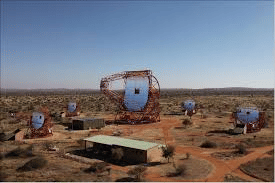
- The High Energy Stereoscopic System (H.E.S.S.) is located in the Khomas Highlands of Namibia, strategically positioned in the southern hemisphere. This location is crucial for observing gamma-ray sources in the Milky Way galaxy and beyond, making it an ideal site for astronomical research.
- Scientific Objectives and Operations:
- Established in 2003, H.E.S.S. is designed to observe gamma rays, the most energetic form of light in the universe. These high-energy gamma rays, exceeding 100 GeV, are produced by extreme cosmic events like supernova remnants, black holes, and neutron stars.
- Technology and Detection Method:
- Due to the inability of gamma rays to penetrate the Earth's atmosphere, H.E.S.S. uses Cherenkov telescopes to detect gamma rays indirectly. When gamma rays interact with atmospheric molecules, they produce Cherenkov radiation — a flash of light that is captured by the telescopes.
- Stereoscopic Arrangement:
- H.E.S.S. operates using a stereoscopic system of multiple telescopes. This arrangement enhances the precision and reliability of observations, providing clearer data on cosmic phenomena, including those related to high-energy astrophysics.
- Research Focus:
- H.E.S.S. contributes to research on dark matter, Lorentz invariance, cosmic ray acceleration, and outbursts in distant galaxies. Its wide-ranging research program is crucial for understanding fundamental physics and the violent processes in the universe.
- International Collaboration:
- The observatory is operated by a collaboration of over 260 scientists from 40 scientific institutions across 13 countries, highlighting its global significance in the field of high-energy astrophysics.
- Contribution to Astrophysics:
- H.E.S.S. plays a pivotal role in studying the most extreme cosmic events and advancing our understanding of the universe’s high-energy processes. Its findings provide valuable insights into the origin of cosmic rays and the nature of exotic phenomena like black holes and dark matter.
- Significance for UPSC Preparation:
- For UPSC General Studies (GS Paper II) and Science & Technology (GS Paper III), understanding H.E.S.S. is essential as it relates to global scientific collaborations, astronomical research, and technological advancements in the study of the universe. It also ties into broader topics such as dark matter and cosmic radiation, which are important areas in contemporary science and research.
Download the PREPP App and attempt FREE IAS Exam Mock Tests and get complete study material!
*The article might have information for the previous academic years, please refer the official website of the exam.
How likely are you to recommend Prepp.in to a friend or a colleague?
Not so likely
Highly likely
UPSC CSE (IAS) 2027 Prelims Mock Test Series
Live Quizzes
Quizzes
Live Tests

• Live
Live Test : UPSC CSE Prelims CSAT (Paper-II) (Oct 08 - 11)
120 Minutes
80 Questions
200 Marks
English, Hindi
MEDIUM
Test will end in 05:31:00
Full Tests
Full Test - 04: UPSC CSE Prelims CSAT (Paper-II)
120 Minutes
80 Questions
200 Marks
English, Hindi
MEDIUM
Attempted by 19 aspirants in 12 hours
Full Test - 03: UPSC CSE Prelims CSAT (Paper-II)
120 Minutes
80 Questions
200 Marks
English, Hindi
MEDIUM
Attempted by 20 aspirants in 12 hours
Previous Year Papers
UPSC CSE Prelims 2026 GS Paper 1 Question Paper (24-May-2026)
120 Minutes
100 Questions
200 Marks
2,989 Attempted
English, Hindi
MEDIUM
Attempted by 12 aspirants in 12 hours
UPSC CSE Prelims 2026 CSAT Paper 2 Question Paper (24-May-2026)
120 Minutes
80 Questions
200 Marks
3,167 Attempted
English, Hindi
MEDIUM
Attempted by 13 aspirants in 12 hours
Videos

17 February 2025 | The Hindu Must Read Articles | Current Affairs
7,202 Views
•4
•7 months ago

16 February 2026 | The Hindu Must Read Articles | Current Affairs
6,962 Views
•4
•7 months ago

13 February 2026 | The Hindu Must Read Articles | Current Affairs
8,765 Views
•5
•7 months ago

12 February 2026 | The Hindu Must Read Articles | Current Affairs
5,788 Views
•4
•7 months ago






Also Check
IAS Exam Overview
IAS Exam Admit Card
IAS Exam Question Paper 2026
IAS Exam Mains Syllabus
IAS Exam Application Process
IAS Exam Eligibility
IAS Exam Result
IAS Exam Exam Pattern
IAS Exam CSAT Syllabus
IAS Exam Answer Key
IAS Exam Previous Year Paper
IAS Exam Current Affairs
IAS Exam Mains Question Paper
IAS Exam IAS Courses
IAS Exam UPSC Study Notes
IAS Exam Foundation Course 2024
IAS Exam Prelims Question Paper
IAS Exam Exam Center
IAS Exam Foundation Course 2025
IAS Exam Notification 2026
IAS Exam IAS Success Stories
IAS Exam Salary
IAS Exam Cutoff
IAS Exam Mock Tests
IAS Exam News


Comments