Great Knot and Indian Skimmer: Migratory Birds of the Godavari Estuary
Why in the News?
An enumeration of local and migratory bird species across 25 wetlands in the Godavari Estuary was recently conducted as part of the Asian Waterbird Census and the annual bird census organized by the Forest Department.
Surveyed Wetlands in the Godavari Estuary
The survey covered notable wetlands such as:
- Sacramento Island
- Masaanitippa-Moolapalem
- Bhairavapalem-Dariyalatippa Wetland
- Coringa Creek in the Coringa Mangroves
- Jagannadhapuram-Kakinada Bay
- Hope Island
The Coringa Mangroves are a significant mangrove forest in the Coringa Wildlife Sanctuary (CWS) located in Andhra Pradesh, India.
The aim of this survey was to assess the ecosystem of the Godavari Estuary, a critical habitat for the endangered Great Knot (Calidris tenuirostris) and the vulnerable Indian Skimmer (Rynchops albicollis). These species are observed together in South India during their migratory routes.
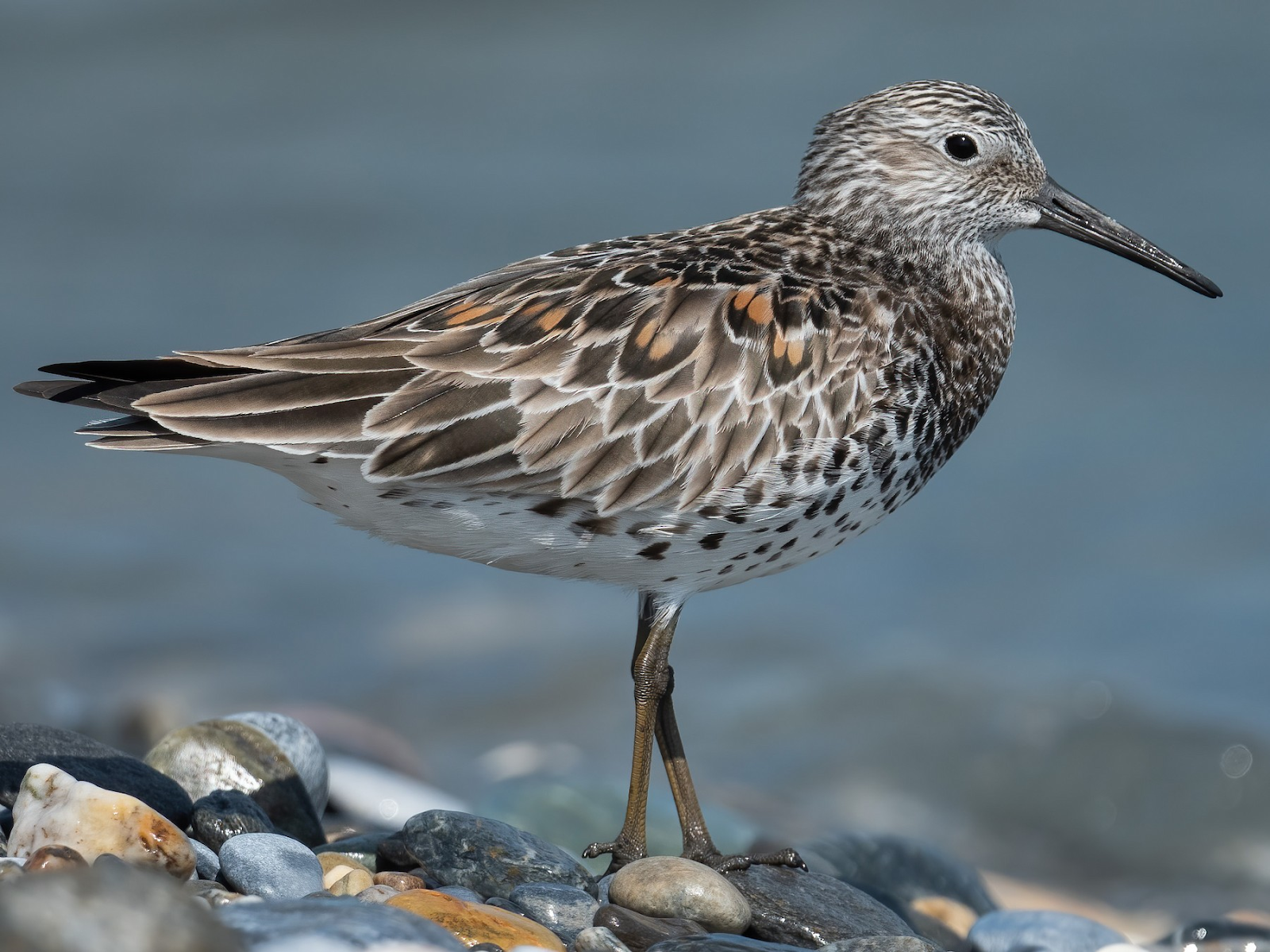
Great Knot (Calidris tenuirostris)
Scientific Classification:
- Scientific Name: Calidris tenuirostris
- Genus: Calidris (derived from the Ancient Greek "kalidris," referring to gray-colored waterside birds)
Habitat and Migration
- Breeding Habitat: The Great Knot breeds in the tundra of northeast Siberia, Russia.
- Migration: It migrates to coastal regions in Southern Asia and Australia during the winter months. Occasionally, the species is spotted in the U.S. and Canada.
Physical Characteristics
- Size: 26–30 cm in length, wingspan 56–66 cm.
- Plumage: The bird has mottled grayish upperparts and a heavily spotted black face, throat, and breast during the breeding season. In winter, the plumage is pale gray.
Diet and Behavior
- Foraging: The Great Knot feeds primarily on mollusks and insects found on mudflats and beaches.
- Behavior: This species is migratory and typically forms large flocks during the winter.
Threats
- Habitat loss and degradation, particularly along migratory routes.
- Disturbance from human activities, such as coastal development.
- Climate change impacts, which can affect breeding habitats and food availability.
Conservation Status
- IUCN Status: Endangered
- Wildlife Protection Act Status: Schedule I
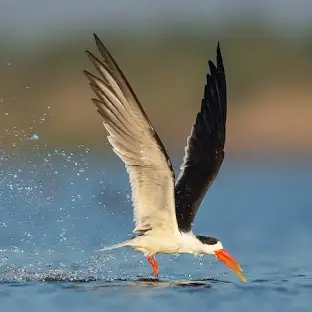
Indian Skimmer (Rynchops albicollis)
Scientific Classification:
- Scientific Name: Rynchops albicollis
- Genus: Rynchops (derived from the Greek words "rynchos" meaning bill, and "ops" meaning face, referring to the bird’s unique bill structure)
Habitat and Distribution
- The Indian Skimmer is found across Southern Asia, particularly in river systems of India, Pakistan, Bangladesh, and Myanmar.
- It breeds on sandy riverbanks and islands in large rivers.
Physical Characteristics
- Size: 40–43 cm in length, wingspan of 108 cm.
- Plumage: The bird has a black cap, orange bill, long pointed wings, and a white body.
- Bill: The lower mandible is longer than the upper, a distinctive feature that allows the bird to skim the surface of the water for prey.
Diet and Behavior
- The Indian Skimmer feeds on fish, crustaceans, and insect larvae, often foraging during dusk or night.
- It forages in small flocks, typically skimming the water's surface.
Threats
- Loss of breeding grounds due to riverbank alterations and disturbances.
- Climate change, which alters river systems and habitats.
Conservation Status
- IUCN Status: Endangered
- Wildlife Protection Act Status: Schedule I
Conservation Efforts and Importance of Wetlands
The protection of wetlands like those in the Godavari Estuary is crucial to preserving the habitats of migratory and local bird species, including the Great Knot and Indian Skimmer. Their presence in these wetlands highlights the importance of safeguarding these ecosystems, especially as these species face numerous threats from habitat destruction, climate change, and human activities.
By continuing to monitor and protect these vital wetlands, conservationists aim to ensure the survival of these endangered and vulnerable bird species, contributing to the overall health and biodiversity of the region.
Download the PREPP App and attempt FREE IAS Exam Mock Tests and get complete study material!

Live Test : UPSC CSE Prelims CSAT (Paper-II) (Oct 08 - 11)
Full Test - 04: UPSC CSE Prelims CSAT (Paper-II)
Full Test - 03: UPSC CSE Prelims CSAT (Paper-II)
UPSC CSE Prelims 2026 GS Paper 1 Question Paper (24-May-2026)
UPSC CSE Prelims 2026 CSAT Paper 2 Question Paper (24-May-2026)

17 February 2025 | The Hindu Must Read Articles | Current Affairs

16 February 2026 | The Hindu Must Read Articles | Current Affairs

13 February 2026 | The Hindu Must Read Articles | Current Affairs









Comments