Gharchola Saree
Why in news?
- Centre gives GI tag to Gujarat’s handicraft ‘Gharchola’, bringing state’s total GI tags to 27.
- With 23 of them recognizing its vibrant handicraft sector.
- The GI tag for Gharchola handicrafts was presented to Gujarat at the “GI and Beyond – Virasat Se Vikas Tak” program in New Delhi.
About Gharchola Saree
- Also Known As: Ghatchola or Gharcholu, famous for its intricate Bandhani work from Gujarat.
- Traditional Use: Traditionally worn by brides in Gujarati weddings, symbolizing their transition to their new home.
- Material: Woven on cotton or silk fabric, featuring large checks using silk and zari threads, and colored with Bandhani (tie & dye).
- Designs: Includes motifs of peacocks, lotus, human figures, and floral patterns in auspicious colors like red, maroon, green, and yellow.
- Symbolism: Designs incorporate symbols of fertility and prosperity, such as kalash and paan.
- Craftsmanship: Sourced from generational artisan clusters in Gujarat, preserving centuries-old traditions.
- GI Tag: Recently awarded a Geographical Indication (GI) tag for its uniqueness, bringing Gujarat's total GI tags to 27.
About GI Tags
- What is GI?: A GI tag is granted to products that possess qualities, reputation, or characteristics unique to a specific geographical origin.
- Legal Framework: Governed by the Geographical Indications of Goods (Registration and Protection) Act, 1999, in line with the WTO TRIPS agreement.
- Objective: To promote traditional craftsmanship, ensuring authenticity and preserving the legacy of products tied to their geographical origins.
- Validity: GI tags are valid for 10 years, after which they need to be renewed.
- Administering Body: The Department for Promotion of Industry and Internal Trade (DPIIT) under the Ministry of Commerce and Industry.
GI Tags in India
- Uttar Pradesh: Holds the highest number of GI tags with 75 products.
- Tamil Nadu: Follows with 61 GI-tagged products, showcasing the state's rich traditional craft heritage.
Advantages of GI Tags
- Legal Protection: Ensures protection for products made with traditional methods, preventing unauthorized use by others.
- Quality Assurance: Guarantees consumers receive genuine, high-quality products, enhancing trust in the product.
- Economic Growth: Promotes the economic prosperity of producers by increasing national and international demand for GI-tagged products.
- Market Differentiation: GI tag helps create a unique market identity, distinguishing products based on their origin and craftsmanship.
Challenges of GI tags
- Disparity among states in registering GIs:- Some states have received multiple registered GIs whereas other states are far lagging behind with just one or two registered.
- Eg Tamil Nadu has 61 whereas Jharkhand and Tripua has only 1.
- Disparity in the percentage of GI Categories:- It has also found that the majority of GIs are registered for handicraft and Agricultural goods.
- Whereas, the rest GIs are registered in other domains namely, foodstuff, manufactured and natural goods.
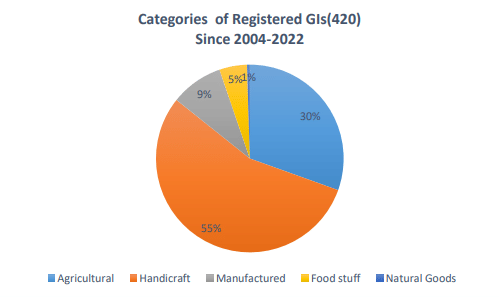
Source:- National law university, Nagpur
- Economical and Technical Challenges:- In order to achieve the sustainability of GI, developing countries like India need to have the financial and technical assistance to promote their product in the international market.
- Social Challenges:- The primary social challenge is the lack of awareness about GI Laws in India.
- Federal Problems:- There have been cases where two different states are fighting for the GI of the same product.
- For example, West Bengal and Odisha for the GI tag of “Rasgulla” although awarded to both.
Download the PREPP App and attempt FREE IAS Exam Mock Tests and get complete study material!
*The article might have information for the previous academic years, please refer the official website of the exam.
How likely are you to recommend Prepp.in to a friend or a colleague?
Not so likely
Highly likely
UPSC CSE (IAS) 2027 Prelims Mock Test Series
Live Quizzes
Quizzes
Live Tests

• Live
Live Test : UPSC CSE Prelims CSAT (Paper-II) (Oct 08 - 11)
120 Minutes
80 Questions
200 Marks
English, Hindi
MEDIUM
Test will end in 05:31:07
Full Tests
Full Test - 04: UPSC CSE Prelims CSAT (Paper-II)
120 Minutes
80 Questions
200 Marks
English, Hindi
MEDIUM
Attempted by 19 aspirants in 12 hours
Full Test - 03: UPSC CSE Prelims CSAT (Paper-II)
120 Minutes
80 Questions
200 Marks
English, Hindi
MEDIUM
Attempted by 20 aspirants in 12 hours
Previous Year Papers
UPSC CSE Prelims 2026 GS Paper 1 Question Paper (24-May-2026)
120 Minutes
100 Questions
200 Marks
2,989 Attempted
English, Hindi
MEDIUM
Attempted by 12 aspirants in 12 hours
UPSC CSE Prelims 2026 CSAT Paper 2 Question Paper (24-May-2026)
120 Minutes
80 Questions
200 Marks
3,167 Attempted
English, Hindi
MEDIUM
Attempted by 13 aspirants in 12 hours
Videos

17 February 2025 | The Hindu Must Read Articles | Current Affairs
7,202 Views
•4
•7 months ago

16 February 2026 | The Hindu Must Read Articles | Current Affairs
6,962 Views
•4
•7 months ago

13 February 2026 | The Hindu Must Read Articles | Current Affairs
8,765 Views
•5
•7 months ago

12 February 2026 | The Hindu Must Read Articles | Current Affairs
5,788 Views
•4
•7 months ago






Also Check
IAS Exam Overview
IAS Exam Admit Card
IAS Exam Question Paper 2026
IAS Exam Mains Syllabus
IAS Exam Application Process
IAS Exam Eligibility
IAS Exam Result
IAS Exam Exam Pattern
IAS Exam CSAT Syllabus
IAS Exam Answer Key
IAS Exam Previous Year Paper
IAS Exam Current Affairs
IAS Exam Mains Question Paper
IAS Exam IAS Courses
IAS Exam UPSC Study Notes
IAS Exam Foundation Course 2024
IAS Exam Prelims Question Paper
IAS Exam Exam Center
IAS Exam Foundation Course 2025
IAS Exam Notification 2026
IAS Exam IAS Success Stories
IAS Exam Salary
IAS Exam Cutoff
IAS Exam Mock Tests
IAS Exam News


Comments