Future of Jobs Report 2025: Key Insights on Job Growth, Disruption, and Skills Required
Why in news
- The future of work is undergoing rapid transformation, as revealed by the Future of Jobs Report 2025 from the World Economic Forum (WEF).
About the report
- The Future of Jobs Report 2025 from the World Economic Forum (WEF) highlights the rapid transformation of the global labor market, driven by technological advancements, demographic shifts, and economic changes
- This report provides valuable insights into job disruption, future job creation, and the skills workers will need to thrive in the evolving workplace.
Overview of the Future of Jobs Report 2025
- Introduction:
- The Future of Jobs Report 2025 is based on data gathered from over 1,000 global companies representing 14 million workers across 22 industry sectors and 55 economies.
- Job Disruption and Creation:
- By 2030, 22% of jobs are expected to face disruption due to automation, technological shifts, and global trends.
- 170 million new jobs will be created, but 92 million jobs will be displaced, leading to a net increase of 78 million jobs by 2030.
Key Drivers of Change in the Global Labor Market
- Technological advancements (AI, automation, big data)
- Geoeconomics fragmentation
- Economic uncertainty
- Demographic shifts (ageing populations, changing workforce dynamics)
- The green transition (sustainability and environmental policies)
Fastest-Growing Jobs
- High Percentage Growth:
- AI and machine learning specialists, software developers, and FinTech engineers will experience the highest growth in percentage terms.
- Absolute Growth:
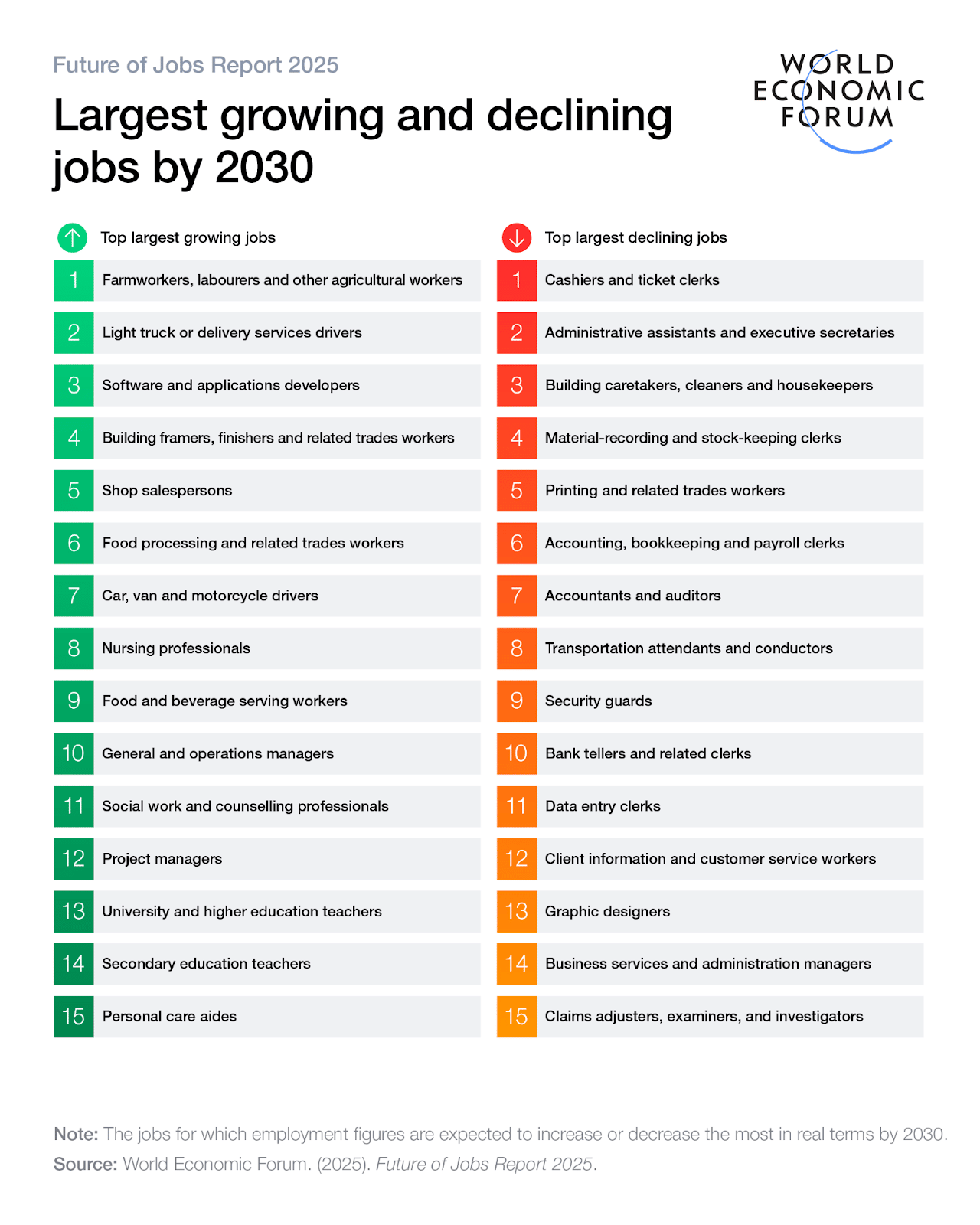
- Farmworkers, delivery drivers, construction workers, salespersons, and care economy jobs (e.g., nursing professionals, social workers) are expected to witness the largest growth in absolute numbers.
Impact on Traditional Jobs
- Jobs that are vulnerable to automation, such as graphic designers and administrative assistants, will see declines in demand.
Skills Gap and Workforce Adaptation
- 40% of skills required for future jobs will be new or evolving.
- To remain competitive, 59% of the global workforce will need reskilling or upskilling by 2030.
Top 10 Fastest-Growing Skills
- AI, big data, cybersecurity, and technological literacy are expected to be the top skills.
- Other high-demand skills include creativity, resilience, flexibility, agility, curiosity, and lifelong learning.
Workforce Transformation and Automation
- 41% of companies plan to reduce their workforce as automation increases, but they are simultaneously investing in reskilling and upskilling programs to equip workers with the necessary skills.
Conclusion
- The Future of Jobs Report 2025 stresses the importance of continuous learning, adaptability, and a combination of technical and human skills to succeed in the rapidly changing job market.
The focus on reskilling initiatives and upskilling programs will be essential to prepare workers for the evolving future of work.
Download the PREPP App and attempt FREE IAS Exam Mock Tests and get complete study material!
*The article might have information for the previous academic years, please refer the official website of the exam.
How likely are you to recommend Prepp.in to a friend or a colleague?
Not so likely
Highly likely
UPSC CSE (IAS) 2027 Prelims Mock Test Series
Live Quizzes
Quizzes
Live Tests

• Live
Live Test : UPSC CSE Prelims CSAT (Paper-II) (Oct 08 - 11)
120 Minutes
80 Questions
200 Marks
English, Hindi
MEDIUM
Test will end in 18:12:30
Full Tests
Full Test - 04: UPSC CSE Prelims CSAT (Paper-II)
120 Minutes
80 Questions
200 Marks
English, Hindi
MEDIUM
Attempted by 18 aspirants in 12 hours
Full Test - 03: UPSC CSE Prelims CSAT (Paper-II)
120 Minutes
80 Questions
200 Marks
English, Hindi
MEDIUM
Attempted by 19 aspirants in 12 hours
Previous Year Papers
UPSC CSE Prelims 2026 GS Paper 1 Question Paper (24-May-2026)
120 Minutes
100 Questions
200 Marks
2,977 Attempted
English, Hindi
MEDIUM
Attempted by 12 aspirants in 12 hours
UPSC CSE Prelims 2026 CSAT Paper 2 Question Paper (24-May-2026)
120 Minutes
80 Questions
200 Marks
3,154 Attempted
English, Hindi
MEDIUM
Attempted by 12 aspirants in 12 hours
Videos

17 February 2025 | The Hindu Must Read Articles | Current Affairs
7,202 Views
•4
•7 months ago

16 February 2026 | The Hindu Must Read Articles | Current Affairs
6,962 Views
•4
•7 months ago

13 February 2026 | The Hindu Must Read Articles | Current Affairs
8,765 Views
•5
•7 months ago

12 February 2026 | The Hindu Must Read Articles | Current Affairs
5,788 Views
•4
•7 months ago






Also Check
IAS Exam Overview
IAS Exam Admit Card
IAS Exam Question Paper 2026
IAS Exam Mains Syllabus
IAS Exam Application Process
IAS Exam Eligibility
IAS Exam Result
IAS Exam Exam Pattern
IAS Exam CSAT Syllabus
IAS Exam Answer Key
IAS Exam Previous Year Paper
IAS Exam Current Affairs
IAS Exam Mains Question Paper
IAS Exam IAS Courses
IAS Exam UPSC Study Notes
IAS Exam Foundation Course 2024
IAS Exam Prelims Question Paper
IAS Exam Exam Center
IAS Exam Foundation Course 2025
IAS Exam Notification 2026
IAS Exam IAS Success Stories
IAS Exam Salary
IAS Exam Cutoff
IAS Exam Mock Tests
IAS Exam News


Comments