EU Carbon Tax: India’s Concerns Over CBAM in Trade Talks
Why in the News?
India is set to raise concerns about the European Union’s (EU) Carbon Border Adjustment Mechanism (CBAM) during upcoming trade discussions with top EU officials. The policy is seen as an unfair trade measure that contradicts global climate agreements.

Key Concerns Surrounding CBAM
1. Unfair Trade Practices
- Indian officials, including Finance Minister Nirmala Sitharaman and Commerce Minister Piyush Goyal, argue that CBAM disproportionately impacts developing economies.
- It contradicts the principle of Common but Differentiated Responsibilities (CBDR) in global climate negotiations.
2. Ongoing Negotiations and Legal Challenges
- Discussions on CBAM are taking place within the framework of the Trade and Technology Council (TTC) and Free Trade Agreement (FTA) negotiations.
- Countries like China, Russia, Brazil, and South Africa have already challenged CBAM at the World Trade Organization (WTO).
- India is yet to take legal action, focusing instead on FTA negotiations with the EU.
Understanding CBAM: The EU’s Carbon Tax
What is CBAM?
- The Carbon Border Adjustment Mechanism (CBAM) is a carbon tariff imposed by the EU on imports of carbon-intensive products from non-EU and non-European Free Trade Association (EFTA) countries.
Implementation Timeline
- May 17, 2023: CBAM regulation adopted.
- October 1, 2023: Transitional phase begins.
- 2026: Full CBAM implementation.
Scope of CBAM
- Initially covers iron and steel, cement, fertilizers, aluminum, electricity, and hydrogen.
- By 2030, all sectors under the EU Emissions Trading System (ETS) will be included.
Legislative Framework
- CBAM was enacted as part of the European Green Deal, with strong backing from the European Parliament and the Council of the EU.
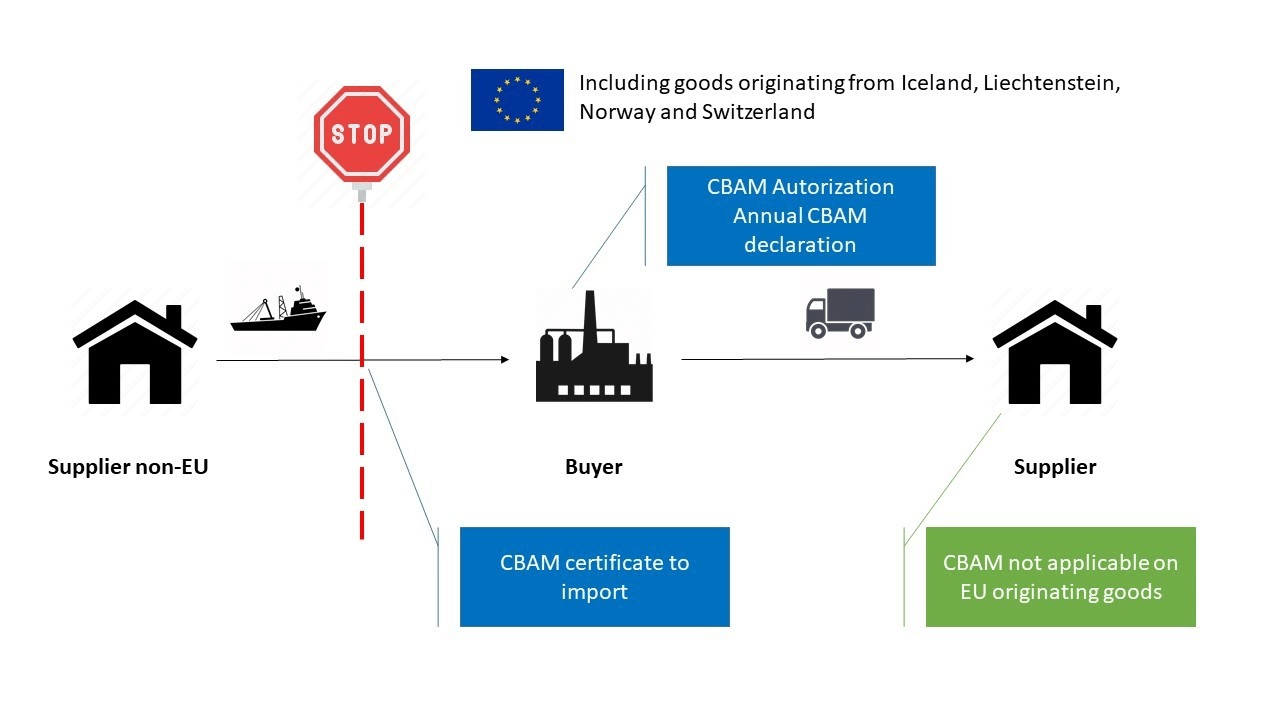
CBAM’s Contentious Provisions
1. Authorization Requirement
- Starting 2026, importers must obtain authorization to bring CBAM-covered goods into the EU.
2. Purchase of CBAM Certificates
- Importers must buy CBAM certificates to offset the embedded carbon emissions in their products.
3. Sectoral Expansion
- Currently applicable to a limited set of industries.
- By 2030, CBAM will cover more sectors, potentially impacting textiles, chemicals, electronics, plastics, and vehicles.
India’s Opposition to CBAM
1. Violation of Climate Agreements
- India argues CBAM contradicts the CBDR principle, which states that developed and developing nations have different responsibilities based on economic capabilities.
2. Trade Barrier Concerns
- CBAM is seen as a trade barrier, disproportionately affecting developing countries.
- Could nullify potential benefits of an India-EU FTA.
3. Economic Impact on Indian Exporters
- Indian exports of iron, steel, and aluminum could face a 20-35% tariff under CBAM.
- Textiles, chemicals, electronics, plastics, and vehicles—which form 32% of India’s exports to the EU—could be impacted in future CBAM expansions.
4. Challenges for MSMEs
- Micro, Small, and Medium Enterprises (MSMEs) may struggle with compliance due to CBAM’s requirement for over 1,000 data points.
- Privacy concerns arise as companies must disclose extensive data on emissions, raising issues of data security and trade secrecy.
Future Outlook: India’s Strategic Response
1. India’s Negotiation Strategy
- The Indian government is pushing for FTA concessions to counteract CBAM’s economic impact.
- Engaging in bilateral talks to seek exemptions or relaxations.
2. Potential Adjustments by the EU
- The EU has acknowledged India’s concerns and is open to discussions on CBAM implementation.
3. Global Response
More developing nations are expected to challenge CBAM at the WTO, making it a contentious global trade issue.
Download the PREPP App and attempt FREE IAS Exam Mock Tests and get complete study material!
*The article might have information for the previous academic years, please refer the official website of the exam.
How likely are you to recommend Prepp.in to a friend or a colleague?
Not so likely
Highly likely
UPSC CSE (IAS) 2027 Prelims Mock Test Series
Live Quizzes
Quizzes
Live Tests

• Live
Live Test : UPSC CSE Prelims CSAT (Paper-II) (Oct 08 - 11)
120 Minutes
80 Questions
200 Marks
English, Hindi
MEDIUM
Test will end in 05:29:52
Full Tests
Full Test - 04: UPSC CSE Prelims CSAT (Paper-II)
120 Minutes
80 Questions
200 Marks
English, Hindi
MEDIUM
Attempted by 19 aspirants in 12 hours
Full Test - 03: UPSC CSE Prelims CSAT (Paper-II)
120 Minutes
80 Questions
200 Marks
English, Hindi
MEDIUM
Attempted by 20 aspirants in 12 hours
Previous Year Papers
UPSC CSE Prelims 2026 GS Paper 1 Question Paper (24-May-2026)
120 Minutes
100 Questions
200 Marks
2,989 Attempted
English, Hindi
MEDIUM
Attempted by 12 aspirants in 12 hours
UPSC CSE Prelims 2026 CSAT Paper 2 Question Paper (24-May-2026)
120 Minutes
80 Questions
200 Marks
3,167 Attempted
English, Hindi
MEDIUM
Attempted by 13 aspirants in 12 hours
Videos

17 February 2025 | The Hindu Must Read Articles | Current Affairs
7,202 Views
•4
•7 months ago

16 February 2026 | The Hindu Must Read Articles | Current Affairs
6,962 Views
•4
•7 months ago

13 February 2026 | The Hindu Must Read Articles | Current Affairs
8,765 Views
•5
•7 months ago

12 February 2026 | The Hindu Must Read Articles | Current Affairs
5,788 Views
•4
•7 months ago






Also Check
IAS Exam Overview
IAS Exam Admit Card
IAS Exam Question Paper 2026
IAS Exam Mains Syllabus
IAS Exam Application Process
IAS Exam Eligibility
IAS Exam Result
IAS Exam Exam Pattern
IAS Exam CSAT Syllabus
IAS Exam Answer Key
IAS Exam Previous Year Paper
IAS Exam Current Affairs
IAS Exam Mains Question Paper
IAS Exam IAS Courses
IAS Exam UPSC Study Notes
IAS Exam Foundation Course 2024
IAS Exam Prelims Question Paper
IAS Exam Exam Center
IAS Exam Foundation Course 2025
IAS Exam Notification 2026
IAS Exam IAS Success Stories
IAS Exam Salary
IAS Exam Cutoff
IAS Exam Mock Tests
IAS Exam News


Comments