Eastern Maritime Corridor: Redefining India-Russia Trade Routes
Why in the News?
The Eastern Maritime Corridor (EMC) has made India the largest buyer of Russian oil, surpassing China.
What is the Eastern Maritime Corridor (EMC)?
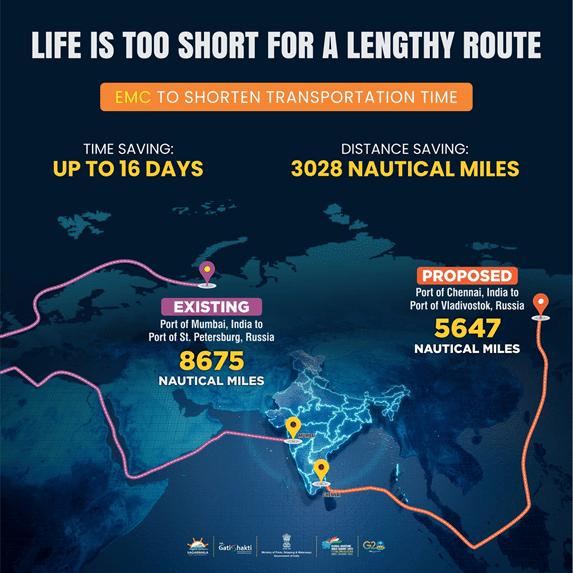
Route Overview: Spanning approximately 5,600 nautical miles, the EMC connects Chennai (India) to Vladivostok (Russia). This strategic route offers a faster, more efficient alternative to the traditional Mumbai-St. Petersburg pathway.
Strategic Importance: By reducing transit times and costs, the EMC boosts trade potential and strengthens economic ties between India and Russia.
Key Features of the EMC
- Faster Shipping: The EMC reduces transit times from over 40 days to just 24 days, saving 16 days compared to western routes.
- Diverse Cargo: Currently handles crude oil, coal, LNG, fertilizers, and containerized goods, with plans to include more commodities.
- Robust Port Network: Leveraging Indian ports like Chennai, Paradip, Visakhapatnam, Tuticorin, Ennore, and Kolkata to handle diverse cargo efficiently.
Economic Benefits of the EMC
- Cost Efficiency: Shorter transit times lead to lower shipping costs, enhancing the global competitiveness of goods.
- Stronger Bilateral Trade: Ensures seamless import of crude oil and export of processed minerals, tea, and other goods, bolstering India-Russia trade relations.
- Expanded Trade Opportunities: Facilitates the exchange of containerized cargo, agricultural products, and fertilizers, diversifying trade portfolios.
- Economic Synergy: Promotes energy security for India while supporting Russia’s export-driven economy.
Geopolitical Impact
- Strategic Partnership: Reduces Russia’s dependence on China by fostering closer ties with India.
- Diplomatic Leverage: Strengthens India’s position as a key trade partner for Russia amid global sanctions.
- Resilience in Crisis: Offers an alternative shipping route, enhancing reliability during regional conflicts or disruptions.
Top Commodities Traded via EMC
- India’s Imports: Crude oil, coal, fertilizers, vegetable oils, and iron and steel dominate imports.
- India’s Exports: Processed minerals, tea, marine products, granite, and processed fruits.
- Emerging Trends: Increased trade in containerized cargo, electronics, and agricultural products.
Challenges and Solutions
- Geopolitical Risks: Political uncertainties may disrupt trade; proactive diplomacy is essential.
- Infrastructure Gaps: Both nations need to modernize ports and logistics to maximize EMC potential.
- Regulatory Barriers: Streamlined trade policies are crucial for smoother operations.
- Seasonal Disruptions: Harsh Arctic and Far East weather conditions can delay shipments; better forecasting and scheduling are needed.
Future of the EMC
- Planned Expansions: India and Russia are working on additional phases and routes to enhance the EMC.
- Global Influence: The EMC is set to be a benchmark for sustainable and efficient maritime trade.
- Technological Advancements: Investments in digital tools, energy-efficient shipping, and modern port infrastructure will further improve operations.
- Trade Diversification: Unlocks new markets and promotes the exchange of a wider range of goods.
Download the PREPP App and attempt FREE IAS Exam Mock Tests and get complete study material!
*The article might have information for the previous academic years, please refer the official website of the exam.
How likely are you to recommend Prepp.in to a friend or a colleague?
Not so likely
Highly likely
UPSC CSE (IAS) 2027 Prelims Mock Test Series
Live Quizzes
Quizzes
Live Tests
Free
• Live
Live Test : UPSC IAS : GS - Indian Geography - Subject Knowledge Test
35 Minutes
30 Questions
60 Marks
English, Hindi
Test will end in 00:04:40

• Live
Live Test : UPSC CSE Prelims CSAT (Paper-II) (Oct 08 - 11)
120 Minutes
80 Questions
200 Marks
English, Hindi
MEDIUM
Test will end on 11th Oct, 07:00 PM
Full Tests
Full Test - 04: UPSC CSE Prelims CSAT (Paper-II)
120 Minutes
80 Questions
200 Marks
English, Hindi
MEDIUM
Attempted by 19 aspirants in 12 hours
Full Test - 03: UPSC CSE Prelims CSAT (Paper-II)
120 Minutes
80 Questions
200 Marks
English, Hindi
MEDIUM
Attempted by 21 aspirants in 12 hours
Previous Year Papers
UPSC CSE Prelims 2026 GS Paper 1 Question Paper (24-May-2026)
120 Minutes
100 Questions
200 Marks
2,971 Attempted
English, Hindi
MEDIUM
Attempted by 13 aspirants in 12 hours
UPSC CSE Prelims 2026 CSAT Paper 2 Question Paper (24-May-2026)
120 Minutes
80 Questions
200 Marks
3,147 Attempted
English, Hindi
MEDIUM
Attempted by 13 aspirants in 12 hours
Videos

17 February 2025 | The Hindu Must Read Articles | Current Affairs
7,202 Views
•4
•7 months ago

16 February 2026 | The Hindu Must Read Articles | Current Affairs
6,962 Views
•4
•7 months ago

13 February 2026 | The Hindu Must Read Articles | Current Affairs
8,765 Views
•5
•7 months ago

12 February 2026 | The Hindu Must Read Articles | Current Affairs
5,788 Views
•4
•7 months ago






Also Check
IAS Exam Overview
IAS Exam Admit Card
IAS Exam Question Paper 2026
IAS Exam Mains Syllabus
IAS Exam Application Process
IAS Exam Eligibility
IAS Exam Result
IAS Exam Exam Pattern
IAS Exam CSAT Syllabus
IAS Exam Answer Key
IAS Exam Previous Year Paper
IAS Exam Current Affairs
IAS Exam Mains Question Paper
IAS Exam IAS Courses
IAS Exam UPSC Study Notes
IAS Exam Foundation Course 2024
IAS Exam Prelims Question Paper
IAS Exam Exam Center
IAS Exam Foundation Course 2025
IAS Exam Notification 2026
IAS Exam IAS Success Stories
IAS Exam Salary
IAS Exam Cutoff
IAS Exam Mock Tests
IAS Exam News


Comments