Delimitation in India: Concerns, Challenges, and Possible Solutions
Why in the News?
Kerala Chief Minister Pinarayi Vijayan has extended his support to Tamil Nadu’s efforts to unite non-BJP-ruled states against the Union government’s proposed delimitation exercise. The primary concerns revolve around federalism, political representation, and the impact on states that have successfully implemented population control measures.
Background
Tamil Nadu recently held an all-party meeting to discuss the potential consequences of the upcoming delimitation exercise. Key issues raised include:
- Delimitation Based on the 1971 Census: Tamil Nadu seeks assurance from the Prime Minister that the delimitation process will be based on the 1971 Census figures and will remain valid for the next 30 years.
- Joint Action Committee Formation: The state proposes forming a committee of MPs and representatives from Southern states to coordinate a unified response against unfair delimitation policies.
Understanding Delimitation in India
-
What is Delimitation?
- Delimitation refers to the process of fixing the number of seats and redrawing parliamentary and state assembly constituency boundaries based on population data. This exercise ensures proportional representation in the legislature.
-
Who Conducts Delimitation?
- The Delimitation Commission, established through an Act of Parliament, is responsible for conducting this exercise.
-
History of Delimitation in India
- Previous delimitation exercises were conducted after the 1951, 1961, and 1971 Censuses. However, in 1976, the number of Lok Sabha seats was frozen at 543 to encourage population control measures. The upcoming delimitation will be based on the first Census conducted after 2026, raising concerns about political representation imbalances.
Major Concerns Regarding Delimitation
- Uneven Population Growth and Representation
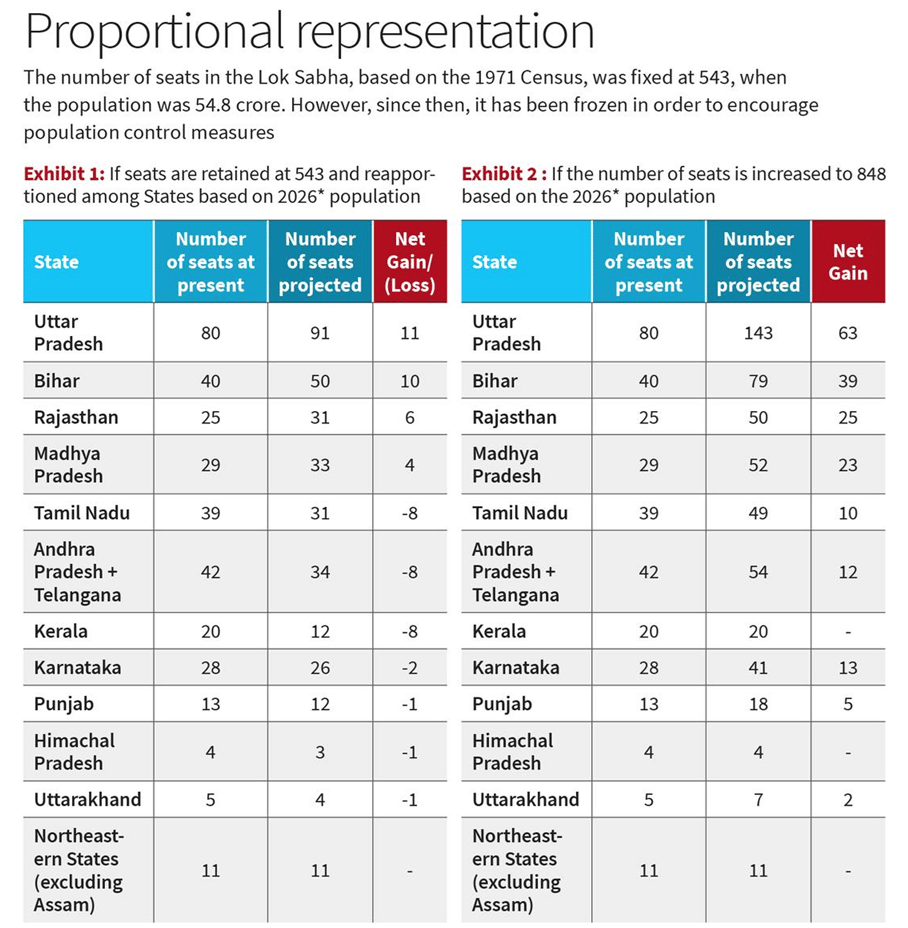
- Northern states like Uttar Pradesh, Bihar, Madhya Pradesh, and Rajasthan have witnessed higher population growth than Southern states such as Tamil Nadu, Kerala, Karnataka, and Andhra Pradesh. This disparity creates the following concerns:
- Disproportionate Representation: If seat distribution is adjusted based on updated population data, Southern states and smaller Northern states (e.g., Punjab, Himachal Pradesh, Uttarakhand) may lose political influence.
- Declining Seat Share for Southern States: Estimates suggest that Southern states could see a 5% decline in their representation, reducing their role in national decision-making.
- Violation of Federal Principles
- A population-based delimitation risks disproportionately benefiting high-growth states, contradicting the equitable representation principles of federalism.
-
Political Disenchantment
- States that have successfully controlled population growth may feel penalized, leading to regional dissatisfaction and political tensions.
Proposed Solutions for Balanced Delimitation
1. Maintain the Current Lok Sabha Seat Distribution
- Keeping the Lok Sabha seat count fixed at 543 can ensure balanced representation across states.
- The U.S. House of Representatives has followed a similar cap on seats since 1913, maintaining stable federal representation.
2. Expand State Legislative Assemblies
- Instead of altering Lok Sabha seats, state assemblies can be expanded to reflect population growth while preserving federal equity.
3. Reassess Representation Criteria
- Seat allocation should consider governance efficiency, economic contributions, and population control efforts, rather than just raw population numbers.
4. Foster Political Consensus
- National and regional parties must engage in collaborative discussions to ensure a fair delimitation process.
- The proposed Joint Action Committee can play a crucial role in advocating for an equitable solution.
Conclusion
The upcoming delimitation exercise has sparked significant debate on political representation, federal balance, and governance equity. Southern states, backed by Tamil Nadu and Kerala, are pushing for a census-based, fair, and balanced approach to ensure their voices are not diminished in the national political landscape. A well-thought-out solution, built on political consensus and fairness, is crucial for maintaining India’s democratic integrity and federal unity.
Download the PREPP App and attempt FREE IAS Exam Mock Tests and get complete study material!

Live Test : UPSC CSE Prelims CSAT (Paper-II) (Oct 08 - 11)
Full Test - 04: UPSC CSE Prelims CSAT (Paper-II)
Full Test - 03: UPSC CSE Prelims CSAT (Paper-II)
UPSC CSE Prelims 2026 GS Paper 1 Question Paper (24-May-2026)
UPSC CSE Prelims 2026 CSAT Paper 2 Question Paper (24-May-2026)

17 February 2025 | The Hindu Must Read Articles | Current Affairs

16 February 2026 | The Hindu Must Read Articles | Current Affairs

13 February 2026 | The Hindu Must Read Articles | Current Affairs









Comments