Dawei Port Project: A Strategic Investment in Southeast Asia
Why in the News?
Russia and Myanmar have signed a landmark memorandum on investment cooperation in the Dawei Special Economic Zone (SEZ), marking a significant step toward regional development. This agreement includes the construction of a deep-sea port, an oil refinery, and a coal-fired thermal power plant.
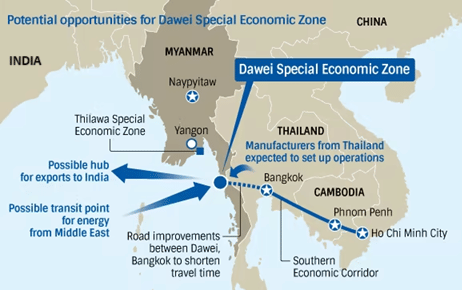
Key Highlights of the Dawei Port Project
1. Strategic Importance
- Strengthening Russia-Myanmar relations post-2021 military coup.
- Potential energy cooperation, including a gas pipeline to Yangon and a nuclear research reactor.
2. Project Location & Objective
- Situated in Dawei, Tanintharyi Region, Myanmar.
- Aims to become Southeast Asia’s largest industrial and trade hub, enhancing regional commerce.
3. Economic Benefits
- Boosts local businesses and generates employment.
- Facilitates regional trade and connectivity with India and Southeast Asia.
- Tax incentives: Investors enjoy income tax exemptions for the first 5–7 years, followed by reduced tax rates.
- Investor-friendly policies: Foreign businesses can own bank accounts, set product prices, and operate freely.
Historical Timeline & Construction Status
- 2008: Thailand and Myanmar sign an MoU to develop the Dawei SEZ.
- 2013: Project stalled due to funding issues, leading to the withdrawal of Italian-Thai Development PCL (ITD).
- 2015: Myanmar and Thailand revive the project with Japanese investment and technical support.
- 2024: New agreements signed with Russia and other international partners; construction is ongoing.
Challenges & Controversies
1. Land and Environmental Concerns
- Forced evictions and under-compensated land grabs affecting thousands of locals.
- Environmental risks, including industrial pollution and habitat destruction.
- Opposition from civil society groups like the Dawei Development Association (DDA) and Tavoyan Women’s Union (TWU).
2. Geopolitical Risks
- Myanmar’s political instability post-2021 coup makes foreign investment risky.
- Myanmar’s government denies allegations, claiming industries will be labor-intensive and eco-friendly.
Future Prospects
Regional Connectivity & Trade
- Dawei Port could become a key trade route linking Southeast Asia with South Asia and beyond.
- Offers India an alternative route to Southeast Asia, reducing dependence on the Malacca Strait and reinforcing the Act East Policy.
Energy & Industrial Growth
- Infrastructure plans include power plants, an oil refinery, and technology zones.
- Potential to transform Dawei into Myanmar’s economic powerhouse.
Conclusion
The Dawei Port Project presents significant economic opportunities but also faces environmental and geopolitical challenges. If successfully completed, it will serve as a key driver of trade and industrial growth in Southeast Asia.
Download the PREPP App and attempt FREE IAS Exam Mock Tests and get complete study material!
*The article might have information for the previous academic years, please refer the official website of the exam.
How likely are you to recommend Prepp.in to a friend or a colleague?
Not so likely
Highly likely
UPSC CSE (IAS) 2027 Prelims Mock Test Series
Live Quizzes
Quizzes
Live Tests

• Live
Live Test : UPSC CSE Prelims CSAT (Paper-II) (Oct 08 - 11)
120 Minutes
80 Questions
200 Marks
English, Hindi
MEDIUM
Test will end in 12:06:47
Full Tests
Full Test - 04: UPSC CSE Prelims CSAT (Paper-II)
120 Minutes
80 Questions
200 Marks
English, Hindi
MEDIUM
Attempted by 18 aspirants in 12 hours
Full Test - 03: UPSC CSE Prelims CSAT (Paper-II)
120 Minutes
80 Questions
200 Marks
English, Hindi
MEDIUM
Attempted by 20 aspirants in 12 hours
Previous Year Papers
UPSC CSE Prelims 2026 GS Paper 1 Question Paper (24-May-2026)
120 Minutes
100 Questions
200 Marks
2,983 Attempted
English, Hindi
MEDIUM
Attempted by 12 aspirants in 12 hours
UPSC CSE Prelims 2026 CSAT Paper 2 Question Paper (24-May-2026)
120 Minutes
80 Questions
200 Marks
3,161 Attempted
English, Hindi
MEDIUM
Attempted by 13 aspirants in 12 hours
Videos

17 February 2025 | The Hindu Must Read Articles | Current Affairs
7,202 Views
•4
•7 months ago

16 February 2026 | The Hindu Must Read Articles | Current Affairs
6,962 Views
•4
•7 months ago

13 February 2026 | The Hindu Must Read Articles | Current Affairs
8,765 Views
•5
•7 months ago

12 February 2026 | The Hindu Must Read Articles | Current Affairs
5,788 Views
•4
•7 months ago






Also Check
IAS Exam Overview
IAS Exam Admit Card
IAS Exam Question Paper 2026
IAS Exam Mains Syllabus
IAS Exam Application Process
IAS Exam Eligibility
IAS Exam Result
IAS Exam Exam Pattern
IAS Exam CSAT Syllabus
IAS Exam Answer Key
IAS Exam Previous Year Paper
IAS Exam Current Affairs
IAS Exam Mains Question Paper
IAS Exam IAS Courses
IAS Exam UPSC Study Notes
IAS Exam Foundation Course 2024
IAS Exam Prelims Question Paper
IAS Exam Exam Center
IAS Exam Foundation Course 2025
IAS Exam Notification 2026
IAS Exam IAS Success Stories
IAS Exam Salary
IAS Exam Cutoff
IAS Exam Mock Tests
IAS Exam News


Comments