Copernicus Programme
Why in news?
The third Copernicus Sentinel-1 satellite was launched aboard a Vega-C rocket from Europe’s Spaceport in French Guiana.
About Copernicus Programme
- Purpose and Scope:
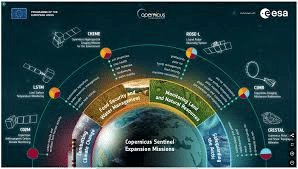
- The Copernicus Programme is the Earth observation arm of the European Union’s Space Programme.
- It aims to deploy 20 satellites by 2030 to offer services based on satellite Earth observation and in-situ data (non-space data).
![upscca]()
- Key Partners: Key partners include the European Commission, European Space Agency (ESA), EUMETSAT, ECMWF, GSA, EU member states, national space agencies, and research organizations.
- Data Collection Sources:
- The programme uses a multi-source system, comprising:
- Sentinel Earth Observation Satellites
- In-situ sensors (e.g., ground stations)
- Airborne and sea-borne sensors
- The programme uses a multi-source system, comprising:
- Free and Open Access: The data collected is freely accessible and processed into near-real-time information for global users.
- Sentinel Satellites:
- Sentinel-1A (launched in 2014) marked the start of the satellite constellation.
- Future satellites, like Sentinel-1C, are designed to monitor Earth’s environment, support scientific research, and track maritime traffic.
- Six Thematic Areas:
- Atmosphere: Monitoring air quality and climate change.
- Marine: Observation of oceans, seas, and coastal regions.
- Land: Monitoring land use, agriculture, and vegetation.
- Climate: Long-term climate monitoring and forecasting.
- Emergency Response: Disaster management and crisis response.
- Security: Surveillance of borders and illegal activities.
- Collaboration and Funding: Managed by the European Commission, the programme operates in collaboration with the European Space Agency (ESA) and other EU agencies, ensuring efficient satellite operations and data services.
- Future Developments: By 2030, the Copernicus Programme aims to have a complete fleet of Earth observation satellites, ensuring continuous and comprehensive monitoring of Earth, providing reliable data to global users.
Download the PREPP App and attempt FREE IAS Exam Mock Tests and get complete study material!
*The article might have information for the previous academic years, please refer the official website of the exam.
How likely are you to recommend Prepp.in to a friend or a colleague?
Not so likely
Highly likely
UPSC CSE (IAS) 2027 Prelims Mock Test Series
Live Quizzes
Quizzes
Live Tests

• Live
Live Test : UPSC CSE Prelims CSAT (Paper-II) (Oct 08 - 11)
120 Minutes
80 Questions
200 Marks
English, Hindi
MEDIUM
Test will end in 05:31:43
Full Tests
Full Test - 04: UPSC CSE Prelims CSAT (Paper-II)
120 Minutes
80 Questions
200 Marks
English, Hindi
MEDIUM
Attempted by 19 aspirants in 12 hours
Full Test - 03: UPSC CSE Prelims CSAT (Paper-II)
120 Minutes
80 Questions
200 Marks
English, Hindi
MEDIUM
Attempted by 20 aspirants in 12 hours
Previous Year Papers
UPSC CSE Prelims 2026 GS Paper 1 Question Paper (24-May-2026)
120 Minutes
100 Questions
200 Marks
2,989 Attempted
English, Hindi
MEDIUM
Attempted by 12 aspirants in 12 hours
UPSC CSE Prelims 2026 CSAT Paper 2 Question Paper (24-May-2026)
120 Minutes
80 Questions
200 Marks
3,167 Attempted
English, Hindi
MEDIUM
Attempted by 13 aspirants in 12 hours
Videos

17 February 2025 | The Hindu Must Read Articles | Current Affairs
7,202 Views
•4
•7 months ago

16 February 2026 | The Hindu Must Read Articles | Current Affairs
6,962 Views
•4
•7 months ago

13 February 2026 | The Hindu Must Read Articles | Current Affairs
8,765 Views
•5
•7 months ago

12 February 2026 | The Hindu Must Read Articles | Current Affairs
5,788 Views
•4
•7 months ago






Also Check
IAS Exam Overview
IAS Exam Admit Card
IAS Exam Question Paper 2026
IAS Exam Mains Syllabus
IAS Exam Application Process
IAS Exam Eligibility
IAS Exam Result
IAS Exam Exam Pattern
IAS Exam CSAT Syllabus
IAS Exam Answer Key
IAS Exam Previous Year Paper
IAS Exam Current Affairs
IAS Exam Mains Question Paper
IAS Exam IAS Courses
IAS Exam UPSC Study Notes
IAS Exam Foundation Course 2024
IAS Exam Prelims Question Paper
IAS Exam Exam Center
IAS Exam Foundation Course 2025
IAS Exam Notification 2026
IAS Exam IAS Success Stories
IAS Exam Salary
IAS Exam Cutoff
IAS Exam Mock Tests
IAS Exam News


Comments