Calyptocephalella gayi: The Helmeted Water Toad
Why in the News?
The Helmeted Water Toad (Calyptocephalella gayi), also known as the Chilean Helmeted Bull Frog or Wide-Mouthed Toad, is facing severe threats from climate change, habitat destruction, and human activities.
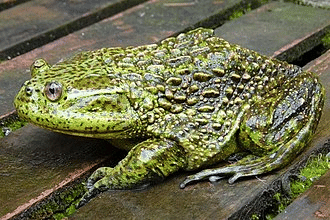
About Calyptocephalella gayi
- Scientific Name: Calyptocephalella gayi
- Common Names: Helmeted Water Toad, Chilean Helmeted Bull Frog, Wide-Mouthed Toad
- Unique Trait: Among the largest frogs in the world.
Habitat and Distribution
- Preferred Habitat: Deep ponds, reservoirs, and wetlands with cooler waters.
- Geographical Range: Native to central Chile, from Coquimbo in the north to Chiloé Island in the south.
Characteristics and Behavior
- Physical Features:
- Broad head and large mouth.
- It grows up to 32 cm (12.6 inches) in females and can weigh up to 1.3 kg (2.9 lbs).
- Coloration ranges from yellow, green, and brown to gray as they age.
- Behavior: Exhibits aggressive behavior toward predators.
- Evolutionary Significance:
- Dubbed a "living fossil" for its ancient lineage.
- Survived alongside dinosaurs and persisted through mass extinctions, showing minimal genetic variation over millions of years.
Threats to Survival
- Climate Change:
- Warming temperatures and increased droughts are diminishing their aquatic habitats.
- Habitat Destruction:
- Urbanization, pollution, and poor water management contribute to habitat loss.
- Invasive Species:
- Predation and competition from non-native species like trout and African clawed frogs.
- Disease:
- Highly vulnerable to chytridiomycosis, a lethal fungal infection devastating amphibian populations globally.
Conservation Status
- IUCN Red List: Vulnerable.
- CITES Listing: Included in Appendix III, regulating international trade to prevent overexploitation.
Why Conservation Matters
Preserving Calyptocephalella gayi is critical for maintaining ecological balance in Chilean freshwater ecosystems. Its ancient lineage serves as a reminder of Earth's evolutionary history, and its decline signals broader environmental challenges.
Download the PREPP App and attempt FREE IAS Exam Mock Tests and get complete study material!
*The article might have information for the previous academic years, please refer the official website of the exam.
How likely are you to recommend Prepp.in to a friend or a colleague?
Not so likely
Highly likely
UPSC CSE (IAS) 2027 Prelims Mock Test Series
Live Quizzes
Quizzes
Live Tests

• Live
Live Test : UPSC CSE Prelims CSAT (Paper-II) (Oct 08 - 11)
120 Minutes
80 Questions
200 Marks
English, Hindi
MEDIUM
Test will end in 18:57:14
Full Tests
Full Test - 04: UPSC CSE Prelims CSAT (Paper-II)
120 Minutes
80 Questions
200 Marks
English, Hindi
MEDIUM
Attempted by 17 aspirants in 12 hours
Full Test - 03: UPSC CSE Prelims CSAT (Paper-II)
120 Minutes
80 Questions
200 Marks
English, Hindi
MEDIUM
Attempted by 19 aspirants in 12 hours
Previous Year Papers
UPSC CSE Prelims 2026 GS Paper 1 Question Paper (24-May-2026)
120 Minutes
100 Questions
200 Marks
2,976 Attempted
English, Hindi
MEDIUM
Attempted by 12 aspirants in 12 hours
UPSC CSE Prelims 2026 CSAT Paper 2 Question Paper (24-May-2026)
120 Minutes
80 Questions
200 Marks
3,154 Attempted
English, Hindi
MEDIUM
Attempted by 12 aspirants in 12 hours
Videos

17 February 2025 | The Hindu Must Read Articles | Current Affairs
7,202 Views
•4
•7 months ago

16 February 2026 | The Hindu Must Read Articles | Current Affairs
6,962 Views
•4
•7 months ago

13 February 2026 | The Hindu Must Read Articles | Current Affairs
8,765 Views
•5
•7 months ago

12 February 2026 | The Hindu Must Read Articles | Current Affairs
5,788 Views
•4
•7 months ago






Also Check
IAS Exam Overview
IAS Exam Admit Card
IAS Exam Question Paper 2026
IAS Exam Mains Syllabus
IAS Exam Application Process
IAS Exam Eligibility
IAS Exam Result
IAS Exam Exam Pattern
IAS Exam CSAT Syllabus
IAS Exam Answer Key
IAS Exam Previous Year Paper
IAS Exam Current Affairs
IAS Exam Mains Question Paper
IAS Exam IAS Courses
IAS Exam UPSC Study Notes
IAS Exam Foundation Course 2024
IAS Exam Prelims Question Paper
IAS Exam Exam Center
IAS Exam Foundation Course 2025
IAS Exam Notification 2026
IAS Exam IAS Success Stories
IAS Exam Salary
IAS Exam Cutoff
IAS Exam Mock Tests
IAS Exam News


Comments