Bose Metal: A Revolutionary Quantum State in Condensed Matter Physics
Why in the News?
A team of researchers from China and Japan has recently provided compelling evidence of a Bose metal in atomically thin films of niobium diselenide (NbSe2). Their findings, published in Physical Review Letters, challenge existing theories in condensed matter physics.
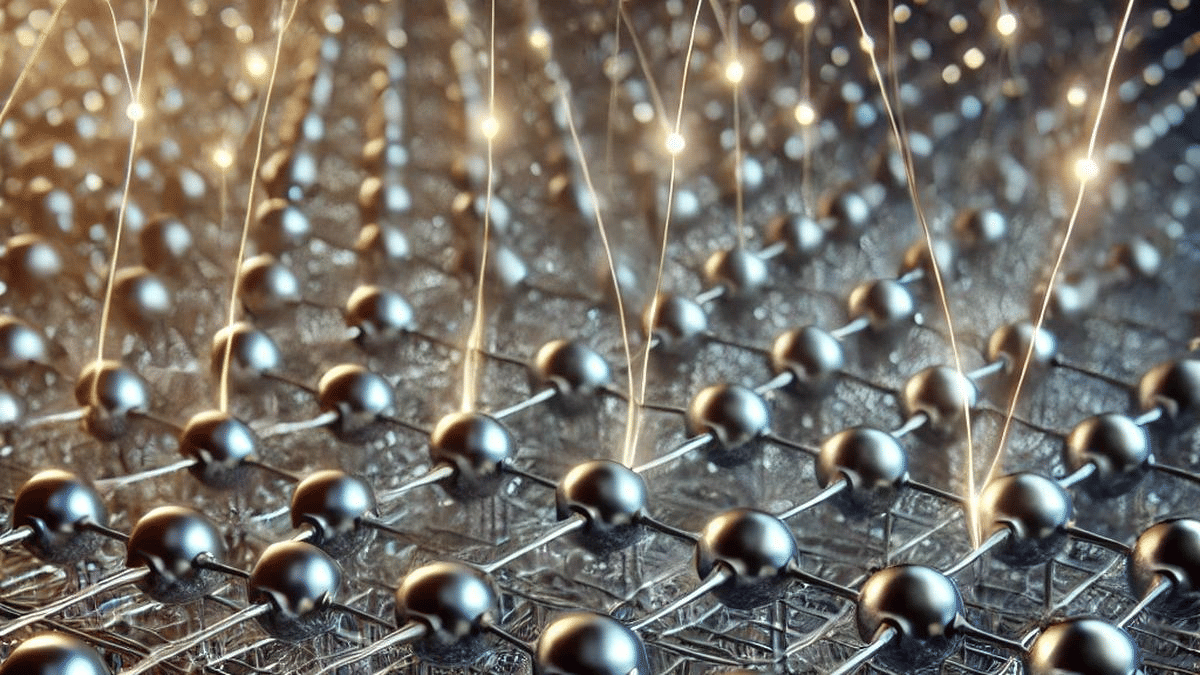
What is a Bose Metal?
A Bose metal is a unique quantum state exhibiting properties distinct from both superconductors and insulators at extremely low temperatures.
Key Characteristics of a Bose Metal
- Intermediate Conductivity: Unlike conventional metals, which transition to either superconductors (infinite conductivity) or insulators (zero conductivity) at low temperatures, a Bose metal maintains an intermediate level of conductivity.
- Anomalous Metallic State (AMS): In this state, Cooper pairs form but do not condense into a superconducting phase, resulting in finite electrical resistance.
- Different from Regular Metals: Unlike ordinary metals where individual electrons conduct electricity, in a Bose metal, paired electrons (Cooper pairs) act as charge carriers without achieving full superconducting coherence.
How is a Bose Metal Formed?
Several factors contribute to the emergence of a Bose metal state:
- Temperature Dependence: At extremely low temperatures, Cooper pairs appear but fail to transition into a superconducting state.
- Magnetic Field Influence: In type-II superconductors like NbSe2, a strong magnetic field suppresses superconductivity, giving rise to an anomalous metallic state resembling a Bose metal.
- Dimensionality Effect: The Bose metal phase is more prominent in two-dimensional (2D) materials, where quantum fluctuations disrupt superconducting coherence.
Significance of Bose Metal Discovery
1. Challenges Existing Theories
Traditional condensed matter physics suggests that materials at absolute zero should be either superconductors or insulators. The existence of a Bose metal challenges this binary classification, prompting a reevaluation of fundamental theories.
2. Insights into Quantum Fluctuations
Bose metals provide a deeper understanding of quantum fluctuations, which influence superconductivity and electrical resistance in low-dimensional materials.
3. Potential Technological Applications
Harnessing the properties of Bose metals could lead to advancements in highly efficient electronic devices and quantum computing.
The Legacy of Satyendra Nath Bose
The concept of Bose metals is deeply rooted in the groundbreaking work of Satyendra Nath Bose, an Indian physicist known for:
- Bose-Einstein Statistics: Developed in collaboration with Albert Einstein, these statistics describe the behavior of bosons—particles that can occupy the same quantum state.
- Foundation for Superconductivity: The theory behind Bose metals builds upon Bose’s work, as Cooper pairs in superconductors follow Bose-Einstein statistics.
- Inspiration for Quantum Research: Bose’s contributions laid the foundation for advancements in quantum mechanics, superconductivity, and Bose-Einstein condensates.
Conclusion
The recent discovery of a Bose metal in NbSe2 marks a significant breakthrough in condensed matter physics. As researchers continue exploring this quantum state, it could pave the way for next-generation superconducting technologies and quantum computing innovations.
By deepening our understanding of quantum fluctuations and low-temperature conductivity, Bose metals hold immense promise for future scientific and technological advancements.
Download the PREPP App and attempt FREE IAS Exam Mock Tests and get complete study material!
Live Test : UPSC IAS : GS - Indian Geography - Subject Knowledge Test

Live Test : UPSC CSE Prelims CSAT (Paper-II) (Oct 08 - 11)
Full Test - 04: UPSC CSE Prelims CSAT (Paper-II)
Full Test - 03: UPSC CSE Prelims CSAT (Paper-II)
UPSC CSE Prelims 2026 GS Paper 1 Question Paper (24-May-2026)
UPSC CSE Prelims 2026 CSAT Paper 2 Question Paper (24-May-2026)

17 February 2025 | The Hindu Must Read Articles | Current Affairs

16 February 2026 | The Hindu Must Read Articles | Current Affairs

13 February 2026 | The Hindu Must Read Articles | Current Affairs









Comments