Atmanirbhar Clean Plant Programme: Enhancing Horticulture Productivity in India
Why in the News?
India has signed a $98 million loan agreement with the Asian Development Bank (ADB) to boost horticulture crop productivity by providing farmers access to certified, disease-free planting materials. This initiative is part of the government’s Atmanirbhar Clean Plant Programme (CPP) and aligns with its vision for self-reliance in agriculture.
What is the Atmanirbhar Clean Plant Programme?
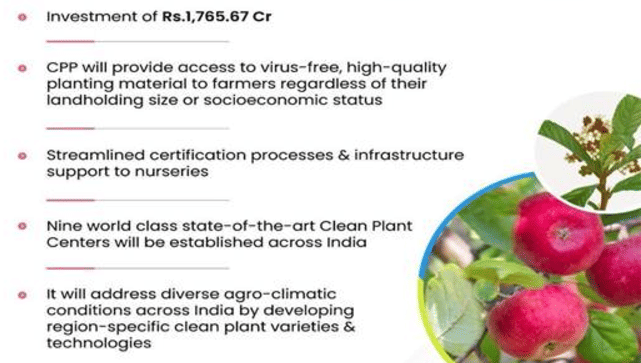
The Atmanirbhar Clean Plant Programme aims to revolutionize India’s horticulture sector by ensuring access to high-quality, virus-free planting materials. Here’s a breakdown of its key features:
- Objective:
Improve crop yield and resilience by providing farmers with superior planting materials free from viruses and diseases.
- Clean Plant Centers (CPCs):
Establishing state-of-the-art Clean Plant Centers equipped with advanced diagnostic tools for disease detection and tissue culture labs to produce clean planting materials.
- Certification System:
A robust certification framework under the Seeds Act of 1966 will ensure quality and traceability for nurseries and planting materials.
- Sustainability Focus:
Strengthening the nursery sector with infrastructure support and large-scale production of clean planting materials.
- Boost to Exports:
Enhanced crop quality will improve India’s competitiveness in the global market, opening doors to international fruit trade opportunities.
- Alignment with Existing Schemes:
CPP complements the Mission for Integrated Development of Horticulture (MIDH), promoting holistic growth in the sector.
Benefits of the Atmanirbhar Clean Plant Programme
- Enhanced Productivity:
Farmers will experience improved yields and reduced losses due to diseases.
- Sustainability:
Long-term benefits include resilient crops, reduced dependency on pesticides, and a strengthened nursery infrastructure.
- Economic Growth:
By boosting exports, India can secure a stronger foothold in the global horticulture market.
Role of the Asian Development Bank (ADB)
The Asian Development Bank (ADB) plays a pivotal role in funding this transformative program.
- Established in 1966, ADB supports economic and social development across Asia.
- Focuses on key areas like clean energy, sustainable infrastructure, financial inclusion, and climate resilience.
- With 68 member countries, it provides loans, grants, and technical assistance to drive sustainable growth in agriculture and other sectors.
- Headquarters: Philippines.
Conclusion
The Atmanirbhar Clean Plant Programme is a significant step toward transforming India’s horticulture sector. By fostering innovation, improving crop quality, and boosting exports, this initiative aligns with India’s vision of self-reliance and sustainability. Supported by the Asian Development Bank, the CPP promises long-term benefits for farmers, consumers, and the global horticulture market.
Download the PREPP App and attempt FREE IAS Exam Mock Tests and get complete study material!

Live Test : UPSC CSE Prelims CSAT (Paper-II) (Oct 08 - 11)
Full Test - 04: UPSC CSE Prelims CSAT (Paper-II)
Full Test - 03: UPSC CSE Prelims CSAT (Paper-II)
UPSC CSE Prelims 2026 GS Paper 1 Question Paper (24-May-2026)
UPSC CSE Prelims 2026 CSAT Paper 2 Question Paper (24-May-2026)

17 February 2025 | The Hindu Must Read Articles | Current Affairs

16 February 2026 | The Hindu Must Read Articles | Current Affairs

13 February 2026 | The Hindu Must Read Articles | Current Affairs









Comments