AI-Based Warfare: Revolutionizing Modern Defense Strategies
Why in the News?
Defense Minister Rajnath Singh recently highlighted the emergence of unconventional warfare methods, particularly AI-based warfare, as significant challenges for national security during his address at the Army War College.
What is AI-Based Warfare?
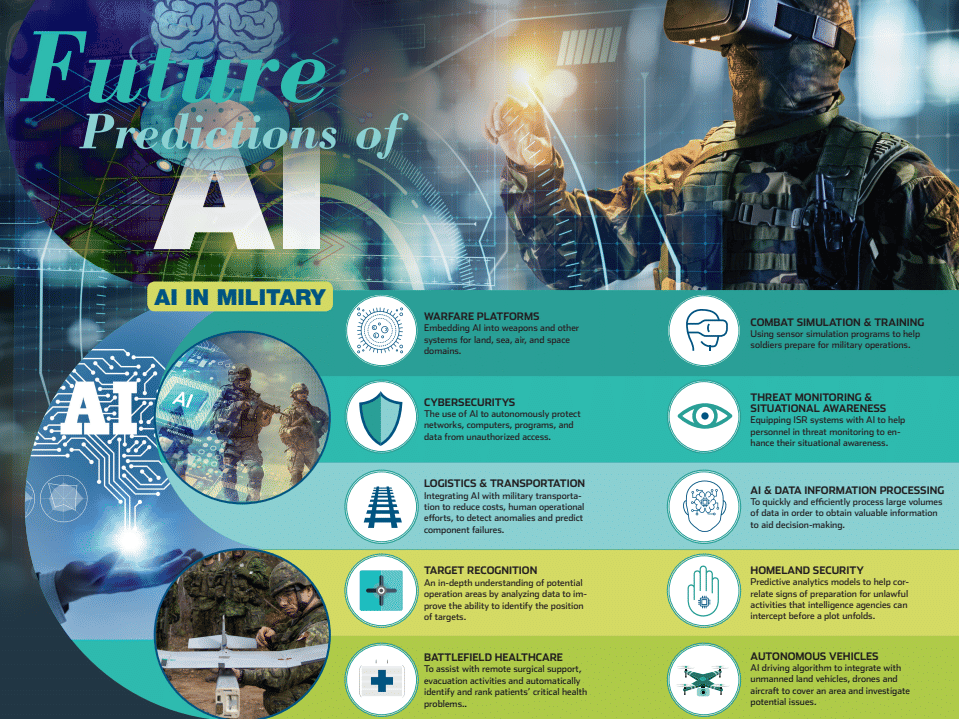
AI-based warfare refers to integrating artificial intelligence technologies into military operations for enhanced strategy, intelligence gathering, surveillance, and autonomous combat systems.
Core Technologies Involved:
- Machine Learning Algorithms: For pattern recognition, data analysis, and decision-making.
- Natural Language Processing (NLP): Facilitates language translation, intelligence analysis, and communication.
- Enhanced Recognition: Identifies objects, vehicles, and individuals in images and video footage.
- Autonomous Systems: Includes drones, unmanned vehicles, and robotic soldiers capable of executing tasks with minimal human intervention.
- Cybersecurity Applications: Protects military systems from cyber threats.
- Big Data Analytics: Processes large datasets for actionable intelligence.
- Satellite Technology Integration: Improves surveillance, reconnaissance, and communication capabilities.
A Brief History of AI in Warfare
Early Developments:
- Cold War Beginnings: AI was first explored for cryptographic analysis and simulations.
- 1980s Expert Systems: Focused on logistics and decision-making.
Evolution Over the Decades:
- 1990s: AI-enabled precision in missile guidance systems.
- 2000s: Enhanced battlefield surveillance and intelligence analysis.
- Post-2010: Emergence of autonomous drones and combat vehicles with AI functionalities.
Recent Examples of AI in Warfare
Israel-Gaza Conflict:
- The Gospel: AI program to predict civilian casualties and optimize targeting decisions.
- The Alchemist: Predicts battlefield dynamics and recommends strategies.
Russia-Ukraine War:
- Facial recognition tools for intelligence and combatant identification.
- Autonomous drones for reconnaissance and targeted strikes.
US Military Initiatives:
- Project Maven: AI-driven video analysis for threat identification.
- Satellite imagery analysis for strategic planning.
China's Advancements:
- Deployment of autonomous drones and surveillance AI in contested regions under its "intelligized warfare" strategy.
Benefits of AI in Warfare
- Enhanced Decision-Making: Rapid data analysis for informed strategies.
- Improved Accuracy: Precision targeting minimizes collateral damage.
- Operational Efficiency: Streamlines logistics and resource allocation.
- Force Multiplier: Autonomous systems perform tasks requiring significant manpower.
- Increased Soldier Safety: Reduces human exposure in dangerous scenarios.
- Predictive Capabilities: Real-time threat forecasting based on trend analysis.
Concerns Surrounding AI in Warfare
Technical Challenges:
- Algorithm Bias: Errors in datasets can skew AI decision-making.
- Reliability Issues: System malfunctions may cause unintended outcomes.
- Cybersecurity Risks: Vulnerabilities to hacking and sabotage.
Ethical Concerns:
- Accountability: Challenges in attributing responsibility for AI-driven actions.
- Lack of Oversight: Fully autonomous systems remove human control.
- Potential Misuse: Risks of oppressive surveillance or targeting civilians.
Strategic Implications:
- Arms Race: Global competition in military AI development could destabilize security.
- Conflict Escalation: Unpredictable actions by autonomous systems may worsen conflicts.
Global Response and Conventions
United Nations Initiatives:
- Discussions on Lethal Autonomous Weapon Systems (LAWS) since 2019.
- Reports addressing ethical and operational challenges of autonomous weapons.
REAIM Summits:
- Focused on responsible AI use in military operations.
- Key summits: 2023 in The Hague and 2024 in Seoul.
NATO Guidelines:
- Principles emphasizing safety, accountability, and compliance with international laws.
US-China Dialogues:
- Bilateral discussions on responsible AI usage, especially regarding nuclear deterrence.
India's Position on AI in Warfare
Current Approach:
- Observing global developments while maintaining cautious engagement in AI arms control.
National Initiatives:
- DRDO Efforts: Development of AI tools for surveillance and logistics.
- Startup Collaborations: Partnerships with private firms for innovative military AI solutions.
Challenges:
- Technological Gaps: India lags behind global leaders like the US and China in AI capabilities.
- Policy Gaps: Absence of comprehensive frameworks for military AI governance.
- Ethical Dilemmas: Balancing advancements with civilian safety concerns.
- Regional Security Risks: Potential AI arms race with neighboring nations.
Way Forward for India
- Invest in AI R&D:
- Increase funding and establish dedicated centers for AI in defense.
- Forge Strategic Partnerships:
- Collaborate with global allies and participate in multilateral forums like REAIM.
- Adopt Ethical Frameworks:
- Create national guidelines ensuring human oversight in AI-driven military decisions.
- Build Capacity:
- Train defense personnel and foster academia-industry partnerships for skill development.
- Regional Collaboration:
- Engage in dialogues to prevent an AI arms race in South Asia.
- Strengthen Cybersecurity:
- Implement robust systems to secure AI technologies against threats.
- Proactive Policy Making:
- Formulate a national AI strategy aligned with defense and geopolitical goals.
Conclusion
AI-based warfare is reshaping the global defense landscape, offering unparalleled advantages while posing significant challenges. India’s strategic focus on ethical AI use, technological advancement, and international collaboration can ensure its readiness to navigate the complexities of this new era of warfare.
Download the PREPP App and attempt FREE IAS Exam Mock Tests and get complete study material!

Live Test : UPSC CSE Prelims CSAT (Paper-II) (Oct 08 - 11)
Full Test - 04: UPSC CSE Prelims CSAT (Paper-II)
Full Test - 03: UPSC CSE Prelims CSAT (Paper-II)
UPSC CSE Prelims 2026 GS Paper 1 Question Paper (24-May-2026)
UPSC CSE Prelims 2026 CSAT Paper 2 Question Paper (24-May-2026)

17 February 2025 | The Hindu Must Read Articles | Current Affairs

16 February 2026 | The Hindu Must Read Articles | Current Affairs

13 February 2026 | The Hindu Must Read Articles | Current Affairs









Comments