African Wildcat Rescue: Conservation Challenges and Key Facts
Why in the News?
The Border Security Force (BSF) recently thwarted an attempt to smuggle an African Wildcat in Nadia district, West Bengal. This highlights ongoing threats to this elusive species, which is often targeted in illegal wildlife trade.
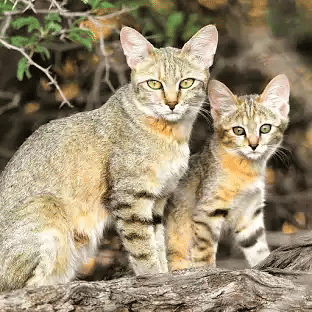
About the African Wildcat
Scientific Name: Felis lybica
The African Wildcat is widely regarded as the ancestral species of today’s domestic cats. Its evolutionary importance underscores the need for its protection.
Habitat and Distribution
- Habitat: The African Wildcat thrives in a variety of environments, including deserts, savannas, shrublands, grasslands, and rugged terrains.
- Geographical Range: It is native to Africa, West and Central Asia, and extends to parts of India (Rajasthan) and China (Xinjiang).
Characteristics and Behavior
- Physical Features: This species is characterized by light sandy grey fur with pale yellow or reddish hues, striped patterns on the sides and face, a cylindrical tail, small ear tufts, and prominent darker stripes along its back and limbs.
- Behavioral Traits: A primarily nocturnal hunter, the African Wildcat preys on rodents, birds, reptiles, and insects. When threatened, it uses intimidation tactics such as raising its fur to appear larger and more formidable.
Threats to Survival
The African Wildcat faces numerous challenges:
- Habitat Loss: Human activities, including agriculture and urbanization, are encroaching on its natural habitats.
- Hybridization: Crossbreeding with domestic cats leads to "genetic pollution," jeopardizing the species’ genetic purity.
- Exploitation: Hunting and trapping for fur and involvement in the illegal wildlife trade further endanger the species.
Conservation Status
- IUCN Red List: Least Concern — Despite its wide distribution and adaptability, localized threats necessitate ongoing monitoring.
- CITES Listing: Appendix II — This designation aims to regulate trade and ensure sustainable management of the species.
Conclusion
Efforts like the BSF’s recent rescue operation are crucial for the survival of the African Wildcat. Public awareness, habitat conservation, and stricter regulations on wildlife trade are essential steps to protect this remarkable species.
Download the PREPP App and attempt FREE IAS Exam Mock Tests and get complete study material!

Live Test : UPSC CSE Prelims CSAT (Paper-II) (Oct 08 - 11)
Full Test - 04: UPSC CSE Prelims CSAT (Paper-II)
Full Test - 03: UPSC CSE Prelims CSAT (Paper-II)
UPSC CSE Prelims 2026 GS Paper 1 Question Paper (24-May-2026)
UPSC CSE Prelims 2026 CSAT Paper 2 Question Paper (24-May-2026)

17 February 2025 | The Hindu Must Read Articles | Current Affairs

16 February 2026 | The Hindu Must Read Articles | Current Affairs

13 February 2026 | The Hindu Must Read Articles | Current Affairs









Comments