A Comprehensive Overview of GM Crops and Recent Regulatory Amendments
Why in the News?
The Union Ministry of Environment, Forest and Climate Change (MoEF&CC) has revised the rules for selecting experts for the Genetic Engineering Appraisal Committee (GEAC), India’s apex body for regulating genetically modified (GM) crops. These amendments aim to enhance transparency, address conflicts of interest, and align with the Supreme Court’s directives to ensure fair and impartial decision-making.
Key Amendments to GEAC Expert Selection Rules
Conflict of Interest Disclosure
- Expert members must disclose any direct or indirect conflicts of interest.
- Members with conflicts must recuse themselves from decision-making unless explicitly requested by the committee.
Transparency Measures
- All members are required to submit a detailed record of their professional affiliations over the past 10 years to ensure accountability.
Participation Restrictions
- Experts with conflicts of interest must report them before meetings and take necessary measures to avoid influencing GEAC decisions.
Significance
Enhanced Governance
- These changes strengthen the regulatory process for genetically modified organisms (GMOs), ensuring unbiased evaluations.
Supreme Court Compliance
- The amendments align with the Supreme Court’s 2023 directive to address conflict of interest concerns, fostering public trust in GEAC’s decision-making process.
Improved Operational Integrity
- Emphasis on transparency ensures scientific appraisals and policy decisions remain free from external influence.
Genetic Engineering Appraisal Committee (GEAC)
Status and Functions
- Status: Statutory body under the "Rules, 1989" of the Environment (Protection) Act, 1986.
- Functions:
- Regulates the use, manufacture, storage, import, and export of genetically engineered organisms and hazardous microbes.
- Appraises large-scale use of hazardous microbes and recombinants for environmental safety.
- Reviews and approves the release of genetically engineered organisms and field trials.
- Assesses modified organisms in high-risk categories for research and industrial use.
- Grants mandatory approvals for commercial use of GM organisms.
- Takes punitive action for violations under the Environment (Protection) Act.
Composition
- Chaired by the Special Secretary/Additional Secretary of MoEF&CC.
- Co-chaired by a representative from the Department of Biotechnology.
- Members include experts from ICAR, ICMR, CCMB, and other key institutions.
Understanding Genetically Modified (GM) Crops
Definition
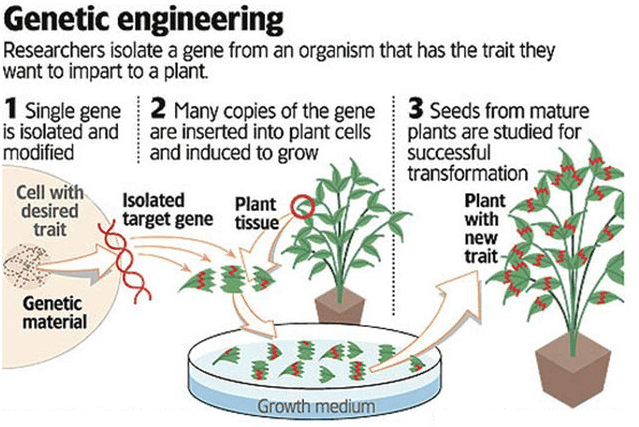
- GM crops are plants whose DNA has been altered using genetic engineering techniques to introduce desirable traits like pest resistance, herbicide tolerance, and improved nutritional content.
Examples
- Cotton (widely grown GM crop), soybean, maize, canola, and Golden Rice.
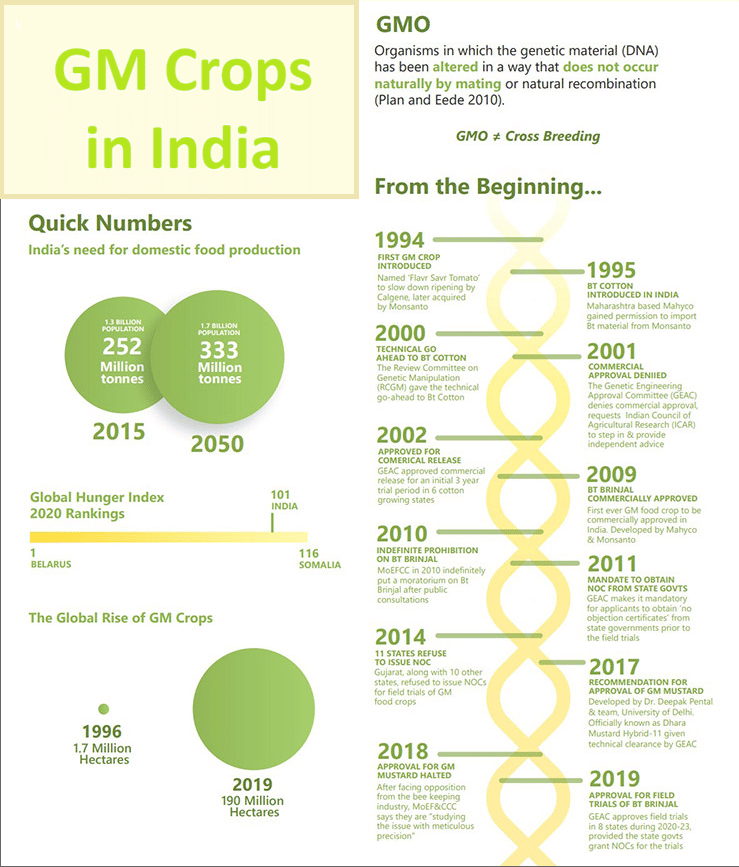
GM Crops in India
Bt Cotton
- Approved in 2002 for commercial cultivation in six states: Andhra Pradesh, Gujarat, Karnataka, Madhya Pradesh, Maharashtra, and Tamil Nadu.
- Developed to combat the bollworm problem.
- First and only transgenic crop approved for commercial cultivation in India.
Bt Brinjal
- GEAC recommended its commercial release in 2007, but it was blocked in 2010 due to public concerns.
- Recently allowed field trials of two indigenous varieties (Janak and BSS-793) in eight states (2020-2023).
HT Mustard (DMH-11)
- Indigenously developed using “barnase/barstar” technology to enhance self-pollination.
- GEAC recommended its commercial approval in 2017, but cultivation has not yet begun.
Legal and Regulatory Framework
Rules, 1989
- Framed under the Environment (Protection) Act, 1986.
- Regulates the manufacture, use, import, export, and storage of genetically engineered organisms or cells.
- Covers research and large-scale applications of GM crops.
Food Safety and Standards Act, 2006
- Prohibits the import, manufacture, use, or sale of GM food without approval from the Food Safety and Standards Authority of India (FSSAI).
Key Regulatory Bodies
- Recombinant DNA Advisory Committee (RDAC): Monitors biotechnology developments.
- Review Committee on Genetic Manipulation (RCGM): Oversees research and high-risk experiments involving GM organisms.
- State Biotechnology Coordination Committee (SBCC): Reviews safety measures at the state level.
- District Level Committee (DLC): Ensures compliance with regulatory guidelines and reports to SBCC and GEAC.
Benefits of GM Crops
- Enhanced Pest Resistance: Reduces reliance on chemical pesticides.
- Virus Resistance: Increases productivity by protecting vulnerable plants.
- Drought Tolerance: Helps crops survive in water-scarce conditions.
- Herbicide Tolerance: Simplifies weed control and reduces soil erosion.
- Sustainable Agriculture: Promotes no-till farming, preserving soil health and reducing carbon emissions.
- Increased Yield: Addresses pest, drought, and virus challenges, boosting farmer incomes.
- Improved Nutritional Value: Crops like Golden Rice combat micronutrient deficiencies.
- Reduced Environmental Pollution: Lowers chemical pesticide and herbicide use, minimizing pollution.
Applications of GM Crops
- Biofortification: Enhances micronutrient content (e.g., Golden Rice).
- Edible Vaccines: Offers cost-effective alternatives to traditional vaccines.
- Biofuels: Provides cleaner energy solutions using GM algae and cyanobacteria.
- Phytoremediation: Cleans up environmental pollutants through genetically engineered enzymes.
Criticism of GM Crops
- Health Concerns: Potential horizontal gene transfer may lead to antibiotic resistance.
- Resistance Development: Overuse of Bt toxins and herbicides can result in resistant pests and weeds.
- Impact on Genetic Diversity: Reduced diversity of neighboring plants and crops.
- Threat to Pollinators: Concerns over Bt toxins affecting honeybees and other pollinators.
- Environmental Impact: Herbicide overuse linked to ecological and health issues.
Way Forward
- Strengthen Regulatory Frameworks: Implement stringent safety assessments.
- Promote Sustainable Practices: Balance GM technology with ecological preservation.
- Invest in Research: Focus on long-term health and environmental impacts.
- Raise Public Awareness: Educate consumers about GM crops' benefits and risks.
- Conserve Biodiversity: Prevent unintended crossbreeding and preserve genetic diversity.
- Foster Global Collaboration: Ensure equitable access to GM technology and address shared concerns.
Download the PREPP App and attempt FREE IAS Exam Mock Tests and get complete study material!
*The article might have information for the previous academic years, please refer the official website of the exam.
How likely are you to recommend Prepp.in to a friend or a colleague?
Not so likely
Highly likely
UPSC CSE (IAS) 2027 Prelims Mock Test Series
Live Quizzes
Quizzes
Live Tests

• Live
Live Test : UPSC CSE Prelims CSAT (Paper-II) (Oct 08 - 11)
120 Minutes
80 Questions
200 Marks
English, Hindi
MEDIUM
Test will end in 05:29:53
Full Tests
Full Test - 04: UPSC CSE Prelims CSAT (Paper-II)
120 Minutes
80 Questions
200 Marks
English, Hindi
MEDIUM
Attempted by 19 aspirants in 12 hours
Full Test - 03: UPSC CSE Prelims CSAT (Paper-II)
120 Minutes
80 Questions
200 Marks
English, Hindi
MEDIUM
Attempted by 20 aspirants in 12 hours
Previous Year Papers
UPSC CSE Prelims 2026 GS Paper 1 Question Paper (24-May-2026)
120 Minutes
100 Questions
200 Marks
2,989 Attempted
English, Hindi
MEDIUM
Attempted by 12 aspirants in 12 hours
UPSC CSE Prelims 2026 CSAT Paper 2 Question Paper (24-May-2026)
120 Minutes
80 Questions
200 Marks
3,167 Attempted
English, Hindi
MEDIUM
Attempted by 13 aspirants in 12 hours
Videos

17 February 2025 | The Hindu Must Read Articles | Current Affairs
7,202 Views
•4
•7 months ago

16 February 2026 | The Hindu Must Read Articles | Current Affairs
6,962 Views
•4
•7 months ago

13 February 2026 | The Hindu Must Read Articles | Current Affairs
8,765 Views
•5
•7 months ago

12 February 2026 | The Hindu Must Read Articles | Current Affairs
5,788 Views
•4
•7 months ago






Also Check
IAS Exam Overview
IAS Exam Admit Card
IAS Exam Question Paper 2026
IAS Exam Mains Syllabus
IAS Exam Application Process
IAS Exam Eligibility
IAS Exam Result
IAS Exam Exam Pattern
IAS Exam CSAT Syllabus
IAS Exam Answer Key
IAS Exam Previous Year Paper
IAS Exam Current Affairs
IAS Exam Mains Question Paper
IAS Exam IAS Courses
IAS Exam UPSC Study Notes
IAS Exam Foundation Course 2024
IAS Exam Prelims Question Paper
IAS Exam Exam Center
IAS Exam Foundation Course 2025
IAS Exam Notification 2026
IAS Exam IAS Success Stories
IAS Exam Salary
IAS Exam Cutoff
IAS Exam Mock Tests
IAS Exam News


Comments