UPSC ESE Exam Date 2027 Out; Check Prelims, Mains Schedule & Timings
What's New in IES?
- Nov 11, 2026: UPSC ESE Exam Date 2027 has been announced. Prelims will be held on January 31, 2027, and Mains on June 18, 2027. UPSC has announced approx 480 vacancies. Download PDF
UPSC has released UPSC ESE Notification 2027 (Notice No. 02/2027-ENGG.) on 16 September 2026 for approximately 480 vacancies, including 19 vacancies for Persons with Benchmark Disabilities (PwBD). The online application window closed on 6 October 2026 at 6:00 PM. Registered candidates will appear for UPSC ESE eaxm now. UPSC has released the exam table as prelims exam will be conducted on 31 January 2027, and the main exam is scheduled for 18 June 2027. The e-admit card will be issued on the last working day of the week preceding the exam.
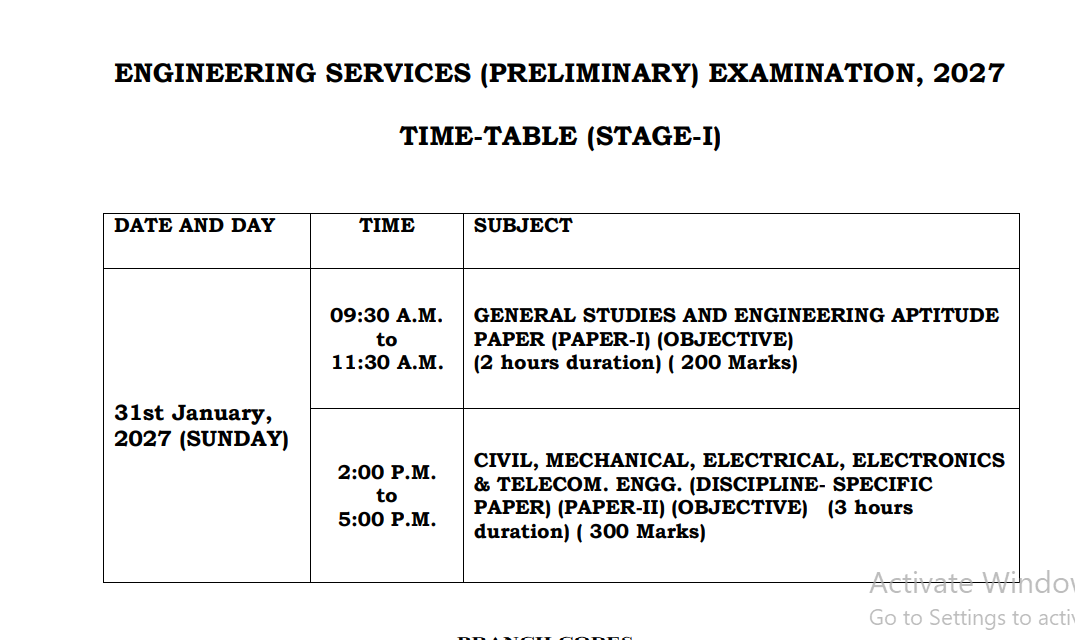
UPSC ESE Notification 2027 Out
UPSC announcedESE 2027 notification on September 16, 2026, under Advertisement No. 02/2027-ENGG, with around 480 vacancies in various engineering disciplines. The official notification for details on eligibility, vacancies, selection, and exam guidelines.
Download UPSC ESE Notification 2027
What is UPSC ESE Exam 2027?
UPSC IES exam is conducted once a year to recruit engineers for Group A and Group B Gazetted posts in Central Government departments. It is conducted in stages of Preliminary exam, Mains exam, and a Personality test. Recruitment is done for the streams of Civil Engineering, Mechanical Engineering, Electrical Engineering, and Electronics & Telecommunication Engineering.
UPSC ESE Notification 2027 Highlights
| Particulars | Details |
|---|---|
| Exam Notice | 02/2027-ENGG. |
| UPSC ESE Notification 2027 Release Date | 16 September 2026 |
| Application Start Date | 16 September 2026 |
| Last Date to Apply | 6 October 2026 (6:00 PM) |
| Application Status | Closed |
| Exam Level | National |
| Exam Mode | Offline |
| Total Vacancies | Approximately 480 (including 19 PwBD) |
| Engineering Disciplines | Civil, Mechanical, Electrical, Electronics and Telecommunication |
| Selection Process | Prelims, Main and Personality Test |
| UPSC ESE Prelims Exam Date 2027 | 31 January 2027 |
| UPSC ESE Mains Exam Date 2027 | 18 June 2027 |
| Job Location | Across India |
| Official Website | upsc.gov.in |
| Application Portal | upsconline.nic.in |
UPSC ESE Important Dates 2027
| Particulars | Details |
|---|---|
| UPSC ESE Notification 2027 | 16 September 2026 |
| UPSC ESE Application Form 2027 Begins | 16 September 2026 |
| Last Date to Submit Application Form | 6 October 2026 (6:00 PM) |
| Last Date for Application Fee Payment | 6 October 2026 |
| UPSC ESE Prelims Time Table | 10 November 2026 |
| UPSC ESE Admit Card 2027 | Last working day of the week preceding the exam |
| UPSC ESE Prelims Exam Date | 31 January 2027 |
| Representation on Question Paper and Provisional Answer Key | 3rd day after the exam to 6:00 PM of the 7th day |
| UPSC ESE Prelims Result | To be announced |
| UPSC ESE Mains Exam Date | 18 June 2027 |
| UPSC ESE Mains Result | To be announced |
| Personality Test | To be announced |
| Final Result | To be announced |
UPSC ESE Application Form 2027
UPSC ESE Application Form 2027 was released on September 16, 2026, through the official UPSC online application portal. Candidates could submit their applications by October 6, 2026, up to 6:00 PM. Applications cannot be withdrawn, and no corrections were allowed after submission; meanwhile, UPSC ESE Application process 2027 is now closed
Steps to Fill UPSC ESE Application Form 2027
Candidates were required to complete Account Creation, Universal Registration, Common Application Form, and the exam-specific form by following these steps:
- Visit the official portal: upsconline.nic.in.
- Create an account and complete Universal Registration to obtain the URN.
- Fill in the Common Application Form with personal, educational, and contact details.
- Upload the required photograph, live photograph and signature.
- Select Engineering Services Examination 2027.
- Enter the engineering discipline and exam centre preferences.
- Pay the application fee, if applicable.
- Review and submit the form. Download the confirmation for future reference.
Documents Required for UPSC ESE Application Form 2027
Candidates were required to keep the following documents and details ready for UPSC ESE Application Form 2027:
- Valid email ID and mobile number.
- Aadhaar card or other accepted photo ID.
- Recent photograph and live photograph.
- Scanned signature.
- Age proof and engineering degree or qualifying examination details.
- SC/ST/OBC/EWS certificate, if applicable.
- PwBD certificate, if applicable.
- Documents supporting age or fee concessions, wherever applicable.
UPSC ESE Application Fee 2027
UPSC ESE Application Fee 2027 was ₹200 for General, OBC and EWS candidates. Female, SC, ST, and PwBD candidates were exempted from the application fee. Payment could be made through net banking, credit/debit cards, or UPI.
| Category | Application Fee |
|---|---|
| General | ₹200 |
| OBC | ₹200 |
| EWS | ₹200 |
| SC/ST | Exempted |
| Female Candidates (All Categories) | Exempted |
| PwBD Candidates | Exempted |
Note: The application fee is non-refundable.
UPSC ESE Eligibility Criteria 2027
Candidates must fulfil the eligibility criteria prescribed by the Union Public Service Commission (UPSC) to apply for the Engineering Services Exam 2027. The criteria include nationality, age limit, age relaxation, educational qualification and medical standards. Admission at each stage is provisional, and original documents are verified after candidates qualify for the personality test.
UPSC ESE Nationality 2027
Candidates must belong to one of the following categories as per UPSC ESE Eligibility Criteria 2027:
- Citizen of India.
- Subject of Nepal or Bhutan.
- Tibetan refugee who came to India before January 1, 1962, intending to settle permanently.
- Person of Indian origin who migrated from Pakistan, Burma, Sri Lanka, specified East African countries, or Vietnam, intending to settle permanently in India.
Candidates other than Indian citizens must obtain an eligibility certificate from the Government of India. They can appear for the exam, but the appointment is subject to the issuance of this certificate.
UPSC ESE Age Limit 2027
Candidates must be at least 21 years old and below 30 years old as of January 1, 2027.
| Particulars | Details |
|---|---|
| Minimum Age | 21 Years |
| Maximum Age | 30 Years |
| Age Calculation Date | January 1, 2027 |
Note: Candidates must have been born between January 2, 1997, and January 1, 2006.
UPSC ESE Age Relaxation 2027
UPSC provides age relaxation to eligible reserved categories and other groups.
| Category | Age Relaxation |
|---|---|
| SC/ST | 5 Years |
| OBC (Non-Creamy Layer) | 3 Years |
| Persons with Benchmark Disabilities (PwBD) | 10 Years |
| Defence personnel disabled during operations and released as a consequence | 3 Years |
| Ex-servicemen, including eligible Commissioned Officers and ECOs/SSCOs | 5 Years |
| Eligible ECOs/SSCOs with extended service | 5 Years |
| Eligible Government Servants in specified departments | Upper age limit up to 35 Years |
Note: Eligible SC/ST and OBC candidates who also belong to the Ex-servicemen or PwBD categories can receive cumulative age relaxation, subject to UPSC rules.
UPSC ESE Educational Qualification 2027
Candidates must hold an engineering degree or an equivalent qualification recognized by UPSC. Accepted qualifications include:
- Engineering degree from a recognized Indian university or institution.
- Sections A and B of the Institution Examinations of the Institution of Engineers (India).
- Engineering degree or diploma from a recognized foreign institution.
- Graduate Membership Examination of the Institution of Electronics and Telecommunication Engineers (India).
- Associate Membership Examination Parts II and III/Sections A and B of the Aeronautical Society of India.
- Graduate Membership Examination of the Institution of Electronics and Radio Engineers, London, conducted after November 1959.
For Indian Naval Armament Service (Electronics Engineering Posts) and Indian Radio Regulatory Service Group A, an M.Sc. or equivalent degree in Wireless Communication Electronics, Radio Physics, or Radio Engineering is also accepted.
Note: Qualifications from the Institution of Electronics and Telecommunication Engineers (India) and Aeronautical Society of India obtained through admission after May 31, 2013, are not accepted. Eligibility of Institution of Engineers (India) candidates admitted after this date is subject to the government's decision.
Candidates appearing for their qualifying engineering degree exam can apply provisionally. Those qualifying for the personality test must submit proof of passing within 10 days of the Main Exam result declaration. Failure to do so will make them ineligible for the personality test.
UPSC ESE Medical Standards 2027
Candidates recommended for UPSC ESE 2027 must undergo a medical examination as directed by the Department of Telecommunications, even if they have undergone one earlier. The Medical Board's findings will be final for service allotment. Candidates must also meet the physical standards specified in Appendix II of the ESE 2027 Rules.
UPSC ESE Exam Pattern 2027
UPSC ESE exam pattern 2027 consists of objective and conventional papers. UPSC ESE Prelims Exam is conducted in objective mode, whereas the Main Exam consists of descriptive or conventional papers. Marks of all three stages, Prelims, Mains and Personality Test, are counted for the final merit, making a total of 1300 marks.
UPSC ESE Prelims Exam Pattern 2027
Prelims Exam comprises two objective-type papers carrying a total of 500 marks.
| Paper | Subject | Marks | Duration |
|---|---|---|---|
| Paper I | General Studies and Engineering Aptitude | 200 | 2 Hours |
| Paper II | Engineering Discipline-Specific Paper | 300 | 3 Hours |
| Total | - | 500 | 5 Hours |
UPSC ESE Prelims Exam Pattern 2027 Important points:
- Both papers in UPSC Prelims Exam Pattern consists of objective-type multiple-choice questions with four options each.
- Paper I is common to all four engineering disciplines.
- Paper II is based on the candidate's selected engineering discipline.
- One-third (0.33) of the marks assigned to a question are deducted for every incorrect answer.
- Multiple answers marked for a question are treated as incorrect.
- No marks are deducted for unanswered questions.
- Candidates must clear the minimum qualifying marks in both Paper I and Paper II. About six to seven times the number of vacancies are admitted to the Main Exam.
UPSC ESE Mains Exam Pattern 2027
Candidates who qualify for the Prelims Exam are eligible to appear for the Main Exam. Main Exam consists of two conventional-type papers based on the candidate's selected engineering discipline.
| Paper | Subject | Marks | Duration |
|---|---|---|---|
| Paper I | Engineering Discipline | 300 | 3 Hours |
| Paper II | Engineering Discipline | 300 | 3 Hours |
| Total | - | 600 | 6 Hours |
Note: UPSC ESE Mains exam evaluates candidates' technical knowledge, conceptual understanding and ability to present engineering solutions through descriptive answers.
UPSC ESE Personality Test 2027
Candidates shortlisted after the Main Exam are called for the Personality Test or interview. The number of candidates called is about twice the number of vacancies.
| Particulars | Details |
|---|---|
| Exam Stage | Stage III |
| Test Type | Personality Test |
| Total Marks | 200 |
| Minimum Qualifying Marks | None |
| Purpose | Assessment of suitability for engineering services |
Note: The Personality Test assesses the candidate's capacity for leadership, initiative and intellectual curiosity, tact and other social qualities, mental and physical energy, powers of practical application and integrity of character.
UPSC ESE 2027 Exam Language
Unlike some other UPSC exams, the Engineering Services Exam does not provide a list of regional languages for candidates to write their descriptive papers. According to UPSC ESE 2027 exam rules:
- The conventional papers in the Main Exam must be answered in English.
- The question papers for the conventional exam are set in English only.
- Candidates cannot choose Hindi or regional languages such as Odia, Bengali, Tamil, Telugu or Marathi as the medium for writing the conventional papers.
UPSC ESE Syllabus 2027
UPSC ESE syllabus 2027 is divided into General Studies and Engineering Aptitude and four engineering disciplines. For each discipline, the combined UPSC ESE Syllabus of Paper I and Paper II applies to Prelims Paper II, while Mains Paper I and Paper II follow it separately. The standard of the discipline papers is approximately that of an engineering degree exam of an Indian university.
General Studies and Engineering Aptitude Syllabus
Paper I is common to candidates from all four engineering disciplines and is set at the level expected of an engineering or science graduate. Questions are set from all 10 topics, and each topic carries 5% to 15% of the total marks.
| Topic | Details |
|---|---|
| Current Issues | Current issues of national and international importance relating to social, economic and industrial development |
| Engineering Aptitude | Logical reasoning and analytical ability |
| Engineering Mathematics | Engineering mathematics and numerical analysis |
| Design and Safety | General principles of design, drawing and importance of safety |
| Standards and Quality | Standards and quality practices in production, construction, maintenance and services |
| Energy and Environment | Basics of energy and environment: conservation, environmental pollution and degradation, climate change, environmental impact assessment |
| Project Management | Basics of project management |
| Materials Science | Basics of material science and engineering |
| ICT | ICT-based tools and their applications in engineering, such as networking, e-governance and technology-based education |
| Ethics | Ethics and values in the engineering profession |
Practice: UPSC ESE Mock Test
Civil Engineering Syllabus
The Civil Engineering syllabus covers structural, water resources, environmental, geotechnical and transportation engineering. Major topics include:
| Paper I | Paper II |
|---|---|
| Building Materials | Flow of Fluids, Hydraulic Machines and Hydro Power |
| Solid Mechanics | Hydrology and Water Resources Engineering |
| Structural Analysis | Environmental Engineering |
| Design of Steel Structures | Geotechnical Engineering and Foundation Engineering |
| Design of Concrete and Masonry Structures | Surveying and Geology |
| Construction Practice, Planning and Management | Transportation Engineering |
Mechanical Engineering Syllabus
The Mechanical Engineering syllabus includes thermal engineering, machine design, manufacturing and mechatronics. Major topics include:
| Paper I | Paper II |
|---|---|
| Fluid Mechanics | Engineering Mechanics |
| Thermodynamics and Heat Transfer | Engineering Materials |
| IC Engines, Refrigeration and Air Conditioning | Mechanisms and Machines |
| Turbo Machinery | Design of Machine Elements |
| Power Plant Engineering | Manufacturing, Industrial and Maintenance Engineering |
| Renewable Sources of Energy | Mechatronics and Robotics |
Electrical Engineering Syllabus
The Electrical Engineering syllabus focuses on electrical circuits, power systems, electrical machines and control systems. Major topics include:
| Paper I | Paper II |
|---|---|
| Engineering Mathematics | Analog and Digital Electronics |
| Electrical Materials | Systems and Signal Processing |
| Electric Circuits and Fields | Control Systems |
| Electrical and Electronic Measurements | Electrical Machines |
| Computer Fundamentals | Power Systems |
| Basic Electronics Engineering | Power Electronics and Drives |
Electronics and Telecommunication Engineering Syllabus
The Electronics and Telecommunication Engineering syllabus includes electronic devices, circuits, communication systems and computer architecture. Major topics include:
| Paper I | Paper II |
|---|---|
| Basic Electronics Engineering | Analog and Digital Communication Systems |
| Basic Electrical Engineering | Control Systems |
| Materials Science | Computer Organization and Architecture |
| Electronic Measurements and Instrumentation | Electro Magnetics |
| Network Theory | Advanced Electronics Topics |
| Analog and Digital Circuits | Advanced Communication Topics |
Note: The complete subject-wise syllabus with detailed subtopics is given in Section III of Appendix-I of the official UPSC ESE 2027 notification.
UPSC ESE Vacancy 2027
UPSC has announced approximately 480 vacancies for the Engineering Services Exam 2027. Reservation applies for SC, ST, OBC, EWS and PwBD candidates as fixed by the Government of India. UPSC ESE vacancy count is provisional and may be altered.
Category-wise UPSC ESE Vacancy 2027
| Discipline | Vacancies |
|---|---|
| Civil Engineering | To be confirmed |
| Mechanical Engineering | To be confirmed |
| Electrical Engineering | To be confirmed |
| Electronics and Telecommunication Engineering | To be confirmed |
| Total | Approximately 480 |
PwBD Vacancy Details
Out of the approximately 480 vacancies, 19 vacancies are reserved for Persons with Benchmark Disabilities. No vacancies are identified for the Blindness category, and Low Vision candidates may apply only for the services identified for them in Annexure-I.
| Disability Category | Vacancies |
|---|---|
| Locomotor Disability (including Leprosy cured, Dwarfism, Acid Attack victims and Muscular Dystrophy) | 11 |
| Hard of Hearing | 6 |
| Low Vision | 1 |
| Specific Learning Disability and Multiple Disabilities | 1 |
| Total | 19 |
UPSC ESE Exam Centres 2027
UPSC ESE exam centres 2027 are provided separately for the Prelims and Main exams. Candidates selected their preferred exam centres while filling out the application form. The Prelims Exam will be conducted across 48 cities, whereas the Main Exam will be conducted across 24 cities.
UPSC ESE Prelims Exam Centres 2027
| Agartala | Kochi (Cochin) |
|---|---|
| Agra | Kohima |
| Ahmedabad | Kolkata |
| Aizawl | Lucknow |
| Aligarh | Madurai |
| Prayagraj (Allahabad) | Gaya |
| Bangalore | Mumbai |
| Bareilly | Nagpur |
| Bhopal | Panaji (Goa) |
| Chandigarh | Patna |
| Gurugram | Port Blair |
| Chennai | Raipur |
| Cuttack | Ranchi |
| Dehradun | Sambalpur |
| Delhi | Shillong |
| Dharwad | Gorakhpur |
| Dispur (Guwahati) | Shimla |
| Gangtok | Srinagar |
| Hyderabad | Thiruvananthapuram |
| Imphal | Tirupati |
| Itanagar | Udaipur |
| Jaipur | Visakhapatnam |
| Jammu | Ghaziabad |
| Jorhat | Varanasi |
UPSC ESE Mains Exam Centres 2027
| Ahmedabad | Jaipur |
|---|---|
| Aizawl | Jammu |
| Prayagraj (Allahabad) | Kolkata |
| Bangalore | Lucknow |
| Bhopal | Mumbai |
| Chandigarh | Patna |
| Chennai | Raipur |
| Cuttack | Ranchi |
| Dehradun | Shillong |
| Delhi | Shimla |
| Dispur (Guwahati) | Thiruvananthapuram |
| Hyderabad | Visakhapatnam |
Documents Required at UPSC ESE Exam Centre
Candidates must carry the following documents to the exam centre:
- Printed UPSC ESE e-admit card.
- Original photo ID mentioned in the Universal Registration profile.
- Any additional documents specified in the admit card.
Entry closes 30 minutes before each session, and face authentication is mandatory. Mobile phones, smartwatches, Bluetooth devices, AI-enabled glasses, and other electronic items are prohibited. No storage facility is available. Candidates must use a black ball pen to mark the OMR sheet
UPSC ESE Admit Card 2027
UPSC ESE Admit Card 2027 will be issued on the last working day of the week preceding the Prelims Exam on the UPSC online application portal. Candidates who opted for a change of scribe seven days before the exam will get their e-admit card three days before the exam. UPSC ESE Admit Cards is not sent by post.
Note: Candidates who do not receive their e-admit card one week before the exam, or find any discrepancy in it, should contact UPSC immediately on 011-24041001 or 011-40303444.
UPSC ESE City Intimation Slip 2027
UPSC has not announced a separate city intimation slip for the Engineering Services Exam 2027. Candidates should use the official e-admit card to confirm their allotted exam centre and venue and should not treat unofficial city-intimation announcements as confirmed UPSC updates.
UPSC ESE Answer Key 2027
UPSC ESE Answer Key 2027 helps candidates check their responses and estimate Prelims scores. Candidates can submit objections to the question papers and provisional UPSC ESE answer keys of objective papers through the UPSC online portal.
- The representation window opens on the 3rd day after the exam and closes at 6:00 PM on the 7th day.
- Submit representations online under Examinations > Representations on Question Paper & Provisional Answer Keys.
- UPSC does not accept objections by email, post or in person, or after the deadline
UPSC ESE Result 2027
UPSC ESE Result 2027 will be declared on the official UPSC website after the completion of the respective exam stages. The Commission will first announce the Prelims Exam result. Candidates who qualify will be eligible to appear for the Main Exam. Subsequently, the Main Exam result will determine which candidates are shortlisted for the Personality Test. UPSC ESE Final Result will be prepared based on the combined performance of candidates in the Prelims Exam, Main Exam and Personality Test.
UPSC ESE Result 2027 Stages
| Result | Status |
|---|---|
| UPSC ESE Prelims Result 2027 | Awaited |
| UPSC ESE Mains Result 2027 | Awaited |
| UPSC ESE Personality Test Result | Awaited |
| UPSC ESE Final Result 2027 | Awaited |
Tie-Breaking Rules in UPSC ESE 2027
Marks are rounded off to two decimal places. In case of a tie, UPSC applies the following order:
- Higher marks in Prelims Paper II, Mains Papers I and II, and Personality Test.
- Higher marks in the three engineering discipline papers alone.
- An older candidate is ranked higher.
What Happens If a Candidate Fails Any Stage of UPSC ESE 2027?
UPSC ESE has three selection stages. Candidates must qualify at each stage to proceed further.
| Stage | Outcome on Failing |
|---|---|
| Prelims Exam | Cannot appear for Mains in the same recruitment cycle. |
| Main Exam | Cannot proceed to the Personality Test. |
| Personality Test | May not qualify for the final merit list if aggregate marks are insufficient. |
-
Failure in UPSC ESE Prelims
Candidates who fail to secure the required marks in Prelims Paper I and II are eliminated and cannot appear for Mains in that recruitment cycle.
-
Failure in UPSC ESE Mains
Candidates who do not meet the qualifying marks in Mains are not shortlisted for the Personality Test.
-
Failure in UPSC ESE Personality Test
The Personality Test carries 200 marks and has no separate minimum qualifying marks. However, candidates must secure sufficient aggregate marks across all stages to enter the final merit list. Candidates who are not recommended may register on the Pratibha Setu portal to share their details with registered employers.
Can Candidates Reappear for UPSC ESE After Failing?
Yes. Candidates can apply in the next recruitment cycle if they meet the prescribed age limit, educational qualification and other eligibility conditions. Marks from previous attempts are not carried forward.
UPSC ESE Cut Off 2027
UPSC ESE Cut Off 2027 will be released by the Commission after the exam process. The cut-off marks represent the minimum marks required by candidates to qualify for the next stage. The cut-off may vary according to the engineering discipline, category, number of vacancies, exam difficulty and overall candidate performance. UPSC generally releases separate cut-off marks for the Prelims Exam, Main Exam and final selection.
UPSC ESE Salary 2027
Candidates selected through Engineering Services Exam are appointed to various Group A and Group B engineering services and posts under the Government of India. Many entry-level engineering services posts are associated with Pay Level 10 of the 7th Central Pay Commission pay matrix, with a basic pay starting at ₹56,100 per month. The applicable pay level should be checked against the specific service or post offered.
UPSC ESE Salary Structure
| Particulars | Details |
|---|---|
| Entry Pay Level (commonly applicable) | Level 10 |
| Starting Basic Pay | ₹56,100 per month |
| Pay Commission | 7th CPC |
| Dearness Allowance | As applicable |
| House Rent Allowance | As applicable |
| Transport Allowance | As applicable |
| Other Benefits | According to service rules |
Note: The actual monthly salary will depend on the place of posting, applicable allowances, deductions, and service-specific rules.
UPSC ESE Jobs and Responsibilities 2027
Candidates selected through UPSC ESE are allotted services based on merit rank, service preferences, vacancies and medical fitness. These include Central Engineering Service, Indian Railway Management Service, Indian Defence Service of Engineers, Central Water Engineering Service, Central Power Engineering Service, Indian Telecommunications Service and others.
| Engineering Discipline | Jobs and Responsibilities |
|---|---|
| Civil Engineering | Planning infrastructure projects; supervising roads, bridges and buildings; managing water resource and irrigation projects; ensuring structural safety. |
| Mechanical Engineering | Supervising machinery and mechanical equipment; managing maintenance and operations; monitoring manufacturing and production systems. |
| Electrical Engineering | Managing power generation and distribution; supervising electrical projects; maintaining equipment and ensuring electrical safety. |
| Electronics and Telecommunication Engineering | Managing communication and electronic systems; supervising telecom infrastructure; maintaining technical networks and equipment. |
UPSC ESE Preparation Strategy 2027
With UPSC ESE Prelims scheduled for January 31, 2027, candidates should focus on these General Studies, Engineering Aptitude and their core engineering subjects. Follow these UPSC ESE Preparation Tips.
- Cover the syllabus: Identify important topics for Prelims and Main Exams.
- Revise core concepts: Strengthen engineering fundamentals and practise numerical questions.
- Prepare Paper I: Cover all 10 General Studies and Engineering Aptitude topics.
- Solve previous year papers: Practise UPSC ESE Question Papers to understand the exam pattern.
- Take mock tests; It improves speed and accuracy.
- Revise regularly: Maintain short notes for formulas, concepts and technical topics.
- Practise descriptive answers: Write structured answers and solve conventional questions for the Main Exam.
Best Books for UPSC ESE 2027 Preparation
Standard engineering textbooks cover most of the UPSC ESE discipline syllabus for both Prelims Paper II and the Mains papers, while Paper I needs separate aptitude and general studies material.
UPSC ESE 2027 General Studies and Engineering Aptitude (Paper I)
| Book | Publisher/Author |
|---|---|
| General Studies and Engineering Aptitude | Made Easy Publications |
| Engineering Aptitude | ACE Engineering Academy |
| Quantitative Aptitude for Competitive Exams | R.S. Aggarwal |
| A Modern Approach to Verbal and Non-Verbal Reasoning | R.S. Aggarwal |
| Objective General English | S.P. Bakshi |
UPSC ESE 2027 Civil Engineering
| Subject | Book | Author |
|---|---|---|
| Strength of Materials | Strength of Materials | R.K. Bansal |
| Structural Analysis | Structural Analysis | S.S. Bhavikatti |
| Building Materials | Building Materials | S.K. Duggal |
| Soil Mechanics | Soil Mechanics and Foundation Engineering | B.C. Punmia |
| Fluid Mechanics | Fluid Mechanics and Hydraulic Machines | R.K. Bansal |
| Environmental Engineering | Environmental Engineering | S.K. Garg |
| Transportation Engineering | Highway Engineering | S.K. Khanna and C.E.G. Justo |
| Surveying | Surveying | B.C. Punmia |
| RCC Design | Reinforced Concrete Design | S. Unnikrishna Pillai and Devdas Menon |
UPSC ESE 2027 Mechanical Engineering
| Subject | Book | Author |
|---|---|---|
| Engineering Mechanics | Engineering Mechanics | S.S. Bhavikatti |
| Strength of Materials | Strength of Materials | R.K. Bansal |
| Theory of Machines | Theory of Machines | S.S. Rattan |
| Machine Design | A Textbook of Machine Design | R.S. Khurmi and J.K. Gupta |
| Thermodynamics | Engineering Thermodynamics | P.K. Nag |
| Fluid Mechanics | Fluid Mechanics | R.K. Bansal |
| Heat Transfer | Heat and Mass Transfer | R.K. Rajput |
| Manufacturing Engineering | Manufacturing Technology | P.N. Rao |
| Industrial Engineering | Industrial Engineering and Management | O.P. Khanna |
UPSC ESE 2027 Electrical Engineering
| Subject | Book | Author |
|---|---|---|
| Electrical Circuits | Network Analysis | M.E. Van Valkenburg |
| Electrical Machines | Electrical Machinery | P.S. Bimbhra |
| Power Systems | Power System Engineering | C.L. Wadhwa |
| Control Systems | Modern Control Engineering | K. Ogata |
| Power Electronics | Power Electronics | P.S. Bimbhra |
| Electrical Measurements | Electrical Measurements and Measuring Instruments | A.K. Sawhney |
| Electromagnetic Fields | Engineering Electromagnetics | William H. Hayt |
| Analog Electronics | Electronic Devices and Circuits | Jacob Millman and Christos Halkias |
UPSC ESE 2027 Electronics and Telecommunication Engineering
| Subject | Book | Author |
|---|---|---|
| Electronic Devices | Electronic Devices and Circuit Theory | Robert L. Boylestad |
| Analog Electronics | Integrated Electronics | Jacob Millman and Christos Halkias |
| Digital Electronics | Digital Design | M. Morris Mano |
| Signals and Systems | Signals and Systems | Alan V. Oppenheim |
| Control Systems | Modern Control Engineering | K. Ogata |
| Communication Systems | Communication Systems | Simon Haykin |
| Electromagnetic Theory | Engineering Electromagnetics | William H. Hayt |
| Microprocessors | Microprocessor Architecture, Programming and Applications | Ramesh S. Gaonkar |
| Network Theory | Network Analysis | M.E. Van Valkenburg |
UPSC ESE 2027 application process closed on 6 October 2026 with approximately 480 vacancies on offer across Civil, Mechanical, Electrical, and Electronics and Telecommunication Engineering. Registered candidates will receive their e-admit cards in the week before the Prelims Exam on 31 January 2027, and those who qualify will move to the Main Exam on 18 June 2027
UPSC ESE 2027 Notification FAQs
Ques: Can a candidate select more than one engineering discipline in UPSC ESE 2027?
Ans: No. A candidate can apply for only one category: Civil, Mechanical, Electrical, or Electronics and Telecommunication Engineering. Appearing in a discipline other than the one on the e-admit card leads to cancellation of candidature.
Ques: Is GATE qualification compulsory for UPSC ESE 2027?
Ans: No. GATE qualification is not required. Candidates need an engineering degree or one of the equivalent qualifications listed in the notification.
Ques: Can UPSC ESE 2027 Mains papers be written in Hindi?
Ans: No. The conventional papers of the Main Exam must be answered in English, and the question papers are set in English only.
Ques: Can candidates change their exam centre after submitting UPSC ESE 2027 application form?
Ans: No. UPSC does not grant any request for a change of exam centre after the application is submitted, although the Commission may itself change centres if required.
Ques: Are Personality Test marks counted in UPSC ESE 2027 final merit?
Ans: Yes. The Personality Test carries 200 marks with no minimum qualifying marks, and its marks are added to the Prelims (500) and Mains (600) marks to prepare the final merit list.
Download the PREPP App and attempt FREE IES Mock Tests and get complete study material!

French revolution
Full Test - 01 : ESE Prelims Paper 2
UPSC ESE Prelims 2026 Mechanical Engineering Question Paper (08-Feb-2026)
UPSC ESE Prelims 2026 Electrical Engineering Question Paper (08-Feb-2026)

17 February 2025 | The Hindu Must Read Articles | Current Affairs

16 February 2026 | The Hindu Must Read Articles | Current Affairs

13 February 2026 | The Hindu Must Read Articles | Current Affairs









Comments