
Al-Cu Alloys: G-P Zones Nature
G-P (Guinier-Preston) zones are initial, localized clusters of solute atoms that form during the early stages of precipitation hardening in alloys like Al-Cu. They act as precursors to larger precipitate phases.
Coherence in Precipitation
In metallurgy, precipitates are described based on their crystallographic relationship with the matrix (the surrounding base metal). Coherence means the precipitate has the same crystallographic orientation as the matrix and there is a good lattice match between their atomic planes. This results in minimal strain at the interface.
G-P Zones in Al-Cu
In Aluminum-Copper (Al-Cu) alloys, the G-P zones (specifically G.P. Zone Type I and Type II) that form are crystallographically aligned with the $\\alpha$-Al matrix. They maintain the matrix structure across their interface, indicating a coherent relationship.
This coherence allows G-P zones to form readily and act as effective sites for subsequent, larger precipitate growth, contributing significantly to strengthening the alloy.
Conclusion
Because G-P zones share the same crystallographic orientation and lattice structure as the parent $\\alpha$-Al matrix, they are classified as coherent.
Important Questions from Heat Treatment Quenching Critical Cooling Rate
- Which of the following statements is/are CORRECT when Ni is added as an alloying element to a low alloy steel?
- In a Jominy end-quench test of the eutectoid plain-carbon steel, which of the following represents the sequence of microstructures observed from the quenched end of the specimen?
- Which one of the following is the correct decreasing sequence of Quenching Power for quenchants used in heat treatment of steels?
- Which one of the following techniques does NOT require quenching to obtain final case hardness?
The microstructures of a quenched steel tempered at three temperatures $T_1 < T_2 < T_3$ for a fixed time are schematically illustrated. The solid circles represent cementite particles in ferrite matrix; $\bar{r}_1, \bar{r}_2$ and $\bar{r}_3$ are average radii of cementite particles, and $V_1, V_2$ and $V_3$ are volume fractions of cementite at temperatures $T_1, T_2$ and $T_3$, respectively.
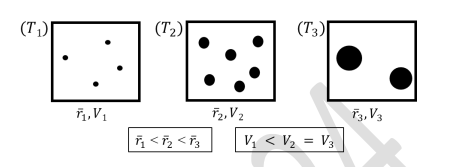
If the cementite in steel is more noble than ferrite, then which one of the three microstructures will have the highest corrosion rate when exposed to an aqueous solution of $3.5 \text{ wt.\% NaCl}$?


