The microstructures of a quenched steel tempered at three temperatures $T_1 < T_2 < T_3$ for a fixed time are schematically illustrated. The solid circles represent cementite particles in ferrite matrix; $\bar{r}_1, \bar{r}_2$ and $\bar{r}_3$ are average radii of cementite particles, and $V_1, V_2$ and $V_3$ are volume fractions of cementite at temperatures $T_1, T_2$ and $T_3$, respectively. If the cementite in steel is more noble than ferrite, then which one of the three microstructures will have the highest corrosion rate when exposed to an aqueous solution of $3.5 \text{ wt.\% NaCl}$?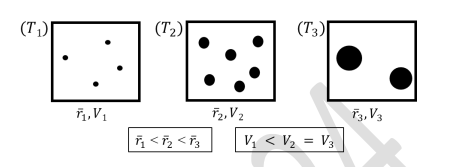
To determine which microstructure will have the highest corrosion rate when exposed to an aqueous solution of 3.5 wt.% NaCl, we need to consider the galvanic couple principle between cementite (more noble) and ferrite (less noble). The corrosion rate depends on the surface area ratio of these two phases.
The microstructures at different temperatures can be analyzed as follows:
- Microstructure at \(T_1\):
- Smaller average radius \(\bar{r}_1\)
- Volume fraction \(V_1\), where \(V_1 < V_2 = V_3\)
- Microstructure at \(T_2\):
- Medium average radius \(\bar{r}_2\)
- Volume fraction \(V_2\) (which is equal to \(V_3\) and greater than \(V_1\))
- Microstructure at \(T_3\):
- Larger average radius \(\bar{r}_3\)
- Volume fraction \(V_3\), which equals \(V_2\)
Key considerations:
- A greater surface area of the noble phase (cementite) in contact with the electrolyte leads to a higher corrosion rate of the less noble phase (ferrite).
- For microstructure at \(T_2\), the surface area to volume ratio of cementite particles is relatively higher due to the medium size of the particles compared to \(T_1\) and \(T_3\).
Conclusion: The microstructure at \(T_2\) will have the highest corrosion rate when exposed to an aqueous solution of 3.5 wt.% NaCl, as it provides the optimal balance of cementite surface area leading to enhanced galvanic corrosion.
Important Questions from Heat Treatment Quenching Critical Cooling Rate
- Which of the following statements is/are CORRECT when Ni is added as an alloying element to a low alloy steel?
- In a Jominy end-quench test of the eutectoid plain-carbon steel, which of the following represents the sequence of microstructures observed from the quenched end of the specimen?
- Which one of the following is the correct decreasing sequence of Quenching Power for quenchants used in heat treatment of steels?
- Which one of the following techniques does NOT require quenching to obtain final case hardness?
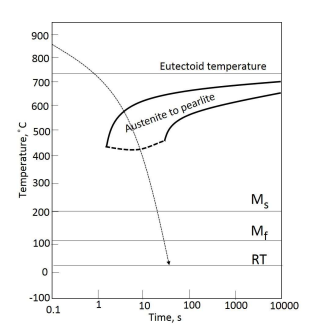
The CCT diagram of a eutectoid steel with a superimposed cooling curve is shown in the figure. The microstructure at room temperature (RT) after this heat treatment is_____________