
The CCT diagram of a eutectoid steel with a superimposed cooling curve is shown in the figure. The microstructure at room temperature (RT) after this heat treatment is_____________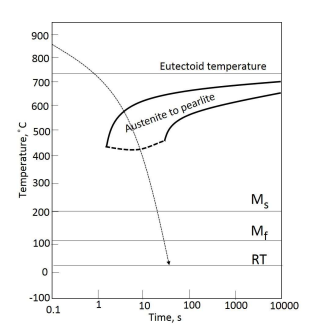
To determine the microstructure at room temperature after the heat treatment of eutectoid steel, we analyze the provided CCT (Continuous Cooling Transformation) diagram, overlaid with a cooling curve.
Understanding the CCT Diagram: A eutectoid steel typically transforms from austenite to pearlite when cooled slowly. The CCT diagram shows regions where these transformations occur, depending on the cooling rate.
Analyzing the Cooling Curve: The cooling curve intersects the start of the pearlite region, indicating that the transformation from austenite to pearlite begins during cooling.
Martensitic Transformation: As the cooling continues, the curve drops below the martensite start temperature (Ms), suggesting the formation of martensite before reaching room temperature.
Conclusion: Since both pearlite and martensite are formed as the microstructure is cooled along the given path, the microstructure at room temperature will be a combination of both pearlite and martensite.
Correct Answer: Pearlite + Martensite
Important Questions from Heat Treatment Quenching Critical Cooling Rate
- Which of the following statements is/are CORRECT when Ni is added as an alloying element to a low alloy steel?
- In a Jominy end-quench test of the eutectoid plain-carbon steel, which of the following represents the sequence of microstructures observed from the quenched end of the specimen?
- Which one of the following is the correct decreasing sequence of Quenching Power for quenchants used in heat treatment of steels?
- Which one of the following techniques does NOT require quenching to obtain final case hardness?
The microstructures of a quenched steel tempered at three temperatures $T_1 < T_2 < T_3$ for a fixed time are schematically illustrated. The solid circles represent cementite particles in ferrite matrix; $\bar{r}_1, \bar{r}_2$ and $\bar{r}_3$ are average radii of cementite particles, and $V_1, V_2$ and $V_3$ are volume fractions of cementite at temperatures $T_1, T_2$ and $T_3$, respectively.
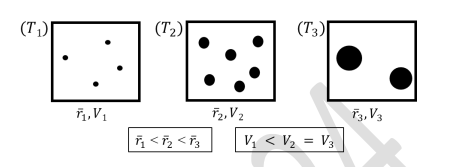
If the cementite in steel is more noble than ferrite, then which one of the three microstructures will have the highest corrosion rate when exposed to an aqueous solution of $3.5 \text{ wt.\% NaCl}$?


