Jominy Test Basics
The Jominy end-quench test measures the hardenability of steel. It involves heating a standard specimen to its austenitizing temperature and then quenching one end with a controlled spray of water. This creates a cooling rate gradient along the length of the specimen: the end being quenched cools the fastest, while the opposite end cools the slowest.
Microstructure Formation
The microstructure formed at different locations along the Jominy specimen depends on the cooling rate experienced at that location. Different cooling rates lead to different transformation products when the steel cools from the austenite phase.
Sequence of Microstructures
For a eutectoid plain-carbon steel, the transformation products observed from the quenched end (fastest cooling) to the unquenched end (slowest cooling) follow a specific sequence:
- Fastest Cooling (Near Quenched End): The extremely rapid cooling rate suppresses diffusion-controlled transformations. This results in the formation of Martensite, a very hard and brittle microstructure.
- Intermediate Cooling Zone 1: As the distance from the quenched end increases, the cooling rate slightly decreases. This allows for partial transformation into pearlite while martensite still forms. The resulting microstructure is a mixture of Martensite and Pearlite.
- Intermediate Cooling Zone 2: With a further decrease in cooling rate, diffusion becomes more significant, leading primarily to pearlite formation. According to the observed sequence, the next structure is Coarse Pearlite.
- Slowest Cooling (Near Unquenched End): At the furthest end from the quench, the cooling rate is the slowest. This allows the most time for atomic diffusion during the austenite-to-pearlite transformation, resulting in the formation of Fine Pearlite.
Therefore, the sequence of microstructures observed from the quenched end of the specimen is Martensite, Martensite and Pearlite, Coarse Pearlite, Fine Pearlite.
Important Questions from Heat Treatment Quenching Critical Cooling Rate
- Which of the following statements is/are CORRECT when Ni is added as an alloying element to a low alloy steel?
- Which one of the following is the correct decreasing sequence of Quenching Power for quenchants used in heat treatment of steels?
- Which one of the following techniques does NOT require quenching to obtain final case hardness?
The microstructures of a quenched steel tempered at three temperatures $T_1 < T_2 < T_3$ for a fixed time are schematically illustrated. The solid circles represent cementite particles in ferrite matrix; $\bar{r}_1, \bar{r}_2$ and $\bar{r}_3$ are average radii of cementite particles, and $V_1, V_2$ and $V_3$ are volume fractions of cementite at temperatures $T_1, T_2$ and $T_3$, respectively.
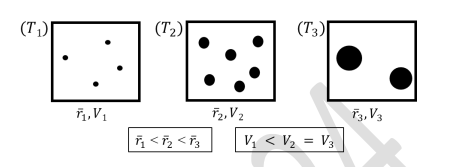
If the cementite in steel is more noble than ferrite, then which one of the three microstructures will have the highest corrosion rate when exposed to an aqueous solution of $3.5 \text{ wt.\% NaCl}$?
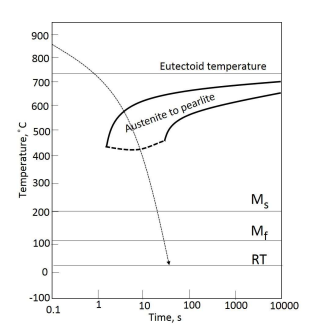
The CCT diagram of a eutectoid steel with a superimposed cooling curve is shown in the figure. The microstructure at room temperature (RT) after this heat treatment is_____________