Case Hardening Techniques Analysis
Case hardening involves creating a hard surface layer (case) while maintaining a tough core in a metal part. Quenching is a rapid cooling process, typically in water or oil, used in many heat treatments to achieve high hardness by forming martensite.
Process Analysis
Let's analyze the given techniques regarding their need for quenching:
- Flame hardening: This method uses a high-temperature flame to rapidly heat the surface layer, followed by quenching to achieve hardness. Quenching is required.
- Induction hardening: Similar to flame hardening, this uses electromagnetic induction for rapid surface heating, which must be followed by quenching to obtain the final hardness. Quenching is required.
- Carburizing: This process adds carbon to the surface of low-carbon steel. While it creates a high-carbon surface layer, achieving the final high case hardness typically requires a subsequent quenching (and often tempering) step. The carburizing process itself enables hardening, but quenching is usually necessary for the final result.
- Nitriding: This is a thermochemical diffusion process where nitrogen is introduced into the surface of steel (usually alloy steels) at temperatures typically around 500°C. The absorbed nitrogen forms very hard and stable metal nitrides directly within the structure. This process creates significant surface hardness without requiring a subsequent quenching step.
Conclusion
Based on the analysis, Nitriding is the surface hardening technique that inherently produces final case hardness through nitride formation and does not require quenching.
Important Questions from Heat Treatment Quenching Critical Cooling Rate
- Which of the following statements is/are CORRECT when Ni is added as an alloying element to a low alloy steel?
- In a Jominy end-quench test of the eutectoid plain-carbon steel, which of the following represents the sequence of microstructures observed from the quenched end of the specimen?
- Which one of the following is the correct decreasing sequence of Quenching Power for quenchants used in heat treatment of steels?
The microstructures of a quenched steel tempered at three temperatures $T_1 < T_2 < T_3$ for a fixed time are schematically illustrated. The solid circles represent cementite particles in ferrite matrix; $\bar{r}_1, \bar{r}_2$ and $\bar{r}_3$ are average radii of cementite particles, and $V_1, V_2$ and $V_3$ are volume fractions of cementite at temperatures $T_1, T_2$ and $T_3$, respectively.
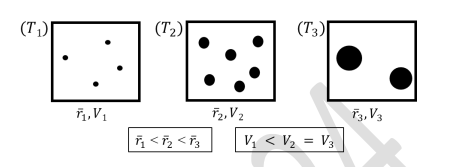
If the cementite in steel is more noble than ferrite, then which one of the three microstructures will have the highest corrosion rate when exposed to an aqueous solution of $3.5 \text{ wt.\% NaCl}$?
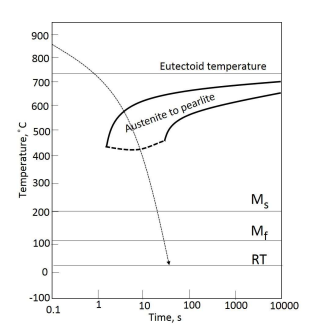
The CCT diagram of a eutectoid steel with a superimposed cooling curve is shown in the figure. The microstructure at room temperature (RT) after this heat treatment is_____________