
Why is it important to use a die stock rather than gripping the die directly with pliers when threading a rod?
Die stock provides stability and alignment
When cutting an external thread with a die, the die must be started and held exactly square (perpendicular) to the axis of the rod and then turned evenly around it.
A die stock is a purpose-made holder that clamps the round die securely and centres it, and its two long handles let the operator apply balanced turning force from both sides.
This balanced, centred grip keeps the die aligned with the rod as it advances, so the thread it cuts is straight, true, and of uniform depth all round.
Gripping the die directly with pliers holds it at only one point, so the die tilts and wanders, cutting a crooked, drunken thread that will not fit its mate.
The real benefit of the die stock is therefore the stability and alignment it gives, not a change in cutting speed (option 2) or a reduction in weight (option 1).
Nor is extra torque the point (option 3): the handles do give leverage, but a lopsided grip that lets the die tilt would ruin the thread no matter how much torque were applied.
Hence, the answer is Die stock provides stability and alignment.
Similar Questions
When cutting an ISO Metric thread for a coarse pitch, by how many degrees should the compound rest be swiveled to?
Taps are re-sharpened by grinding:
The type of thread used in lead screw of a lathe is ______
The surface connecting crest and root of a thread is termed as
Angle of Knuckle thread is ______
Which one of the following is used to rectify damaged or rusted threads?
The resistance of fine thread unscrewing is ______
Lead is equal to double the pitch value then this type of thread is called as _____.
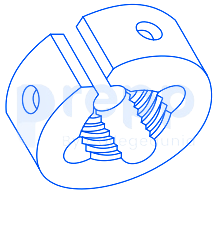
Identify the type of Die in the above Fig.
- The distance from a point on a thread to the corresponding point on the next thread of a screw is called ______.
Important Questions from Screw Threads
When cutting an ISO Metric thread for a coarse pitch, by how many degrees should the compound rest be swiveled to?
What is the blank size (diameter) for preparing a bolt of M12 × 1.5?
What is the relation between the lead (L) and pitch (P) of a two-start thread screw?
Taps are re-sharpened by grinding:
The form of thread in a saw tooth thread is



