
Which traversal algorithm is typically implemented using a stack data structure?
DFS
Let's understand which common graph traversal algorithm typically uses a stack data structure. We have two main algorithms for traversing graphs and trees: Depth First Search (DFS) and Breadth First Search (BFS).
Understanding Graph Traversal
Graph traversal is the process of visiting every node in a graph. This is important for many graph algorithms, such as finding a path between two nodes, finding connected components, or topological sorting.
Depth First Search (DFS) Explained
Depth First Search (DFS) is an algorithm for traversing or searching tree or graph data structures. The algorithm starts at the root (or an arbitrary node) and explores as far as possible along each branch before backtracking. It goes deep first before going wide.
Think of DFS like exploring a maze. You go down one path as far as you can. If you hit a dead end, you back up (backtrack) and try another path. This process of going deep and then backtracking aligns perfectly with how a stack data structure works.
How DFS Uses a Stack
The Depth First Search (DFS) algorithm is naturally implemented using a stack. When you visit a node, you push its unvisited neighbors onto a stack. Then, you pop a node from the stack and visit it, repeating the process. Because a stack is Last-In, First-Out (LIFO), the algorithm explores the most recently added (and thus deepest) neighbor first before returning to explore siblings.
Here's a simple idea of the DFS process using a stack:
- Start at a source node, mark it as visited, and push it onto the stack.
- While the stack is not empty:
- Pop a node from the stack.
- For each neighbor of the popped node:
- If the neighbor has not been visited:
- Mark the neighbor as visited.
- Push the neighbor onto the stack.
This stack data structure keeps track of the nodes that need to be visited next, prioritizing the nodes encountered deeper in the traversal path before backtracking.
Breadth First Search (BFS) Explained
In contrast to DFS, Breadth First Search (BFS) is an algorithm for traversing or searching tree or graph data structures that starts at the tree root (or some arbitrary node of a graph, sometimes referred to as a 'search key') and explores all of the neighbor nodes at the present depth prior to moving on to the nodes at the next depth level. BFS explores the graph level by level.
BFS is typically implemented using a queue data structure. When a node is visited, its unvisited neighbors are added to the back of the queue. Because a queue is First-In, First-Out (FIFO), the algorithm explores nodes in the order they were added, which means exploring all nodes at the current level before moving to the next level.
Comparing DFS and BFS Data Structures
Let's summarize the key data structure used by each algorithm:
| Algorithm | Data Structure Used | Traversal Style |
|---|---|---|
| Depth First Search (DFS) | Stack | Explores deep into one branch before backtracking. |
| Breadth First Search (BFS) | Queue | Explores level by level. |
Based on this comparison, it is clear that the Depth First Search (DFS) algorithm is typically implemented using a stack data structure.
Important Questions from Graph Search
Consider the following algorithm someAlgo that takes an undirected graph G as input.
someAlgo (G)
1. Let $v$ be any vertex in G. Run BFS on G starting at $v$. Let $u$ be a vertex in G at maximum distance from $v$ as given by the BFS.
2. Run BFS on G again with $u$ as the starting vertex. Let $z$ be the vertex at maximum distance from $u$ as given by the BFS.
3. Output the distance between $u$ and $z$ in G.
The output of someAlgo (T) for the tree shown in the given figure is ____________ (Answer in integer)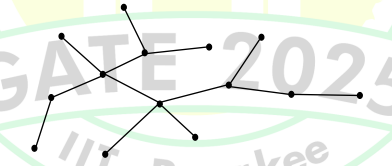
- The depth first search will use ________ as a structure to held nodes for further processing.
Given below are two statements: one is labelled as Assertion A and the other is labelled as Reason R
Assertion A: Depth first search can be used to perform a topological sort of a directed acyclic graph.
Reason R: A topological sort a directed acyclic graph G =(V, E) is a linear ordering of its vertices such that if G contain an edge (u, v) then u appears before v in the ordering.
In the light of the above statements, choose the most appropriate answer from the options given below
Which of the following statements about DFS are correct?
A. It can detect cycles in a graph
B. It can be used to find connected components.
C. It works for both directed and undirected graph.
D. Guarantees shortest path in unweighted graphs.
Choose the correct answer from the options given below:
Consider the following pseudocode for depth-first search (DFS) algorithm which takes a directed graph $G(V, E)$ as input, where $d[v]$ and $f[v]$ are the discovery time and finishing time, respectively, of the vertex $v \in V$.
DFS(G):
unmark all v ∈ V
t ← 0
for each v ∈ V
if v is unmarked
t ← Explore(G, v, t)
end if
end forExplore(G, v, t):
mark v
t ← t + 1
d[v] ← t
for each (v, w) ∈ E
if w is unmarked
t ← Explore(G, w, t)
end if
end for
t ← t + 1
f[v] ← t
return tSuppose that the input directed graph $G(V, E)$ is a directed acyclic graph (DAG).
For an edge $(u, v) \in E$, which of the following options will NEVER be correct?


