
Which part of a die ensures the alignment of the die with the workpiece during threading?
The lead-in chamfer
A die is the cutting tool used to form external (male) threads on a rod or bolt, and for the thread to be true the die must start square and concentric with the workpiece.
The feature that provides this self-centring start is the lead-in chamfer, a tapered bevel ground on one face of the die where the first few threads are cut shallower and flared out.
As the die is pressed onto the rod, this tapered mouth engages the workpiece gradually, drawing the die into line so the threads are cut straight rather than crooked or drunken.
The central hole is simply the threaded bore that determines the nominal thread size; it defines the thread but does not guide the initial alignment.
The adjusting screw opens or closes a split die slightly to set the exact thread depth or fit, a sizing function unrelated to squaring the start.
The split slot allows that small adjustment of diameter, again a size control rather than an alignment aid.
Hence, the answer is The lead-in chamfer.
Similar Questions
When cutting an ISO Metric thread for a coarse pitch, by how many degrees should the compound rest be swiveled to?
Taps are re-sharpened by grinding:
The type of thread used in lead screw of a lathe is ______
The surface connecting crest and root of a thread is termed as
Angle of Knuckle thread is ______
Which one of the following is used to rectify damaged or rusted threads?
The resistance of fine thread unscrewing is ______
Lead is equal to double the pitch value then this type of thread is called as _____.
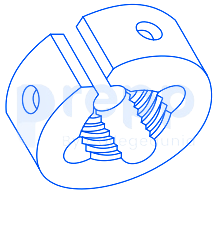
Identify the type of Die in the above Fig.
- The distance from a point on a thread to the corresponding point on the next thread of a screw is called ______.
Important Questions from Screw Threads
When cutting an ISO Metric thread for a coarse pitch, by how many degrees should the compound rest be swiveled to?
What is the blank size (diameter) for preparing a bolt of M12 × 1.5?
What is the relation between the lead (L) and pitch (P) of a two-start thread screw?
Taps are re-sharpened by grinding:
The form of thread in a saw tooth thread is



