
Understanding Natural Selection for Nectar Production Evolution
Natural selection drives evolution when specific conditions are met. For a trait like increased nectar production to evolve in insect-pollinated plants, the following principles must apply:
- Variation: Differences in the trait must exist among individuals in the population.
- Heritability: The trait must be genetically based and passed from parents to offspring.
- Differential Reproduction (Selection): Individuals with specific trait variations must produce more offspring than others due to those variations.
Analysis of Conditions for Nectar Production Evolution
Let's evaluate each condition based on the principles of natural selection:
-
Condition A (Option 1):
Increased nectar production in individual plants results in greater fruit set and number of offspring for these individuals
This condition directly addresses differential reproduction. If plants producing more nectar are more successful reproductively (greater fruit set, more offspring), this acts as the selective pressure favoring higher nectar production. This is necessary.
-
Condition B (Option 2):
The quantity of nectar produced by flowers varies across individuals in the population
This condition addresses variation. Without variation in nectar production among plants, natural selection cannot favor one level of production over another. This is necessary.
-
Condition C (Option 3):
The quantity of nectar produced by a flower increases when more pollinators visit that same flower
This describes a potential physiological response of a flower to pollinator visits, not a fundamental requirement for the *evolution* of nectar production levels across generations. While potentially related, it doesn't guarantee heritable change or differential reproductive success based on inherent nectar quantity. This is not necessary.
-
Condition D (Option 4):
The quantity of nectar produced is heritable, i.e. passed on from parent to offspring
This condition addresses heritability. If the tendency for higher nectar production isn't passed down, any reproductive advantage gained by high-nectar plants won't lead to an increase in nectar production in subsequent generations. This is necessary.
Conclusion on Necessary Conditions
The evolution of increased nectar production via natural selection requires variation in nectar quantity within the population (B), heritability of that trait (D), and a link between higher nectar production and greater reproductive success (A). Therefore, conditions A, B, and D are necessary.
Important Questions from Natural selection
Aphids feed on both alfalfa and clover plants. A researcher collected and reared different genotypes of aphids from separate alfalfa and clover fields. He then measured the fecundity of both aphid groups when fed on each of the two host plants. The figure summarizes the performance of aphid groups originating from alfalfa (dashed) or clover (solid).
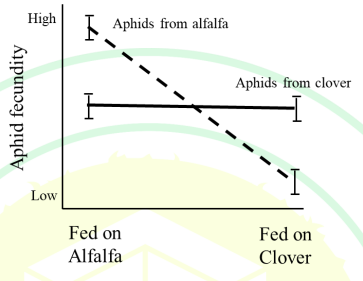
Which one or more of the following situations does the figure depict?There are two species, X and Y, with abundances $x$ and $y$, respectively. Species X has growth rate $\alpha$, and species Y has growth rate $\beta$. Assume that the sum of the species abundances is constant over time, i.e., $x + y = 1$. Let $x$ and $y$ follow the rate equations:
$$\frac{dx}{dt} = \alpha x - \varphi x,$$
$$\frac{dy}{dt} = \beta y - \varphi y,$$ where $\varphi$ is the average species fitness.
Which one of the following options correctly represents the expression for $\varphi$?The figure illustrates the soil zinc tolerance of the grass species Anthoxanthum along a transect from inside a mine to the middle of a pasture outside the mine.
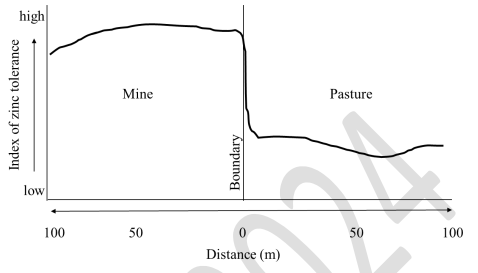
Which one or more of the following processes explain(s) the observed pattern of zinc tolerance in this grass species?A researcher estimates the relationship between reproductive success ($N$, number of offspring) and horn length ($H$, in cm) in a wild goat as
$N = 40 – 2.2H + 0.04H^2$
Horn length typically varies from 10 cm to 50 cm in this species. Which one of the following graphs correctly represents this relationship?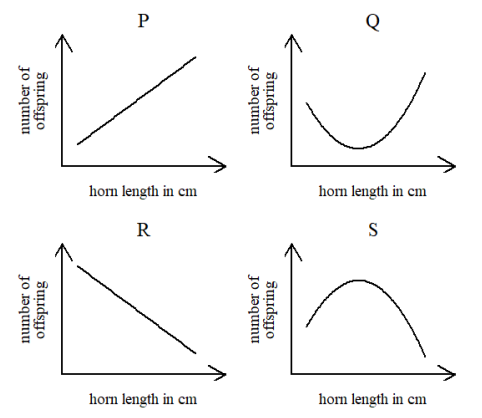
- A new food requesting behaviour has been observed in bonnet macaques in Bandipur National Park. The macaques extend their hand and make a cooing sound only towards humans, which effectively results in food given to them. If this behaviour is to increase in frequency in the population over time by the process of natural selection, which one or more of the options below is/are necessary condition(s)?


