Natural Selection Conditions for Macaque Behavior
For a behavior like the food requesting observed in bonnet macaques to increase in frequency due to natural selection, specific conditions must be met. Natural selection requires traits to be heritable and provide a reproductive advantage.
Analyzing Necessary Conditions
- Option A: Food requesting behaviour must be transmitted from one generation to the next. This is essential. Natural selection acts on heritable traits. If the behavior isn't passed down (through genes or learned behavior from parents/group), its frequency cannot increase across generations via selection. This condition is necessary.
- Option B: All bonnet macaques in the area must show this behaviour. This is incorrect. Natural selection operates on variation within a population. If all individuals already exhibit the trait, there's no variation for selection to act upon to increase its frequency.
- Option C: Macaques who receive food using this behaviour are able to have more offspring. This is also essential. This represents differential reproductive success. The individuals exhibiting the advantageous trait (food requesting behavior leading to food) must be more successful at reproducing than those who don't, ensuring the trait becomes more common over time.
- Option D: Food requesting behaviour must only be taught by parents to offspring. While parent-offspring transmission is a common form of heritability, it's not the *only* way a behavior can be transmitted or be considered heritable for natural selection. The behavior could potentially be innate or learned from non-parents. The key is transmission, which Option A covers more broadly. This specific limitation is not a necessary condition for natural selection itself.
Therefore, the necessary conditions are that the behavior must be heritable (transmitted across generations) and must lead to greater reproductive success.
Conclusion on Necessary Conditions
Based on the principles of natural selection:
- Transmission across generations (heritability) is required.
- Increased offspring count for individuals exhibiting the trait is required.
Thus, options A and C are the necessary conditions.
Important Questions from Natural selection
Aphids feed on both alfalfa and clover plants. A researcher collected and reared different genotypes of aphids from separate alfalfa and clover fields. He then measured the fecundity of both aphid groups when fed on each of the two host plants. The figure summarizes the performance of aphid groups originating from alfalfa (dashed) or clover (solid).
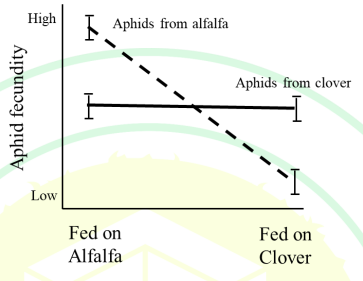
Which one or more of the following situations does the figure depict?- Which one or more of the following conditions is/are necessary for the evolution of increased nectar production in an insect-pollinated plant via natural selection?
There are two species, X and Y, with abundances $x$ and $y$, respectively. Species X has growth rate $\alpha$, and species Y has growth rate $\beta$. Assume that the sum of the species abundances is constant over time, i.e., $x + y = 1$. Let $x$ and $y$ follow the rate equations:
$$\frac{dx}{dt} = \alpha x - \varphi x,$$
$$\frac{dy}{dt} = \beta y - \varphi y,$$ where $\varphi$ is the average species fitness.
Which one of the following options correctly represents the expression for $\varphi$?The figure illustrates the soil zinc tolerance of the grass species Anthoxanthum along a transect from inside a mine to the middle of a pasture outside the mine.
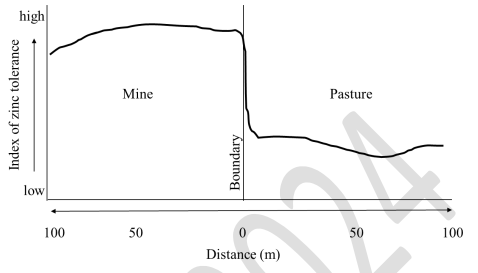
Which one or more of the following processes explain(s) the observed pattern of zinc tolerance in this grass species?A researcher estimates the relationship between reproductive success ($N$, number of offspring) and horn length ($H$, in cm) in a wild goat as
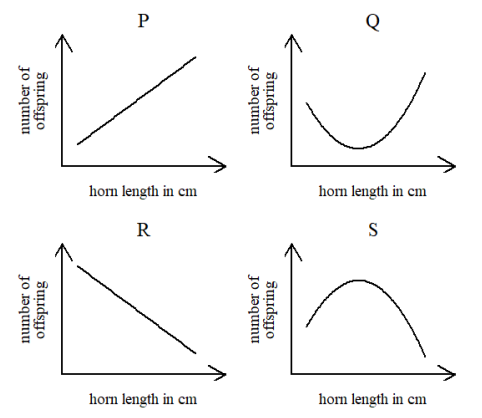
$N = 40 – 2.2H + 0.04H^2$
Horn length typically varies from 10 cm to 50 cm in this species. Which one of the following graphs correctly represents this relationship?