
Mineral Formation During Weathering
The question asks to identify a mineral formed during the weathering of rocks on the Earth's surface.
Weathering is the process where rocks are broken down by physical, chemical, or biological means. Certain minerals are products of this decomposition.
Analyzing Mineral Options
- Quartz: A very stable mineral, often resistant to weathering. It's typically a primary mineral, not formed by weathering itself, though it can be liberated during rock breakdown.
- Bauxite: This is an aluminum ore, primarily composed of aluminum hydroxide minerals (like gibbsite). Bauxite is a residual deposit formed by the intense chemical weathering (laterization) of aluminum-rich rocks (like granite or basalt) in tropical climates. It is directly formed during the weathering process.
- Feldspar: A common group of primary rock-forming minerals. Feldspars are susceptible to chemical weathering (hydrolysis) and break down into clay minerals. They are parent minerals, not products formed by weathering.
- Muscovite: A type of mica, also a primary mineral. While it can weather over geological time, it is not typically considered a mineral formed during the weathering process itself; rather, it's a mineral that weathers.
Conclusion on Weathering Products
Based on the definitions, bauxite is the mineral specifically formed as a result of extensive weathering of parent rocks on the Earth's surface.
Important Questions from Weathering
- Bauxite formation is an example of metal enrichment by extreme
- Silcretes or silica-rich duricrusts generally form under
During normal weathering of a granite rock (A), clay minerals and then residue of gibbsite are formed. Which one is the correct weathering path for the rock in the given diagram ($\text{Al}_2\text{O}_3$, $\text{CaO}$, $\text{Na}_2\text{O}$ and $\text{K}_2\text{O}$ are in moles).
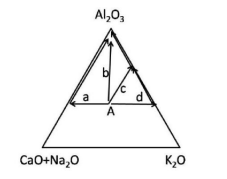
- During spheroidal weathering, a block of rock converts to a spheroid due to
- Which type(s) of chemical reactions occur(s) during the weathering of pyroxene?


