
Wave Function Properties Explained
In quantum mechanics, a wave function, often denoted by the Greek letter psi ($\psi$), is a mathematical description of the quantum state of a particle or system. It contains information about the probability distribution of various outcomes that are possible when a measurement is made on the system.
Statement Analysis
Let's analyze each statement to determine which one is NOT correct:
-
Statement 1: "Wave functions are three dimensional and contain three quantum numbers $n$, $l$ and $m$".
This statement is generally considered correct in the context of atomic physics. For electrons in atoms, the wave functions (orbitals) are indeed described in three-dimensional space. The state of an electron is uniquely defined by three quantum numbers: the principal quantum number ($n$), the azimuthal or angular momentum quantum number ($l$), and the magnetic quantum number ($m$). These numbers dictate the energy, shape, and spatial orientation of the electron's orbital.
-
Statement 2: "Wave functions represent total movement of a particle over a period".
This statement is NOT correct. A wave function $\psi(x, t)$ describes the probability amplitude of finding a particle at a specific position $x$ at a specific time $t$. The square of the absolute value of the wave function, $|\psi(x, t)|^2$, represents the probability density of finding the particle at that position and time. It does not represent the 'total movement' in a deterministic way, as quantum mechanics is fundamentally probabilistic regarding particle location and trajectory.
-
Statement 3: "Probability density is interpreted as the square of wave function".
This statement is correct. This is known as the Born interpretation, a cornerstone of quantum mechanics. The probability per unit volume of finding a particle near a point $x$ is given by $|\psi(x)|^2$ (or $|\psi(x, t)|^2$ if time-dependent).
-
Statement 4: "Wave functions should be differentiable".
This statement is correct. For a wave function to be physically realistic and solvable within the framework of the Schrödinger equation, it must satisfy certain mathematical conditions, including being continuous and differentiable (or at least have derivatives that are continuous). These properties ensure that quantities like momentum can be calculated consistently.
Incorrect Statement Identification
Based on the analysis, the statement that incorrectly describes wave functions is:
- Wave functions represent total movement of a particle over a period.
Wave functions describe the probability amplitude, and their squared magnitude gives the probability density of finding a particle, rather than its deterministic path or total movement.
Important Questions from Quantum chemistry
Which of the following statements regarding electron configuration of atoms is/are correct?
1. Principal quantum number = 1, K shell, example : He
2. Principal quantum number = 3, M shell, example : Ne
3. Principal quantum number = 2, L shell, example : F
4. Principal quantum number = 3, K shell, example : SiSelect the answer using the code given below :
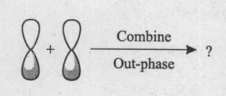
Which one of the following molecular orbitals will be formed by combination of the two $2p$ orbitals as shown below ?
- Radial distribution function does NOT depend upon


