Radial Distribution Function Explained
The radial distribution function is a concept used in quantum mechanics to describe the probability of finding an electron at a specific distance from the nucleus in an atom.
Factors Influencing Radial Distribution
The radial distribution function, often denoted as $P(r)$, depends primarily on three factors:
- Distance from the nucleus ($r$): This is the independent variable of the function. The function itself gives the probability density at a distance $r$.
- Principal quantum number ($n$): This quantum number determines the energy level and the average distance of the electron from the nucleus. Higher values of $n$ generally lead to larger atomic radii and different radial distributions.
- Azimuthal quantum number ($l$): This quantum number defines the shape of the orbital (e.g., $s$, $p$, $d$, $f$ orbitals correspond to $l=0, 1, 2, 3$, respectively). The value of $l$ significantly affects the radial distribution, influencing the number and location of radial nodes.
Mathematically, the radial distribution function is related to the square of the radial wave function, $R_{nl}(r)$, and the surface area of a thin spherical shell at radius $r$, which is $4 \pi r^2$. So, $P(r) = 4 \pi r^2 |R_{nl}(r)|^2$. This formula clearly shows the dependence on $r$, $n$, and $l$.
What Radial Distribution Does NOT Depend On
The radial distribution function is independent of the orientation of the orbital. The orientation of an atomic orbital in space is determined by the magnetic quantum number, $m_l$. The radial distribution function represents a probability averaged over all possible orientations. Since the radial part of the wave function ($R_{nl}(r)$) does not depend on $m_l$, the resulting radial distribution function $P(r)$ also does not depend on $m_l$.
In simpler terms, while the shape ($l$) and energy level ($n$) dictate how the electron's probability is spread out radially, the specific direction the orbital points in space does not change this radial probability distribution.
Summary Table
| Factor | Dependence on Radial Distribution Function |
|---|---|
| Distance from the nucleus ($r$) | Yes (Directly) |
| Principal quantum number ($n$) | Yes |
| Azimuthal quantum number ($l$) | Yes |
| Orientation of orbital ($m_l$) | No |
Therefore, the radial distribution function does NOT depend upon the orientation of the orbital.
Important Questions from Quantum chemistry
- Which one of the following statements regarding wave functions is NOT correct?
Which of the following statements regarding electron configuration of atoms is/are correct?
1. Principal quantum number = 1, K shell, example : He
2. Principal quantum number = 3, M shell, example : Ne
3. Principal quantum number = 2, L shell, example : F
4. Principal quantum number = 3, K shell, example : SiSelect the answer using the code given below :
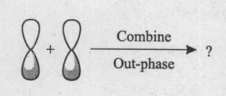
Which one of the following molecular orbitals will be formed by combination of the two $2p$ orbitals as shown below ?