
Which of the following statements regarding electron configuration of atoms is/are correct? 1. Principal quantum number = 1, K shell, example : He Select the answer using the code given below :
2. Principal quantum number = 3, M shell, example : Ne
3. Principal quantum number = 2, L shell, example : F
4. Principal quantum number = 3, K shell, example : Si
Understanding Electron Configuration and Quantum Numbers
This question involves understanding the relationship between electron configurations, principal quantum numbers, and atomic shells (K, L, M...). The principal quantum number, denoted by $n$, describes the main energy level or shell of an electron.
- $n=1$ corresponds to the K shell.
- $n=2$ corresponds to the L shell.
- $n=3$ corresponds to the M shell.
- And so on...
We need to evaluate each statement based on these principles and the electron configurations of the given elements.
Analyzing the Statements on Electron Configuration
Statement 1: Principal quantum number = 1, K shell, example : He
Analysis: The principal quantum number $n=1$ indeed represents the K shell. Helium (He) is the first element with atomic number 2. Its electron configuration is $1s^2$. All electrons in Helium are in the first energy level ($n=1$), which is the K shell. This statement is correct.
Statement 2: Principal quantum number = 3, M shell, example : Ne
Analysis: The principal quantum number $n=3$ represents the M shell. Neon (Ne) has atomic number 10, and its electron configuration is $1s^2 2s^2 2p^6$. The outermost electrons in Neon are in the L shell ($n=2$), not the M shell ($n=3$). The M shell starts filling after the L shell is completely filled. Therefore, this statement is incorrect.
Statement 3: Principal quantum number = 2, L shell, example : F
Analysis: The principal quantum number $n=2$ represents the L shell. Fluorine (F) has atomic number 9. Its electron configuration is $1s^2 2s^2 2p^5$. The outermost electrons in Fluorine are located in the second energy level ($n=2$), which is the L shell. This statement is correct.
Statement 4: Principal quantum number = 3, K shell, example : Si
Analysis: The principal quantum number $n=3$ corresponds to the M shell, not the K shell. The K shell is defined by $n=1$. Silicon (Si) has atomic number 14, and its electron configuration is $1s^2 2s^2 2p^6 3s^2 3p^2$. While Silicon does have electrons in the M shell ($n=3$), the statement incorrectly associates $n=3$ with the K shell. Therefore, this statement is incorrect.
Conclusion on Electron Configuration Statements
Based on the analysis, statements 1 and 3 are correct descriptions relating principal quantum number, shell name, and an example element's electron distribution.
- Statement 1: Correct (He: $n=1$, K shell)
- Statement 2: Incorrect (Ne's outer electrons are in L shell, $n=2$)
- Statement 3: Correct (F: $n=2$, L shell)
- Statement 4: Incorrect ($n=3$ is M shell, not K shell)
Therefore, the correct statements are 1 and 3 only.
Important Questions from Quantum chemistry
- Which one of the following statements regarding wave functions is NOT correct?
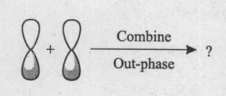
Which one of the following molecular orbitals will be formed by combination of the two $2p$ orbitals as shown below ?
- Radial distribution function does NOT depend upon


