
Which one of the following represents the electron occupancy for a superconductor in its normal and superconducting states?
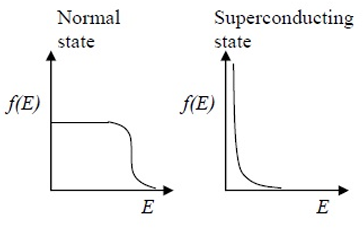
The question asks to identify the correct representation of electron occupancy for a superconductor in its normal and superconducting states.
Normal State Electron Occupancy
In a normal metal (above the critical temperature, Tc), electrons occupy energy states according to the Fermi-Dirac distribution. The density of states (DOS), N(E), represents the number of available electron states per unit energy. For many metals, the DOS near the Fermi level (EF) is continuous.
Superconducting State Electron Occupancy
Below Tc, electrons form Cooper pairs, leading to the opening of a superconducting energy gap, $ \Delta $, centered around the Fermi level (EF). This phenomenon is described by the Bardeen-Cooper-Schrieffer (BCS) theory.
- Within the gap, specifically for energies $ E $ such that $ |E - E_F| < \Delta $, the density of states becomes zero. $ N(E) = 0 $ in this region.
- The DOS exhibits sharp peaks just outside the gap edges, at $ E = E_F \pm \Delta $.
- The total number of available states remains conserved.
Analyzing the Options
Option B correctly depicts the density of states for a superconductor. It shows:
- A standard DOS curve representing the normal state.
- A modified DOS curve for the superconducting state featuring a distinct energy gap ($ \Delta $) around the Fermi level ($E_F$), where $N(E)=0$, and characteristic coherence peaks outside the gap.
The other options do not accurately represent the gap formation and the resulting density of states modification characteristic of the superconducting transition.
Therefore, the image corresponding to Option B illustrates the electron occupancy in the normal and superconducting states.
Important Questions from Superconductivity Meissner Effect BCS Theory
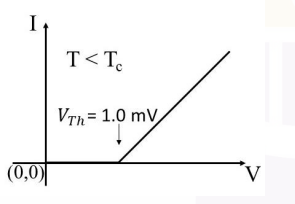
Consider a metal-superconductor junction connected to a dc voltage $V$. At $T < T_c$, where $T_c$ is the superconductor's transition temperature, the current $I$ versus $V$ behavior of this junction is shown schematically in the figure below. If the superconducting energy gap is $D \text{ meV}$. The value of $D$ (rounded off to one decimal place) is _____
- Which of the following option(s) is/are correct for a Type I superconductor?
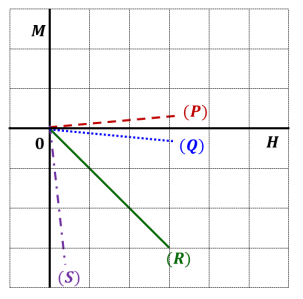
The figure schematically shows the $M$ (magnetization) - $H$ (magnetic field) plots for certain types of materials. Here $M$ and $H$ are plotted in the same scale and units. Which one of the following is the most appropriate combination?
- A material behaves as a superconductor below a critical temperature $T_c$ and as a normal conductor above $T_c$. A magnetic field $\vec{B} = B\hat{z}$ is applied when $T > T_c$. The material is then cooled below $T_c$ in the presence of $\vec{B}$. Which of the following figure represent the correct configuration of magnetic field lines?
- Amongst electrical resistivity ($\rho$), thermal conductivity ($\kappa$), specific heat ($C$), Young's modulus ($Y$), and magnetic susceptibility ($\chi$), which quantities show a sharp change at the superconducting transition temperature?


