
Key Quantities Showing Sharp Change at Superconducting Transition
The superconducting transition is a phase transition occurring at a critical temperature ($T_c$). Several physical properties exhibit abrupt changes at this temperature. We need to identify which of the given quantities show a sharp change:
- Electrical Resistivity ($\rho$)
- Specific Heat ($C$)
- Magnetic Susceptibility ($\chi$)
Analysis of Relevant Quantities
Let's examine the behavior of the quantities listed in the correct option (B) at the superconducting transition temperature ($T_c$):
Electrical Resistivity ($\rho$)
Below the critical temperature ($T < T_c$), a superconductor offers zero electrical resistance. This means the resistivity ($\rho$) drops abruptly from a finite value (in the normal state) to zero. This is a primary characteristic and a sharp change.
Change: Finite value $\rightarrow 0$
Specific Heat ($C$)
The specific heat ($C$) of a material typically shows a characteristic anomaly, often a peak or lambda-type shape, at the superconducting transition temperature ($T_c$). This indicates a second-order phase transition and represents a sharp change in the heat capacity.
Change: Exhibits a peak/discontinuity at $T_c$.
Magnetic Susceptibility ($\chi$)
Superconductors exhibit the Meissner effect below $T_c$, meaning they expel magnetic fields from their interior. This corresponds to a sudden transition to a state of perfect diamagnetism, where the magnetic susceptibility ($\chi$) changes drastically (often towards $-1$ in appropriate units). This is a sharp change.
Change: Sharp transition to perfect diamagnetism.
Conclusion on Other Quantities
Quantities like Young's modulus ($Y$) are related to elastic properties and do not typically show the defining sharp changes associated with the primary superconducting transition. Thermal conductivity ($\kappa$) often shows a significant change or discontinuity, but based on the provided options, resistivity ($\rho$), specific heat ($C$), and magnetic susceptibility ($\chi$) are the quantities identified as showing sharp changes in this context.
Final Answer Determination
Based on the analysis, electrical resistivity ($\rho$), specific heat ($C$), and magnetic susceptibility ($\chi$) exhibit sharp changes at the superconducting transition temperature. This corresponds to Option B.
Important Questions from Superconductivity Meissner Effect BCS Theory
Consider a metal-superconductor junction connected to a dc voltage $V$. At $T < T_c$, where $T_c$ is the superconductor's transition temperature, the current $I$ versus $V$ behavior of this junction is shown schematically in the figure below. If the superconducting energy gap is $D \text{ meV}$. The value of $D$ (rounded off to one decimal place) is _____
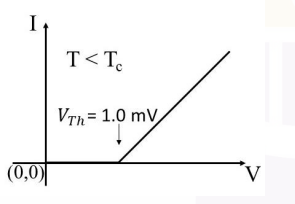
- Which of the following option(s) is/are correct for a Type I superconductor?
The figure schematically shows the $M$ (magnetization) - $H$ (magnetic field) plots for certain types of materials. Here $M$ and $H$ are plotted in the same scale and units. Which one of the following is the most appropriate combination?
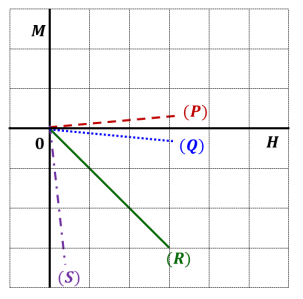
- A material behaves as a superconductor below a critical temperature $T_c$ and as a normal conductor above $T_c$. A magnetic field $\vec{B} = B\hat{z}$ is applied when $T > T_c$. The material is then cooled below $T_c$ in the presence of $\vec{B}$. Which of the following figure represent the correct configuration of magnetic field lines?
- At $T = 0$ K, which of the following diagram represents the occupation probability $P(E)$ of energy states of electrons in a BCS type superconductor?


