
To determine the correct options for a Type I superconductor, we need to understand the fundamental properties and behavior associated with Type I superconductors:
- Phase Transition in the Absence of a Magnetic Field:
- Type I superconductors undergo a second-order phase transition to the normal state in the absence of an external magnetic field upon reaching the critical temperature (T_c).
- In a second-order transition, there is no latent heat involved; instead, properties like entropy and specific heat change continuously. Therefore, the statement "The phase transition to the normal state in the absence of a magnetic field is of second order" is correct.
- Critical Magnetic Field Behavior with Temperature:
- Type I superconductors have a critical magnetic field (H_c) that decreases with increasing temperature and goes to zero at the critical temperature.
- This critical field does not necessarily decrease linearly; it is often a non-linear variation described by a parabolic relationship rather than a simple linear one. Therefore, the statement "With increase in temperature, the critical magnetic field decreases linearly to zero" is incorrect.
- Entropy in the Superconducting State:
- Below the critical temperature, the entropy in the superconducting state is less than that in the normal state. This is due to the spontaneous symmetry breaking and the ordered state that a superconductor represents.
- As a result, the statement "Below the critical temperature, the entropy in the superconducting state is less than that in the normal state" is correct.
- Phase Transition in the Presence of a Magnetic Field:
- When an external magnetic field is applied, the transition from the superconducting to the normal state in Type I superconductors becomes first-order. This involves a latent heat change at the boundary.
- Thus, the statement "The phase transition to the normal state in the presence of a magnetic field is of first order" is correct.
Based on the explanations above, the correct options for Type I superconductors are:
- The phase transition to the normal state in the absence of a magnetic field is of second order.
- Below the critical temperature, the entropy in the superconducting state is less than that in the normal state.
- The phase transition to the normal state in the presence of a magnetic field is of first order.
Important Questions from Superconductivity Meissner Effect BCS Theory
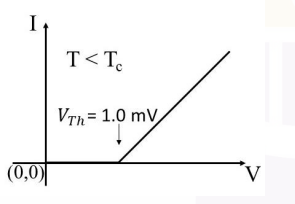
Consider a metal-superconductor junction connected to a dc voltage $V$. At $T < T_c$, where $T_c$ is the superconductor's transition temperature, the current $I$ versus $V$ behavior of this junction is shown schematically in the figure below. If the superconducting energy gap is $D \text{ meV}$. The value of $D$ (rounded off to one decimal place) is _____
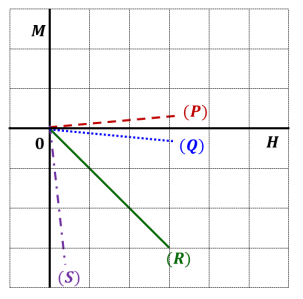
The figure schematically shows the $M$ (magnetization) - $H$ (magnetic field) plots for certain types of materials. Here $M$ and $H$ are plotted in the same scale and units. Which one of the following is the most appropriate combination?
- A material behaves as a superconductor below a critical temperature $T_c$ and as a normal conductor above $T_c$. A magnetic field $\vec{B} = B\hat{z}$ is applied when $T > T_c$. The material is then cooled below $T_c$ in the presence of $\vec{B}$. Which of the following figure represent the correct configuration of magnetic field lines?
- Amongst electrical resistivity ($\rho$), thermal conductivity ($\kappa$), specific heat ($C$), Young's modulus ($Y$), and magnetic susceptibility ($\chi$), which quantities show a sharp change at the superconducting transition temperature?
- At $T = 0$ K, which of the following diagram represents the occupation probability $P(E)$ of energy states of electrons in a BCS type superconductor?


