
Superconductor Behavior Below Critical Temperature
A material transitions from a normal conductor to a superconductor when its temperature drops below a specific critical temperature, denoted as $T_c$. In the superconducting state, these materials exhibit unique electromagnetic properties.
Understanding the Meissner Effect
One fundamental property of superconductors is the expulsion of magnetic fields from their interior. This phenomenon is known as the Meissner effect. When a material becomes superconducting (i.e., $T < T_c$) in the presence of an external magnetic field $\vec{B}$, it actively pushes the magnetic flux lines out.
Analysis of Magnetic Field Configurations
The question describes a scenario where a magnetic field $\vec{B} = B\hat{z}$ is applied, and the material is subsequently cooled below $T_c$. We need to identify the figure representing the magnetic field lines correctly after cooling.
- Normal State ($T > T_c$): Above $T_c$, the material acts as a normal conductor. Magnetic field lines can penetrate it.
- Superconducting State ($T < T_c$): Below $T_c$, the material becomes superconducting and exhibits the Meissner effect.
Correct Representations (Meissner Effect)
The Meissner effect dictates that the magnetic field should be expelled. Figures representing this effect show the external magnetic field lines bending around the superconducting material, preventing them from entering its volume.
- Figure A: This figure shows the magnetic field lines being completely expelled from the material. This is a direct representation of the Meissner effect.
- Figure C: This figure also illustrates the expulsion of magnetic field lines. The lines are shown bending sharply around the material, indicating they do not penetrate the superconducting volume. This configuration is consistent with the Meissner effect.
Incorrect Representations
- Figure B: This figure shows magnetic field lines penetrating the material's interior. This behavior is characteristic of a normal conductor, not a superconductor exhibiting the Meissner effect.
- Figure D: This figure shows some degree of field penetration or significant distortion that doesn't fully align with the complete expulsion expected from the basic Meissner effect.
Therefore, the configurations correctly representing the magnetic field lines around a superconductor below its critical temperature $T_c$ due to the Meissner effect are those showing field expulsion.
Important Questions from Superconductivity Meissner Effect BCS Theory
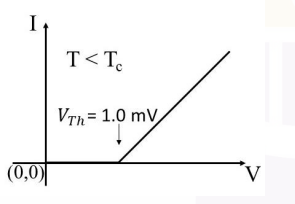
Consider a metal-superconductor junction connected to a dc voltage $V$. At $T < T_c$, where $T_c$ is the superconductor's transition temperature, the current $I$ versus $V$ behavior of this junction is shown schematically in the figure below. If the superconducting energy gap is $D \text{ meV}$. The value of $D$ (rounded off to one decimal place) is _____
- Which of the following option(s) is/are correct for a Type I superconductor?
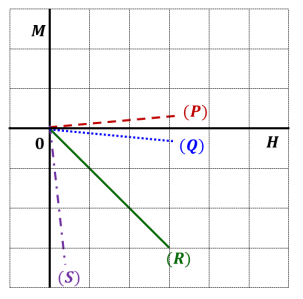
The figure schematically shows the $M$ (magnetization) - $H$ (magnetic field) plots for certain types of materials. Here $M$ and $H$ are plotted in the same scale and units. Which one of the following is the most appropriate combination?
- Amongst electrical resistivity ($\rho$), thermal conductivity ($\kappa$), specific heat ($C$), Young's modulus ($Y$), and magnetic susceptibility ($\chi$), which quantities show a sharp change at the superconducting transition temperature?
- At $T = 0$ K, which of the following diagram represents the occupation probability $P(E)$ of energy states of electrons in a BCS type superconductor?


