
Ecological Community: Factors Affecting Species Coexistence
The question asks which process is least likely to result in the stable coexistence of two species occupying the same trophic level.
Competitive Exclusion Principle
Intense interspecific competition directly challenges the principle of competitive exclusion. This ecological principle states that two species competing for the exact same limited resources cannot stably coexist. The species that is more efficient at exploiting the shared resource will eventually outcompete and eliminate the other species. Therefore, intense competition is a mechanism that typically leads to exclusion, not stable coexistence.
Processes Supporting Coexistence
Other options presented describe mechanisms that can facilitate stable coexistence:
- Density-dependent predation: Predators may target the more abundant species, preventing it from reaching densities where it could exclude the less abundant species. This can help maintain both species.
- Facilitation: One species might modify the environment in a way that benefits the other species, potentially reducing competition or providing a necessary resource, thus aiding coexistence.
- Niche differentiation: When species evolve differences in resource use (e.g., diet, habitat, foraging time), they reduce direct competition. This divergence allows them to coexist even when sharing the same general trophic level.
Based on ecological principles, intense interspecific competition is the factor least likely to lead to the stable coexistence of species at the same trophic level.
Important Questions from Competition
- Ecologists have studied the distributions of birds on archipelagos. Some studies found an interesting 'checkerboard' pattern within island groups. Sister species were never present on the same island, even when the islands were very close to each other. Which one of the following processes best explains this checkerboard pattern?
- Two bird species, A and B, are found on a single mountainside. A is a low-elevation species, found between 500 m and 1500 m Above Sea Level (ASL), while B is a high-elevation species, found between 1000 m and 2000 m ASL. At 1250 m ASL, species A and B have very different bill morphologies, but the bill morphology of species A at 500 m is very similar to the bill morphology of species B at 2000 m ASL. Which one or more of the following explain(s) the difference in bill morphology at 1250 m ASL?
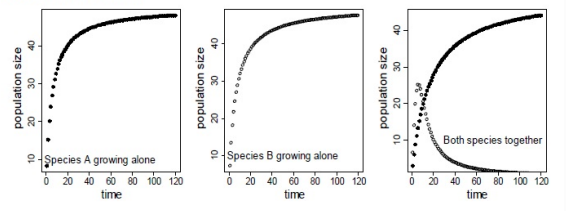
The figure panels below show population growth in two species (solid circles and open circles), when they are grown alone, and when they are grown together. The interaction between these species is an example of
- In an assemblage of coexisting wild cat species, the size of canine teeth was found to be strikingly different between these species. Which one or more of the following statements explain(s) this observation?
The barnacle species, Chthamalus stellatus (CS), is found only in the high intertidal zone whereas Balanus glandula (BG) is found only in the low intertidal zone. A researcher transplanted CS from the high to low (T-CS), and BG from the low to high (T-BG) intertidal zones. Additionally, they allowed the species to grow alone or in competition with each other, and quantified survival.
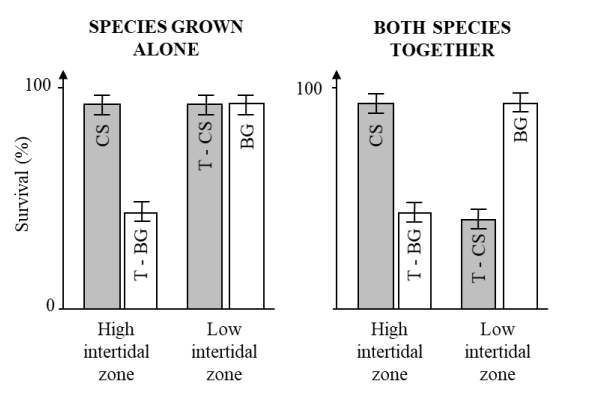
Which one or more of the following inferences is/are consistent with the experimental results shown below?


