Wild Cat Canine Teeth Size Variations Explained
Coexisting wild cat species often exhibit significant differences in canine teeth size. This observation is explained by several evolutionary and ecological factors:
Canine Size Driven by Prey Capture
The size and shape of a predator's canine teeth are strongly influenced by the size and type of prey it typically hunts. Species specializing in larger prey may evolve larger, more robust canines for gripping and dispatching, while those hunting smaller prey might have different adaptations. This allows different species to exploit different food resources within the same habitat, reducing direct competition.
Divergent Evolution Principle
Differences in canine teeth size among related or closely coexisting species are a classic example of divergent evolution. This occurs when populations derived from a common ancestor evolve distinct traits, often due to adaptation to different environmental pressures or ecological niches. Specialization in hunting strategies, reflected in canine morphology, is a common outcome.
Impact of Past Competition
Historical or ongoing competition among wild cat species can drive evolutionary changes. To minimize resource overlap and direct conflict, species may undergo character displacement, leading to morphological differences. Differences in canine teeth size can facilitate niche partitioning, allowing species to coexist by specializing on different prey sizes or types, thus reducing competitive pressure.
Why Convergent Evolution Doesn't Apply
Convergent evolution involves unrelated species independently evolving similar traits in response to similar environmental challenges. The variation in canine teeth size among coexisting wild cats, likely sharing recent ancestry or ecological pressures, is a result of diversification (divergence), not convergence.
Correct Explanations
The key factors explaining the observed differences in canine teeth size are:
- Differences in the size of prey captured by the different species (Option A).
- Differences in the size of canine teeth as an example of divergent evolution (Option B).
- Differences in the size of canine teeth being driven by past competition (Option D).
Important Questions from Competition
- Ecologists have studied the distributions of birds on archipelagos. Some studies found an interesting 'checkerboard' pattern within island groups. Sister species were never present on the same island, even when the islands were very close to each other. Which one of the following processes best explains this checkerboard pattern?
- Two bird species, A and B, are found on a single mountainside. A is a low-elevation species, found between 500 m and 1500 m Above Sea Level (ASL), while B is a high-elevation species, found between 1000 m and 2000 m ASL. At 1250 m ASL, species A and B have very different bill morphologies, but the bill morphology of species A at 500 m is very similar to the bill morphology of species B at 2000 m ASL. Which one or more of the following explain(s) the difference in bill morphology at 1250 m ASL?
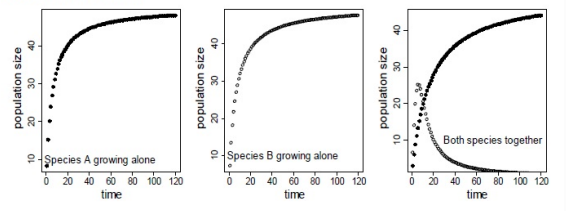
The figure panels below show population growth in two species (solid circles and open circles), when they are grown alone, and when they are grown together. The interaction between these species is an example of
The barnacle species, Chthamalus stellatus (CS), is found only in the high intertidal zone whereas Balanus glandula (BG) is found only in the low intertidal zone. A researcher transplanted CS from the high to low (T-CS), and BG from the low to high (T-BG) intertidal zones. Additionally, they allowed the species to grow alone or in competition with each other, and quantified survival.
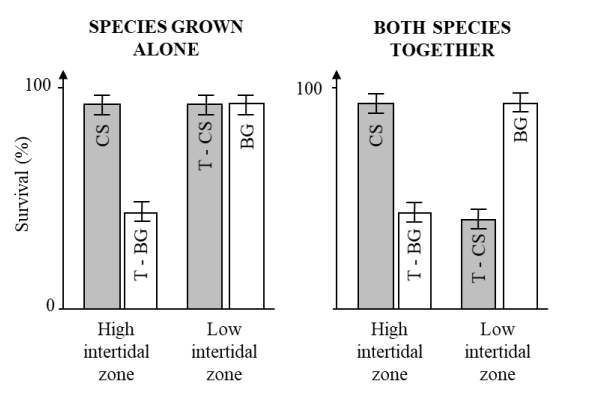
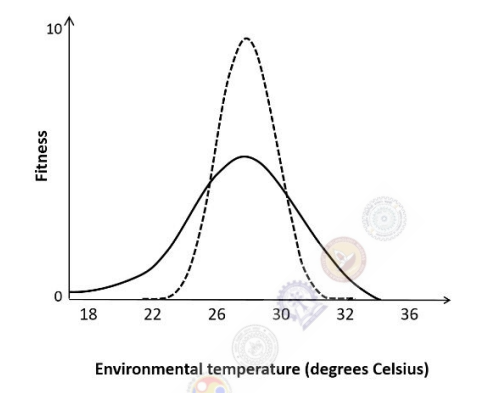
Which one or more of the following inferences is/are consistent with the experimental results shown below?Species 1 and 2 are sympatric, but species 2 has a wider physiological tolerance than species 1. The two species simultaneously invade a new environment that has an average temperature of 22 degrees C. What are the expected outcomes for species 1 and 2 ?