
Species 1 and 2 are sympatric, but species 2 has a wider physiological tolerance than species 1. The two species simultaneously invade a new environment that has an average temperature of 22 degrees C. What are the expected outcomes for species 1 and 2 ?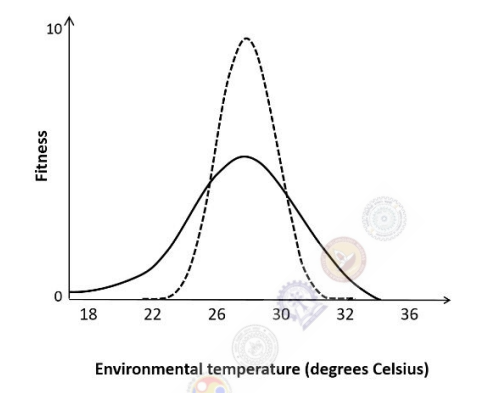
To determine the expected outcomes for species 1 and 2 when they invade a new environment with an average temperature of 22 degrees Celsius, we need to evaluate the implications of their physiological tolerances.
- Understanding Physiological Tolerance: Species 2 has a wider physiological tolerance compared to species 1. This means species 2 can survive and thrive in a broader range of temperatures.
- Impact of Temperature: The average temperature of the new environment is 22 degrees Celsius. The fitness graph indicates that species 2 has a significant fitness level in a wider temperature range, while species 1 has a narrower fitness peak.
- Competition Dynamics: Given its broader tolerance, species 2 will be able to survive and potentially thrive across varying conditions more effectively than species 1. This will likely lead to species 2 outcompeting species 1 in the long term at the given temperature.
- Conclusion: As species 2 can adapt to a wider range of temperatures and potentially exploit more environmental niches than species 1, it will outcompete species 1.
Therefore, the correct outcome for this ecological scenario is: Species 2 will outcompete species 1.
Important Questions from Competition
- Ecologists have studied the distributions of birds on archipelagos. Some studies found an interesting 'checkerboard' pattern within island groups. Sister species were never present on the same island, even when the islands were very close to each other. Which one of the following processes best explains this checkerboard pattern?
- Two bird species, A and B, are found on a single mountainside. A is a low-elevation species, found between 500 m and 1500 m Above Sea Level (ASL), while B is a high-elevation species, found between 1000 m and 2000 m ASL. At 1250 m ASL, species A and B have very different bill morphologies, but the bill morphology of species A at 500 m is very similar to the bill morphology of species B at 2000 m ASL. Which one or more of the following explain(s) the difference in bill morphology at 1250 m ASL?
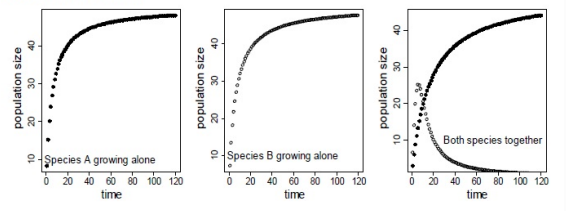
The figure panels below show population growth in two species (solid circles and open circles), when they are grown alone, and when they are grown together. The interaction between these species is an example of
- In an assemblage of coexisting wild cat species, the size of canine teeth was found to be strikingly different between these species. Which one or more of the following statements explain(s) this observation?
The barnacle species, Chthamalus stellatus (CS), is found only in the high intertidal zone whereas Balanus glandula (BG) is found only in the low intertidal zone. A researcher transplanted CS from the high to low (T-CS), and BG from the low to high (T-BG) intertidal zones. Additionally, they allowed the species to grow alone or in competition with each other, and quantified survival.
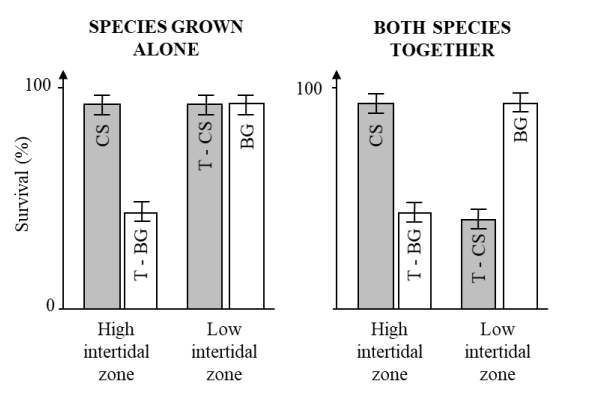
Which one or more of the following inferences is/are consistent with the experimental results shown below?


