Explanation of Bird Bill Morphology Differences
The scenario describes two bird species, A and B, inhabiting different elevational ranges on a mountainside. Species A occupies lower elevations (500 m - 1500 m Above Sea Level, or 'ASL'), while species B occupies higher elevations (1000 m - 2000 m ASL). There is an overlapping zone between 1000 m and 1500 m ASL.Analyzing the Observation
At 1250 m ASL, which falls within the overlapping zone, species A and B exhibit significantly different bill morphologies. Interestingly, species A's bill at the lowest elevation (500 m ASL) resembles species B's bill at the highest elevation (2000 m ASL). This suggests that in areas where their ranges do not overlap, the species might have similar morphologies, but in the zone of overlap, divergence occurs.Character Displacement as the Cause
Character displacement is the evolutionary process where differences among coexisting species are accentuated due to interspecific competition. When two species with similar ecological requirements (like niche or resource use) overlap in distribution, natural selection may favor individuals within each species that utilize resources differently, thereby reducing competition. This leads to a divergence in traits, such as morphology (like bill shape), that are related to resource use. * In this case, the overlap in elevational ranges (1000 m - 1500 m ASL) likely leads to interspecific competition for resources. * The observed difference in bill morphology at 1250 m ASL is a direct result of this competition, as divergent bill shapes would allow each species to exploit different food sources or feeding methods, minimizing direct competition. * The similarity between species A at 500 m ASL and species B at 2000 m ASL supports this, indicating that away from the zone of interaction, their morphologies are less divergent, possibly reflecting their ancestral states or adaptations to different environmental conditions at the extremes.Evaluating Other Options
- Competitive exclusion describes the outcome where one species eliminates another due to competition, rather than the mechanism driving morphological divergence itself.
- Convergent evolution leads to similar traits in unrelated species due to similar environmental pressures, which is contrary to the observation of *different* morphologies in the overlap zone. The similarity at extreme elevations could potentially involve convergence, but it doesn't explain the *difference* at 1250 m ASL.
- Allopatric speciation occurs when populations become geographically isolated, leading to reproductive isolation and eventually speciation. These species share a mountainside and have overlapping ranges, so they are not allopatrically separated.
Important Questions from Competition
- Ecologists have studied the distributions of birds on archipelagos. Some studies found an interesting 'checkerboard' pattern within island groups. Sister species were never present on the same island, even when the islands were very close to each other. Which one of the following processes best explains this checkerboard pattern?
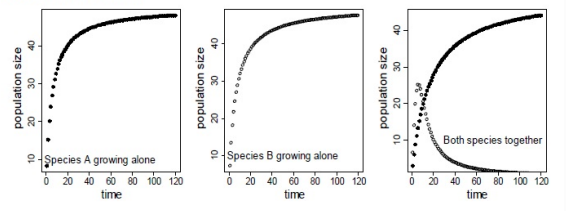
The figure panels below show population growth in two species (solid circles and open circles), when they are grown alone, and when they are grown together. The interaction between these species is an example of
- In an assemblage of coexisting wild cat species, the size of canine teeth was found to be strikingly different between these species. Which one or more of the following statements explain(s) this observation?
The barnacle species, Chthamalus stellatus (CS), is found only in the high intertidal zone whereas Balanus glandula (BG) is found only in the low intertidal zone. A researcher transplanted CS from the high to low (T-CS), and BG from the low to high (T-BG) intertidal zones. Additionally, they allowed the species to grow alone or in competition with each other, and quantified survival.
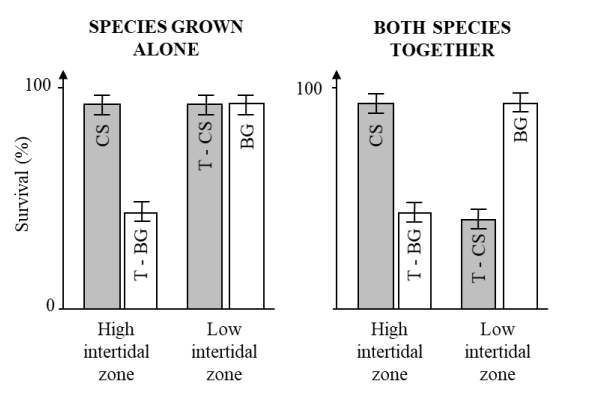
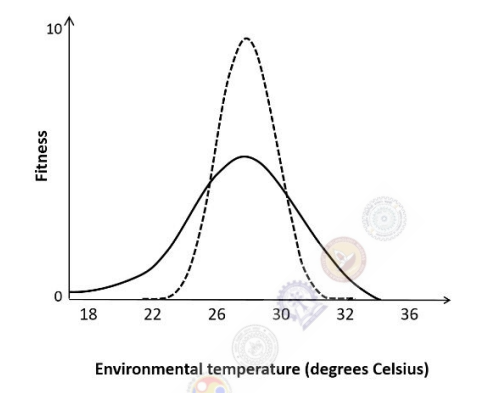
Which one or more of the following inferences is/are consistent with the experimental results shown below?Species 1 and 2 are sympatric, but species 2 has a wider physiological tolerance than species 1. The two species simultaneously invade a new environment that has an average temperature of 22 degrees C. What are the expected outcomes for species 1 and 2 ?