
Which one of the following options is correct? For Al - 4 % Ag alloy (composition in atom %), the correct sequence of operations involved in precipitation hardening is:
Precipitation Hardening Sequence for Al-Ag Alloys
Precipitation hardening is a heat treatment technique used to increase the yield strength of malleable metals. For alloys like Al-Ag (Aluminum-Silver), it involves creating fine, uniformly dispersed precipitates within the matrix.
Understanding the Steps
The process requires specific steps in a defined order to achieve the desired strengthening effect:
- Solution Treatment: The alloy is heated to a high temperature, typically above the solvus line (e.g., around 500°C for Al-Ag), to dissolve the solute (Ag) atoms into the matrix (Al) phase, forming a homogeneous single-phase solid solution (e.g., $\alpha$ phase).
- Quenching: The alloy is then rapidly cooled (e.g., quenched in water) from the solution treatment temperature. This rapid cooling traps the solute atoms in the matrix, creating a supersaturated solid solution and preventing the formation of coarse, undesirable precipitates at this stage.
- Aging: Finally, the quenched alloy is subjected to a lower-temperature heat treatment (aging). This can be done at room temperature (natural aging) or an elevated temperature (artificial aging). During aging, the excess solute atoms diffuse within the matrix to form extremely fine, coherent or semi-coherent precipitates (e.g., $\gamma'$ or $\gamma$ phases in Al-Ag). These precipitates impede dislocation motion, significantly strengthening and hardening the alloy.
Therefore, the correct sequence is Solution treatment $\rightarrow$ Quenching $\rightarrow$ Aging.
Important Questions from Heat Treatment Quenching Critical Cooling Rate
- Which of the following statements is/are CORRECT when Ni is added as an alloying element to a low alloy steel?
- In a Jominy end-quench test of the eutectoid plain-carbon steel, which of the following represents the sequence of microstructures observed from the quenched end of the specimen?
- Which one of the following is the correct decreasing sequence of Quenching Power for quenchants used in heat treatment of steels?
- Which one of the following techniques does NOT require quenching to obtain final case hardness?
The microstructures of a quenched steel tempered at three temperatures $T_1 < T_2 < T_3$ for a fixed time are schematically illustrated. The solid circles represent cementite particles in ferrite matrix; $\bar{r}_1, \bar{r}_2$ and $\bar{r}_3$ are average radii of cementite particles, and $V_1, V_2$ and $V_3$ are volume fractions of cementite at temperatures $T_1, T_2$ and $T_3$, respectively.
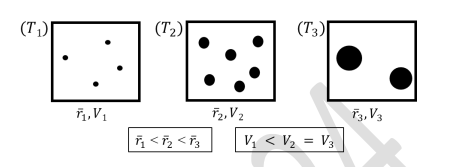
If the cementite in steel is more noble than ferrite, then which one of the three microstructures will have the highest corrosion rate when exposed to an aqueous solution of $3.5 \text{ wt.\% NaCl}$?


